WMS Readiness Checklist: Location, Master Data, Interfaces
When a WMS fails acceptance, it is rarely the software. More often, location coding, material master data ownership, whether FIFO should be enforced, and where the ERP and MES interface boundaries sit were never settled before go-live. Turning these into a checklist is the first step to a smoother warehouse digitalization project.
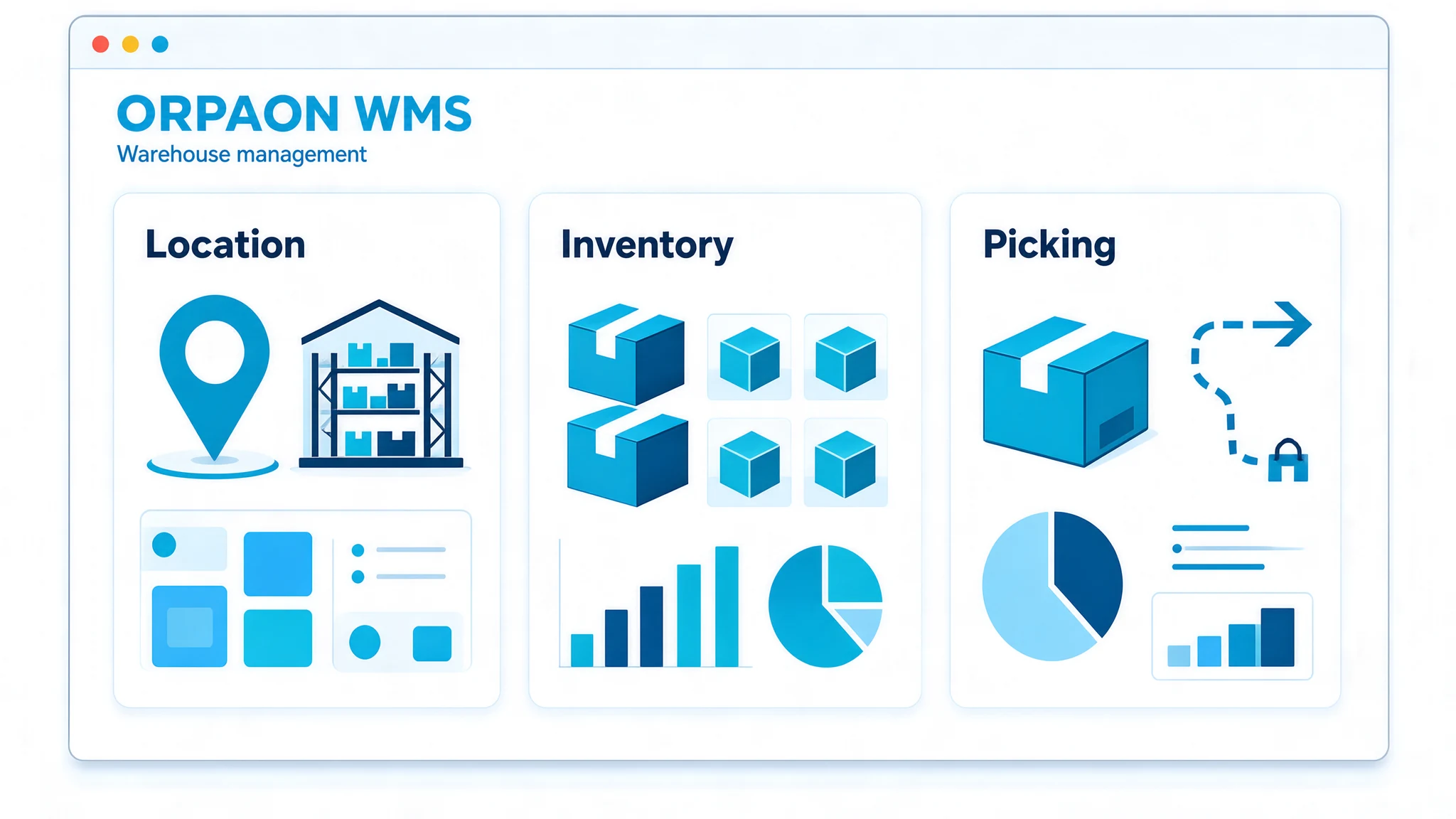
Why deploying the system before the data causes go-live to stall
Many factories treat a WMS as an off-the-shelf product that works the moment it is installed. Then at go-live they discover: locations have no unified coding, and the scan gun reads "the row by the wall" instead of a shelf; material master data is scattered across spreadsheets, and the same part has different names and units in the ERP and the warehouse ledger; and whether FIFO should be enforced or how batches are traced depends on whom you ask on the floor or in the warehouse office.
None of these are software problems. They are business rules that were never defined. A WMS only executes rules that have already been decided—if the rules are missing, even an advanced system just moves the confusion from paper to the screen.
Five things to agree before go-live: a checklist
| # | Readiness item | Common point of disagreement |
|---|---|---|
| 1 | Location coding rule | A warehouse-zone-row-level-bin hierarchy, or shelf sequence numbers; whether old locations should be re-coded |
| 2 | Master data ownership | Which side owns SKU, unit, and batch/expiry fields; who creates master data first, ERP or WMS |
| 3 | FIFO and batch policy | Whether FIFO is mandatory; how far expiry, batch, and serial numbers are traced |
| 4 | Workflow and roles | The owner and action standard for receiving, putaway, picking, checking, and counting |
| 5 | Upstream interface boundary | With ERP, MES, AS/RS, and AGV: who sends data down, who writes back, how failures are recovered |
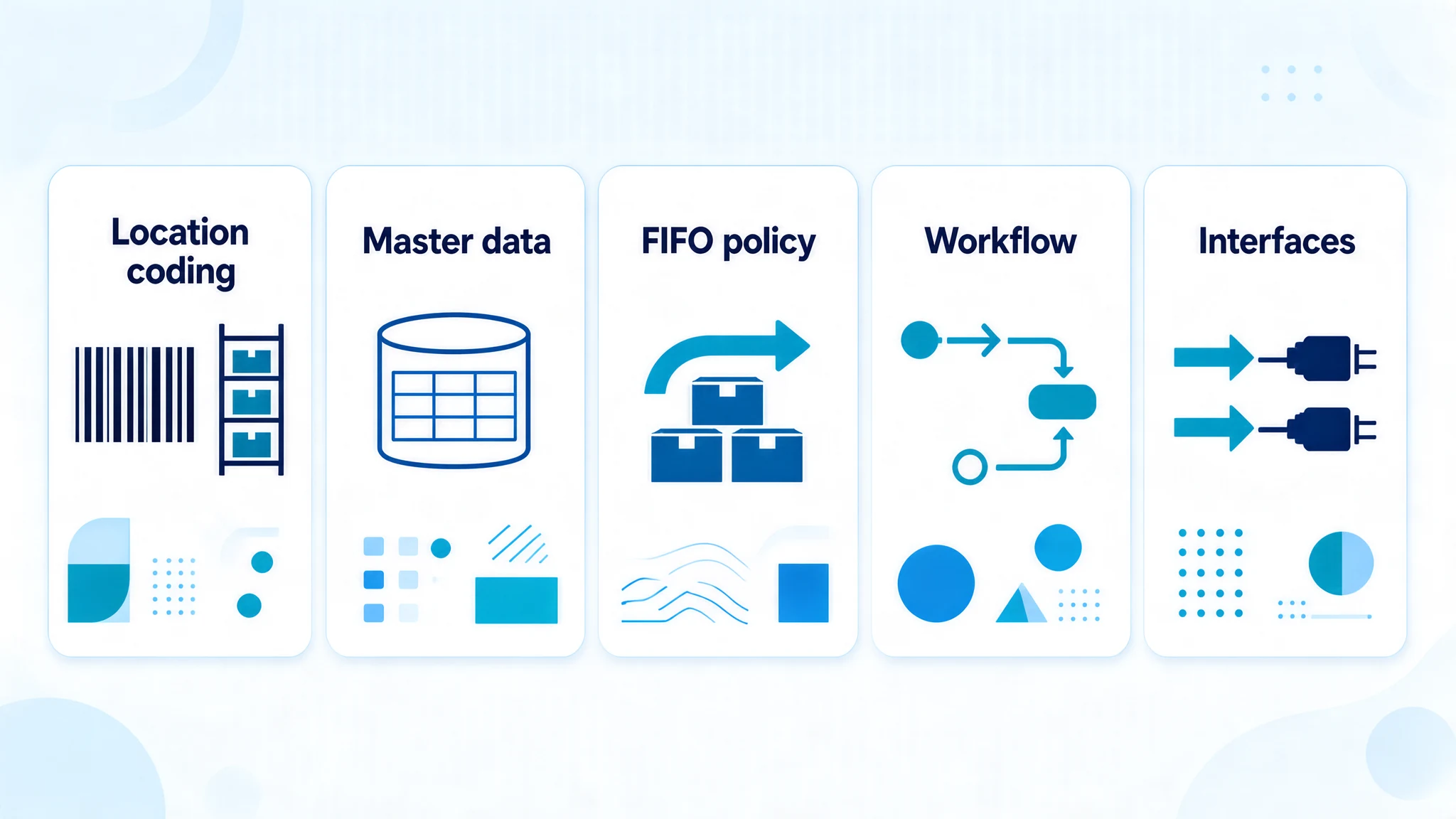
Agree on these five and the warehouse moves from "somebody manages it" to "rules drive it", which sharply reduces post-go-live disputes.
Master data and locations: the foundation most likely to fail
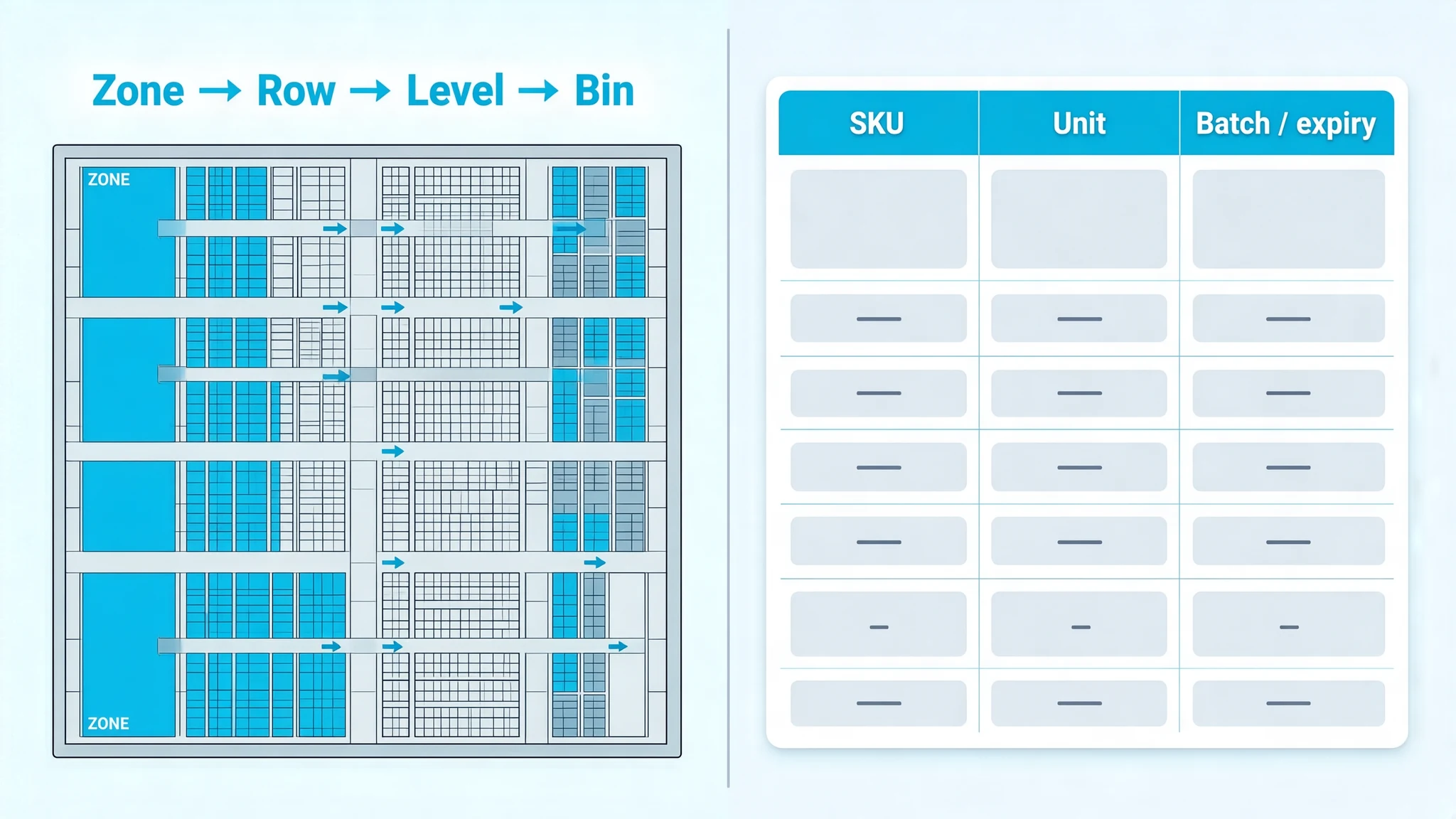
Location coding is the coordinate system for every warehouse action. Get the coding rule wrong and every later scan pays back the debt. A common approach is a hierarchy—warehouse, zone, row, level, bin—with a fixed number of digits or letters per level, so the scan gun lands on a cell instead of relying on someone imagining where an item roughly is.
Material master data must be right the first time: SKU must be unique, units unified, and batch or expiry fields defined. In practice, the most rework comes from the same part being called "A-01" in the ERP and "A01" in the warehouse ledger—the two never match and counting never balances. Master data ownership should be written into the agreement; usually ERP is the source of master data and the WMS only references and executes it, with changes flowing through a change process.
FIFO and batch traceability: how far to go
FIFO is not a checkbox. How far it goes depends on material characteristics and industry compliance:
- Enforced FIFO: food, chemicals, and materials with shelf life or batch traceability require the system to lock stock by expiry or batch and refuse out-of-batch issues
- Batch traceability: tracing which raw-material batch went into which finished batch, reversed at issue by scanning, to satisfy audit and recall requirements
- Serial-number traceability: single equipment or high-value items traced to a unique serial number for after-sales and warranty
The right level depends on the regulatory floor and customer audit requirements—not "the more the better". The higher the traceability level, the more scanning and data-maintenance effort the floor absorbs.
ERP and MES interface boundaries: who sends down, who writes back
- ERP sends down: material master data, purchase receipts, sales issue orders, and the stock-balance definition
- WMS executes and writes back: receiving, putaway, picking, checking, counting results, and stock movements are written back to ERP
- MES side: production material issue, line-side stock, and completion receiving interact with MES to stay aligned with the production rhythm
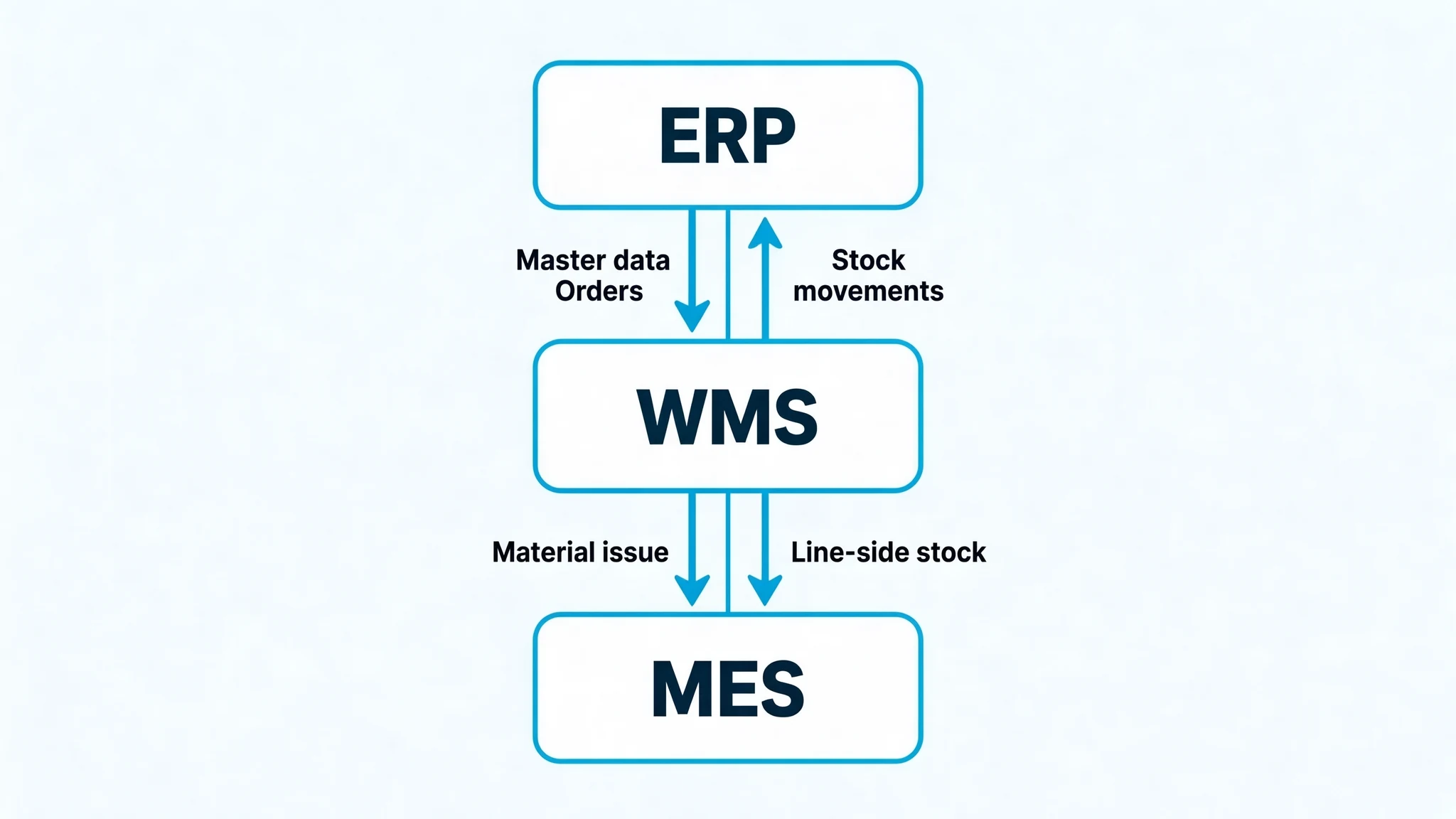
A WMS rarely runs alone; it sits between the ERP and the shop floor. If the boundary is unclear, go-live turns into "nobody's ledger matches":
Disconnections, ledger mismatches, and master-data changes all need a pre-agreed backfill and reconciliation mechanism. In one equipment manufacturer's warehouse barcode project, inbound/outbound and stock linkage between WMS, ERP, and MES was part of the delivery scope, with master data maintained centrally in ERP—defining that boundary early is what lets later warehouse nodes replicate without each going its own way.
What ORPAON delivers in the WMS space
Shanghai ORPAON has been in manufacturing digitalization since 2009, with 600+ projects and solution practices. Warehouse barcode management, inventory management, and location & batch management are deliverable capabilities, and integration with ERP, MES, AS/RS, and AGV is part of the delivery scope.
- Location coding and master-data governance: help define the warehouse-zone-row-level-bin coding rule and material master-data conventions so counting balances
- Inbound/outbound and traceability flows: make receiving, putaway, picking, checking, and counting digital; FIFO and batch traceability landed per industry compliance
- Upstream system integration: connect ERP, MES, AS/RS, and AGV; define master-data ownership and interface boundaries once and replicate across warehouses
From warehouse barcode management to WMS integration with ERP and MES, this can be delivered as a whole project or customized for location and master-data preparation alone. It suits factories planning a WMS, or those with a WMS but unresolved master data and interfaces.
Summary
Whether a WMS passes acceptance on the first attempt depends on what is settled before go-live: location coding, material master data, FIFO policy, workflows, and upstream interface boundaries. Put these five into documents and you have ledgers to match and records to audit afterward. The system is only the executor—the rules are the asset.
If your warehouse is planning a WMS, or already has one but the master data, batch traceability, and ERP/MES integration are unresolved, start by auditing the current state of these five items, settle the rules first, then decide the system scope and rollout pace.
Book a WMS Solution Discussion
Tell us your existing ERP and MES brands and versions, warehouse scale and product types, and batch-traceability and compliance requirements. We can then provide location and master-data recommendations and a phased rollout path based on your site conditions, with engineers available to engage directly.
Contact Us