How to accept a vision inspection line
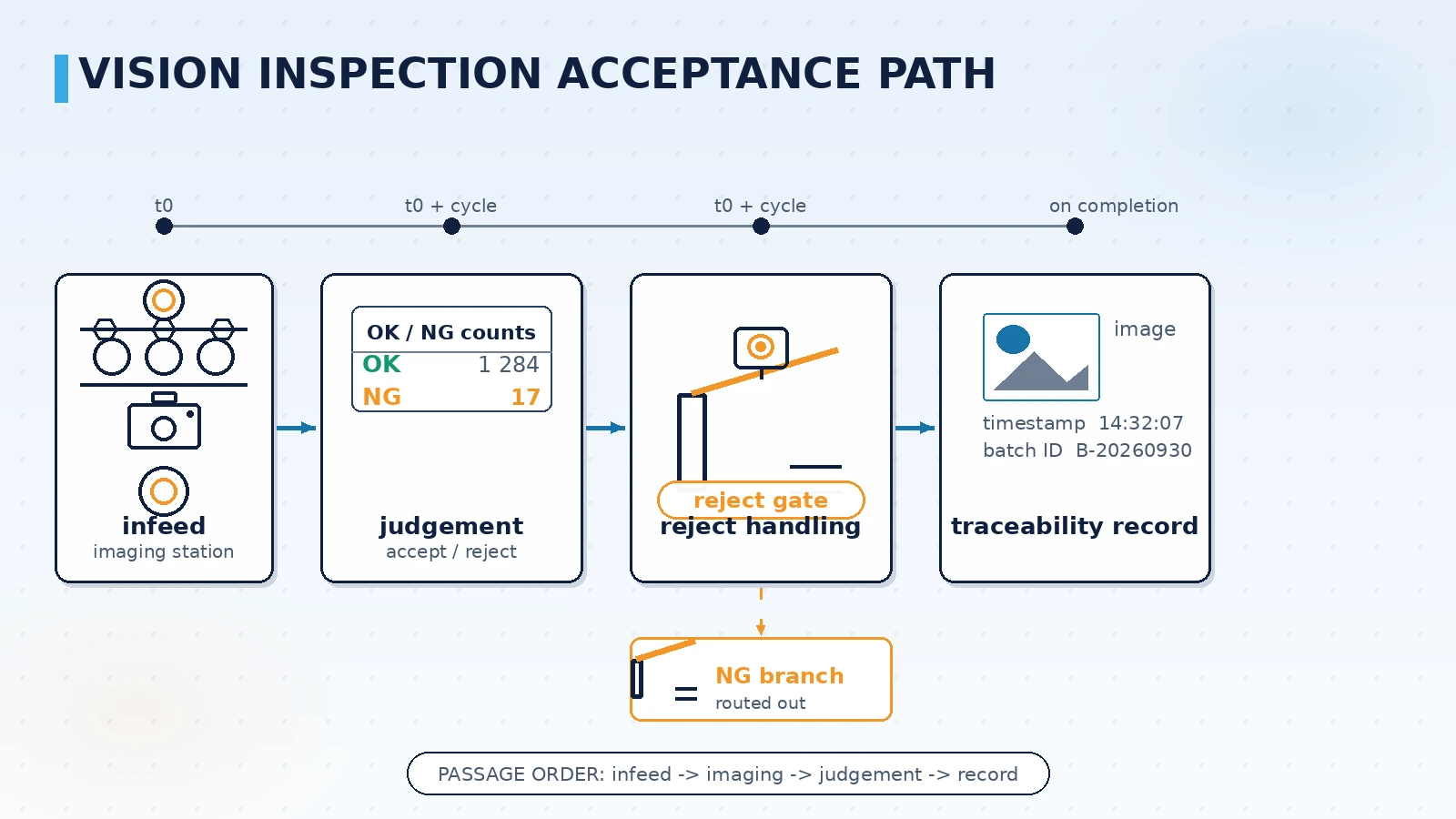
Accepting a vision inspection line does not mean counting how many demo images the algorithm judged correctly. It means running an agreed set of defect samples continuously at line takt, comparing the system judgement with human judgement part by part, and confirming that every part judged defective has a recorded destination. A demo shows what the algorithm can do on selected samples; acceptance proves the line can keep doing it under continuous production conditions — they are not the same question.
1. Why a detection rate is not an acceptance criterion
A detection rate is an easy number to report, but on its own it constrains very little. The same algorithm can reach a high detection rate on a hand-picked sample set and then see that figure fall once continuous production introduces slight defects, borderline samples and shape variation from process drift. More important, a detection rate answers none of the following: which class of defect was missed, under what conditions misjudgements occur, and where the parts judged defective actually went.
Acceptance criteria are therefore normally written as three sets of comparisons. The table below separates a demo setup from an acceptance setup.
Table: demo setup versus acceptance setup
| Item | Demo setup | Acceptance setup |
|---|---|---|
| Sample source | Selected typical defect samples | Samples drawn from continuous production, including borderline and slight defects |
| Operating mode | Single run, parameters adjustable at will | Continuous run at line takt, parameters frozen |
| Judged object | The result for a single image | The full path of each part, from infeed to disposition |
| Conclusion form | A detection or accuracy figure | Per-class judgement consistency plus a record of reject destinations |
| Pass standard | Visual impression at the demo | Acceptance criteria confirmed in writing by both sides in advance |
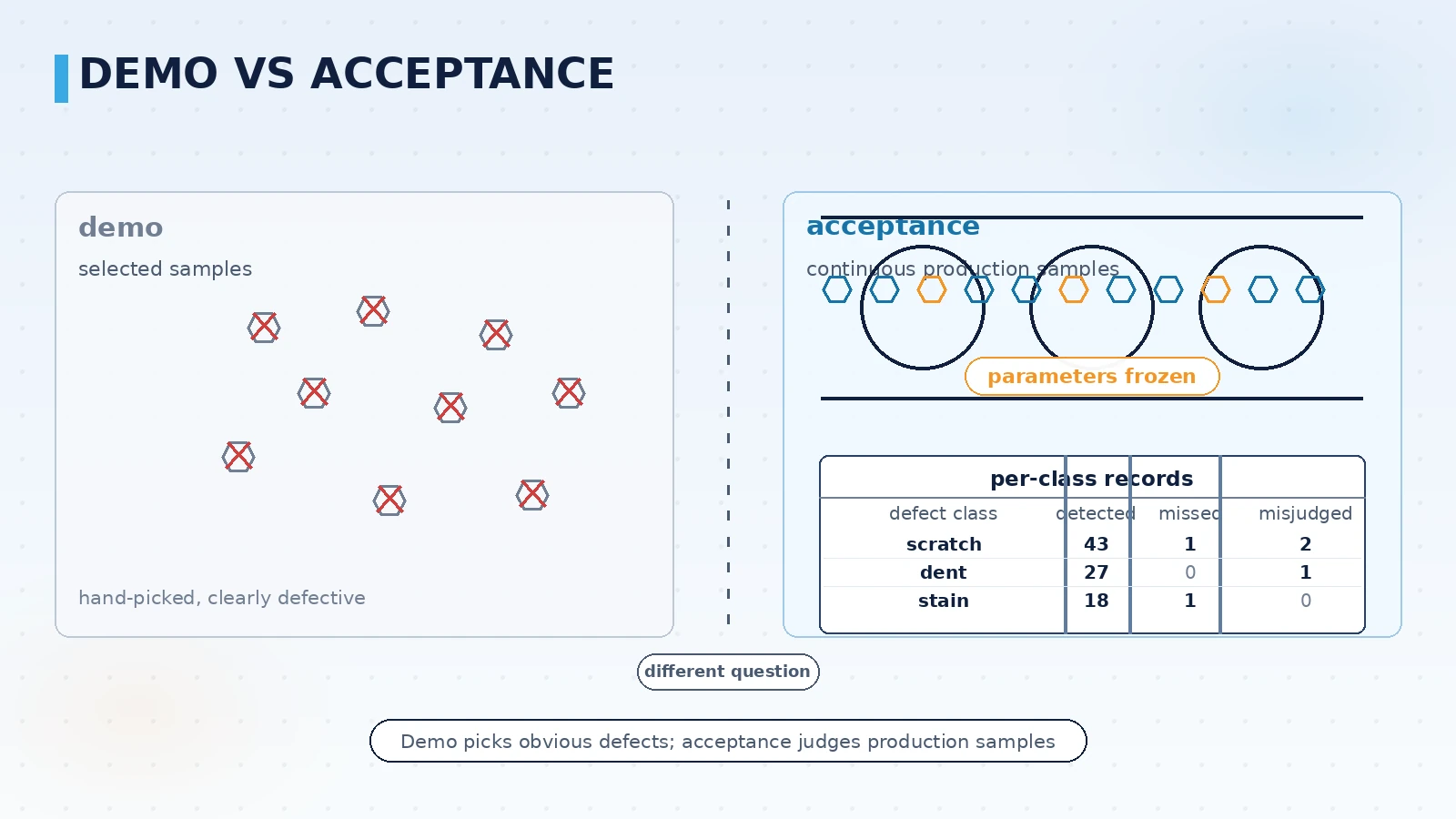
The last row is where late-stage disputes usually start. If the criteria stay verbal, acceptance day brings arguments about whether something counts as a missed defect; put the criteria into the acceptance document and the same discussion becomes a data check.
2. A ten-point acceptance checklist
The checklist below follows the inspection line from imaging to disposition. Each item can be measured on site during acceptance, and each one leaves a record.
- Imaging stability: shoot a number of consecutive parts of the same product at the same station and confirm that lighting and camera parameters do not drift, with consistent brightness and sharpness.
- Takt capability: run continuously at the actual line takt and confirm that per-part processing time stays below the takt throughout — not merely an acceptable average with peaks over the limit.
- Detection and misses: run the agreed defect sample set part by part and record detected, missed and misjudged counts by class, instead of replacing the breakdown with one total figure.
- Misjudgement and manual re-check: state which classes require manual re-check, whether the re-check action leaves a trace in the system, and whether the result is written back to the label.
- Reject handling: confirm whether a part judged defective is rejected, marked or merely flagged, and whether the disposition action corresponds one-to-one with the judgement.
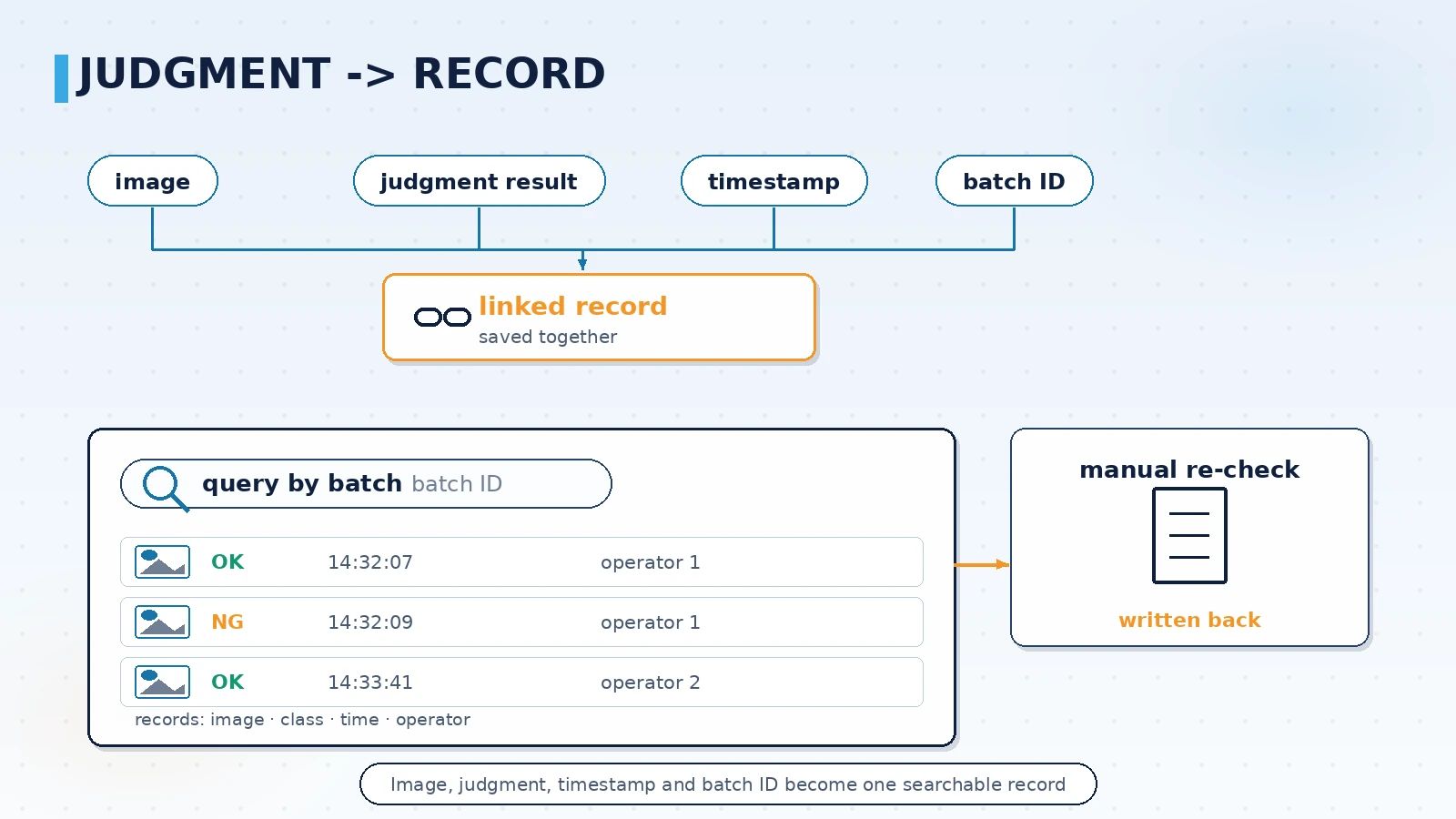
- Traceability record: confirm that image, judgement result, timestamp and part or batch identifier are stored together, and that batch-based retrieval is possible afterwards.
| Check item | Criterion | How data is obtained | Owner |
|---|---|---|---|
| Takt capability | Per-part processing time stays within line takt during continuous running | Continuous timing log | Line and system vendor |
| Detection and misses | Per-class statistics meet the agreed level | Part-by-part comparison against the sample set | Quality and system vendor |
| Misjudgement control | Misjudgement classes and counts stay within the agreed range | Statistics from re-check records | Quality department |
| Reject handling | Judgement and disposition action correspond one-to-one | Reject and marking records | Production line |
| Traceability completeness | Images and judgement results can be retrieved by batch | Sampled batch retrieval | System vendor |
Table: acceptance criteria, data source and owner
3. From judgement to disposition: how to verify traceability
Inspection results only carry the weight of a quality document once they enter the traceability chain. Verification here is not about counting how many images sit in a database, but about walking one batch along the entire path to see whether every stage leaves a searchable record.
- Image bound to part: an image should map to a specific part or batch identifier, not merely be findable in chronological order.
- Structured judgement result: defect class, judgement time and the recipe version in use should each be queryable, so that the behaviour of the same defect class can be reviewed after a recipe change.
- Disposition actions logged: rejection, marking and manual re-check each carry a timestamp and an operator, so no gap appears where the system judged a defect but nothing happened on the floor.
- Manual re-check traceable: the re-check conclusion should be written back to the same record, not left in a notebook or on a radio.
- Batch-based retrieval: a batch should act as the entry point that pulls out all inspection records for that batch, which is the capability most often requested during audits and customer complaints.
4. Rollout order for acceptance
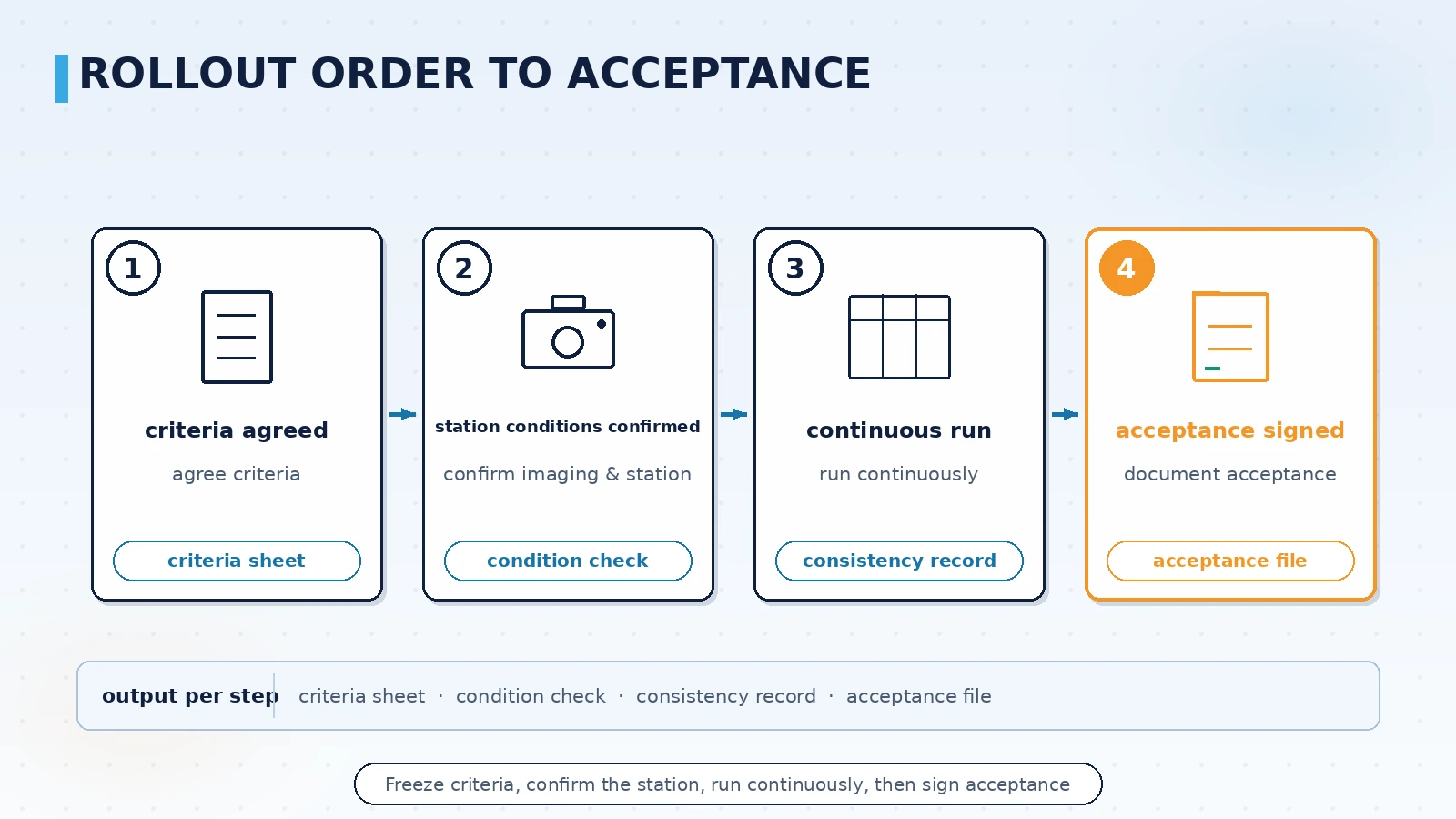
Translated into a project plan, the requirements above usually roll out in the following order, each step with a defined output.
- Agree defect classes and criteria: confirm defect classes, acceptance criteria and the sample set with the quality department before discussing system parameters.
- Confirm imaging and station conditions: confirm station space, lighting scheme, triggering method and reject mechanism, since these conditions determine whether takt and stability can later be met.
- Continuous running and data comparison: run the sample set continuously at line takt, compare judgement results class by class, and produce the consistency record.
- Acceptance document and archiving: assemble criteria, measured data, the jointly confirmed conclusion and the traceability query method into the acceptance document.
An inspection line project follows a pattern similar to equipment-side projects: agree the judgement criteria first, then confirm hardware and station conditions, then complete system integration and board configuration, and finally measure against the checklist. That is the order we use on machine vision projects — the defect classification and judgement criteria are written into a document first, and imaging conditions and algorithm parameters are then adjusted around that document. Where the line control system or a quality board needs the results, inspection data can be written through an agreed interface for later traceability and statistics. Capabilities involving intelligent judgement are currently handled as reserve and pilot work; joint verification can be carried out for a specific defect class, without promising judgement results in advance.
Conclusion
Accepting a vision inspection line comes down to proving two things at once: that the judgement can be trusted, and that rejected parts have a recorded destination. A detection rate is only an easy number to report. What decides whether the line runs for years is per-class consistency, a re-check mechanism for misjudgements, a one-to-one correspondence between judgement and disposition, and the ability to retrieve results by batch. Write those four into the acceptance document, measure them by continuous running and data comparison, and the inspection line is genuinely delivered.
Book a product demo
If your line is evaluating appearance defect inspection or in-line dimensional measurement, we can walk through an acceptance criteria and record-keeping approach built around your defect classes and station conditions.
Contact Us