What a TPM equipment maintenance system really manages
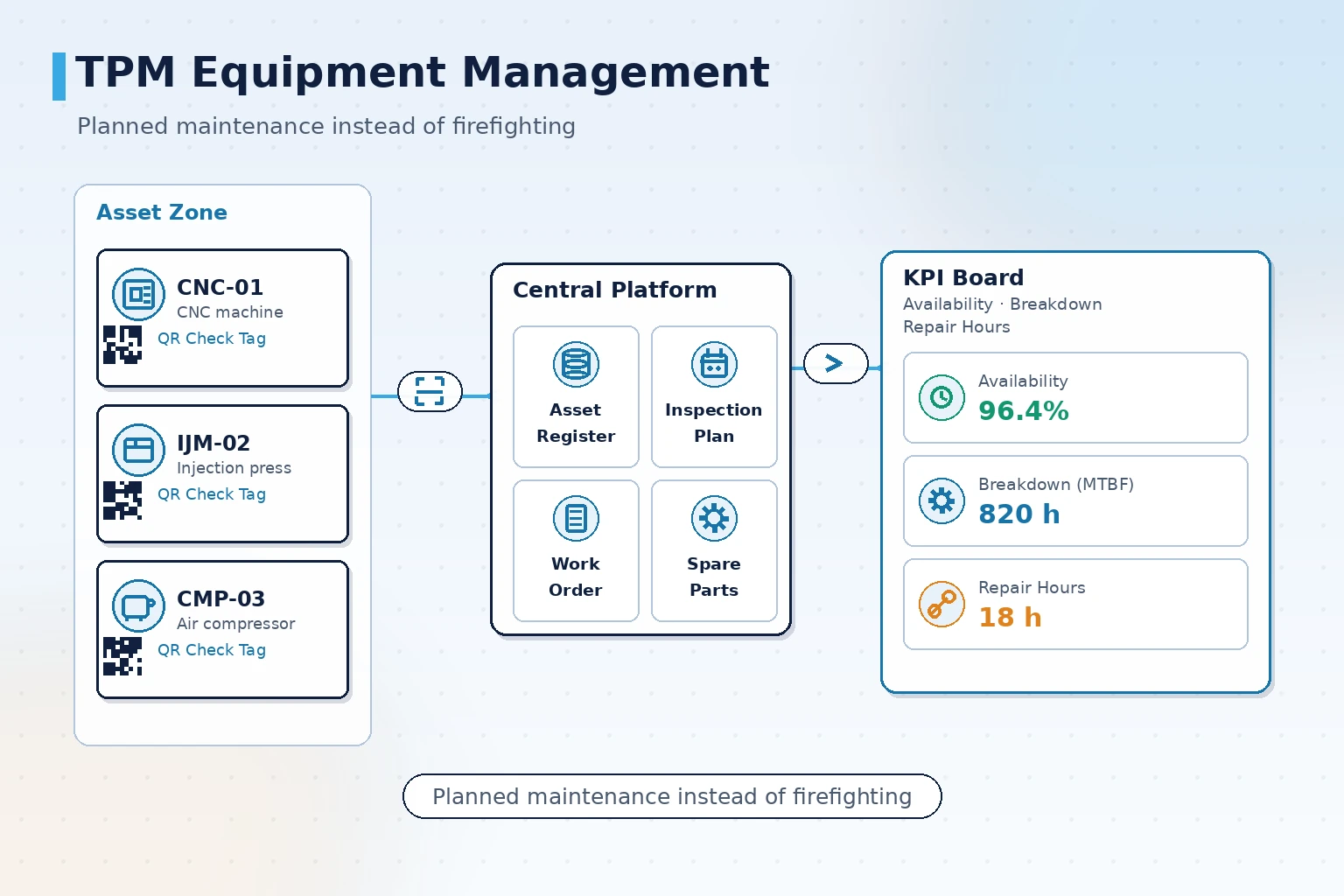
A TPM equipment maintenance management system covers the ongoing management of plant assets: it brings the equipment register, inspection and maintenance plans, repair work orders, spare parts stock and KPI reporting into one working routine, so planned maintenance actually happens, breakdowns leave a record, spare parts decisions rest on data, and maintenance cost can be explained. It is not simply another software purchase. It turns information that normally lives in paper check sheets, technicians' memory and the spare parts cabinet into routines that can be queried, scheduled and reviewed. This article follows five lines: which data to manage, how to schedule inspections, how work orders connect, where system boundaries sit, and where to start.
What TPM equipment management refers to
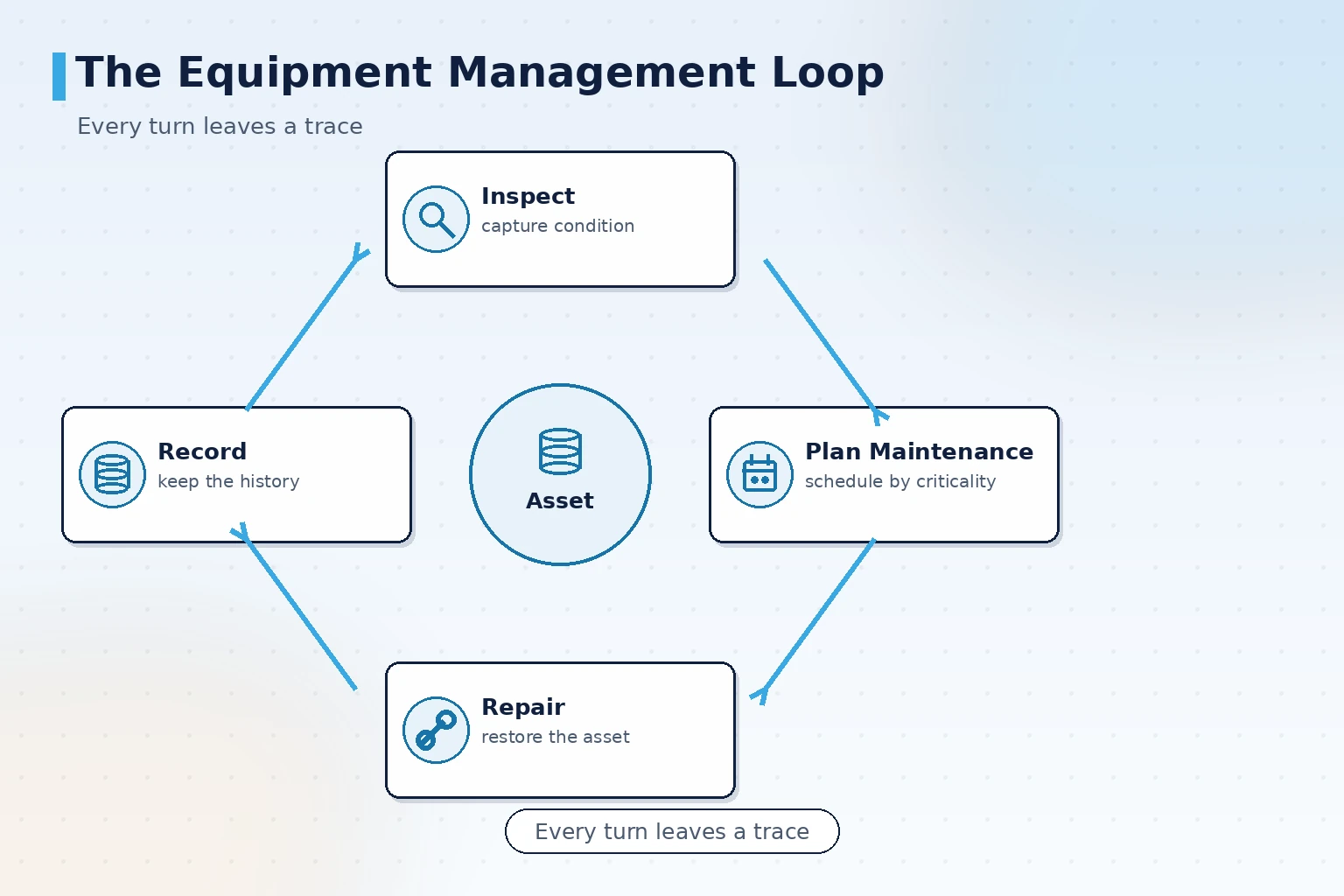
TPM (Total Productive Maintenance) originated in Japanese manufacturing and was systematised by JIPM, the Japan Institute of Plant Maintenance, in the later twentieth century. Its core idea is that equipment management is not the maintenance team's job alone: asset condition, maintenance plans and operating discipline all belong to daily operations. At system level this maps to whole-life asset management, from registration at commissioning through routine inspection, planned maintenance, fault reporting, repair execution and spare parts consumption, to performance reporting and replacement decisions.
Two established standards provide useful reference lines. ISO 55000:2014 sets out the management-system framework for asset management, answering how assets should be governed. EN 13306:2017 defines maintenance terminology and classification, drawing the line between preventive and corrective maintenance. The system's job is to land the data these frameworks require on each individual machine.
A useful test of any TPM system is whether it can answer eight questions: what is this asset, what condition is it in, when was it last serviced, who is due next, how often has it failed, what was done each time, which spare parts were used, and what has the asset delivered for what it cost. Whichever question it cannot answer marks the gap in the programme.
The five data sets that hold an equipment programme together
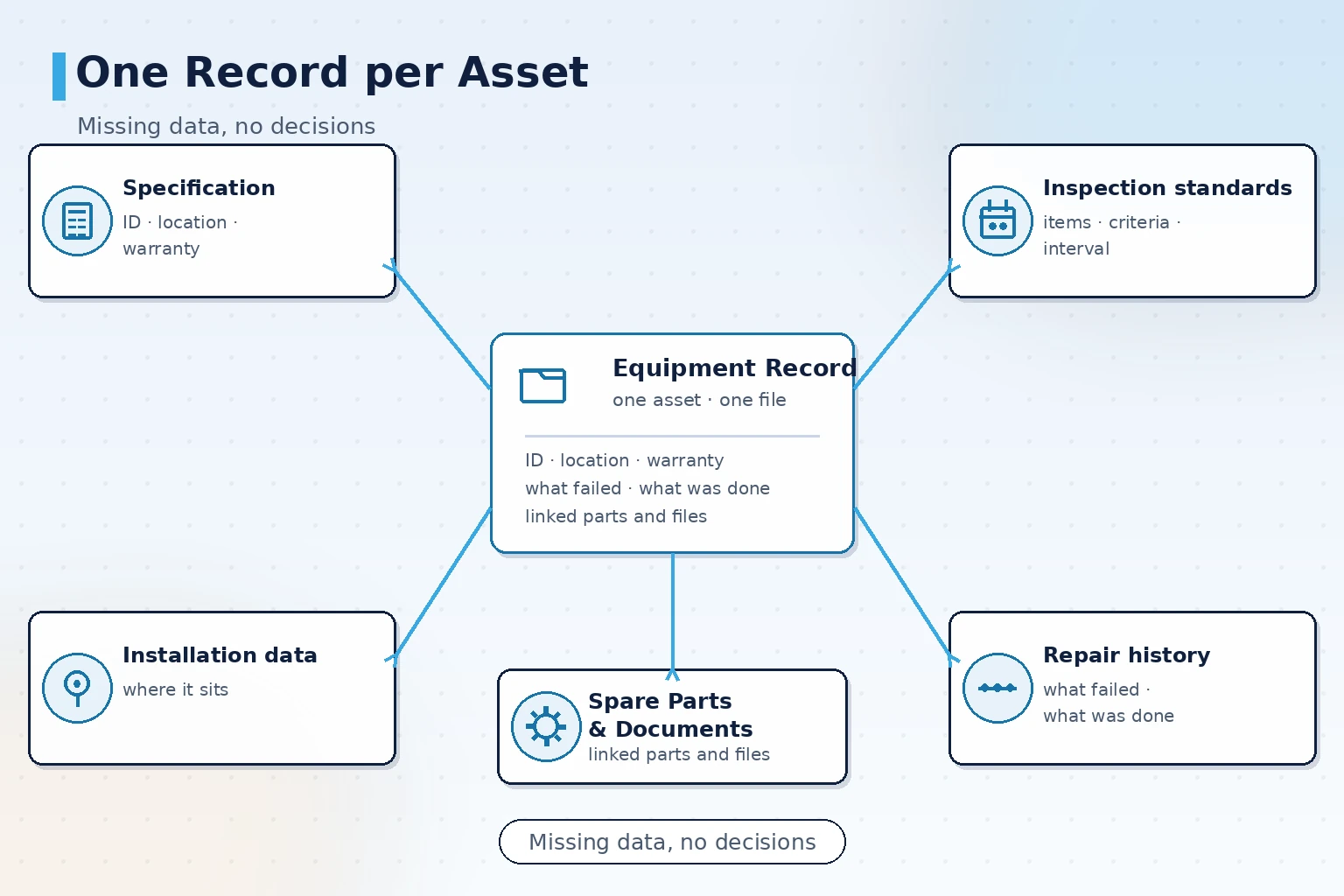
Equipment management looks like a process problem, but what usually blocks it is data. Miss any of these five sets and the reporting and decisions built on top lose their footing.
| Data category | What to record | What breaks without it |
|---|---|---|
| Asset register | Equipment ID, location, specification, supplier, commissioning date, warranty | Assets cannot be located, depreciation is unclear, and there is no list for renewal planning |
| Inspection and maintenance standards | Check items, acceptance criteria, interval, responsible role | Maintenance is done from memory and the same problems recur |
| Repair history | Fault symptom, cause, action taken, downtime, technician | Repeat faults stay invisible and repair know-how stays with individuals |
| Spare parts and stock | Part number, applicable equipment, safety stock, issue and receipt records | Parts are missing in an emergency and overstocked otherwise, with unclear parts cost |
| Performance and cost | Utilisation, breakdown downtime, repair hours, parts consumption | KPIs are compiled by hand and management decisions lag |
A recurring sequencing mistake is worth noting: many plants build the dashboard and KPI layer first and only then go back to fill in the asset register. With inaccurate source data, nobody trusts the reports. The register and the inspection standards are the foundation of this layer and deserve the time up front.
How to schedule inspections so they actually hold
A schedule that can be printed is not the same as a schedule that gets executed; what usually sits in between is knowing who does what, and when.
- Bind inspection items to equipment: each check item belongs to a specific machine or component rather than to one person's habits, so the standard survives shift changes and staff turnover.
- Set intervals by criticality: critical equipment takes a shorter inspection interval while auxiliary units can be relaxed; the tier comes from the process and the consequence of failure, not one interval applied to everything.
- Execute by scanning: the inspector scans the machine or station code on site and records results item by item on a terminal, replacing the retro-filling that paper sheets invite.
- Route exceptions straight to a work order: when a reading falls outside its criterion, the system raises the exception and converts it into a repair order instead of relying on a verbal handover.
The value of this mechanism is not a better-looking report; it is turning "was the maintenance done, and was it done correctly" from a verbal assurance into a retrievable record. ISO 9001:2015 places comparable expectations on process control and record traceability, and equipment maintenance is no exception.
How repair work orders and spare parts interact
Low repair efficiency is usually not a repair skill problem but an information handover problem: who goes, what to bring, and what was done last time.
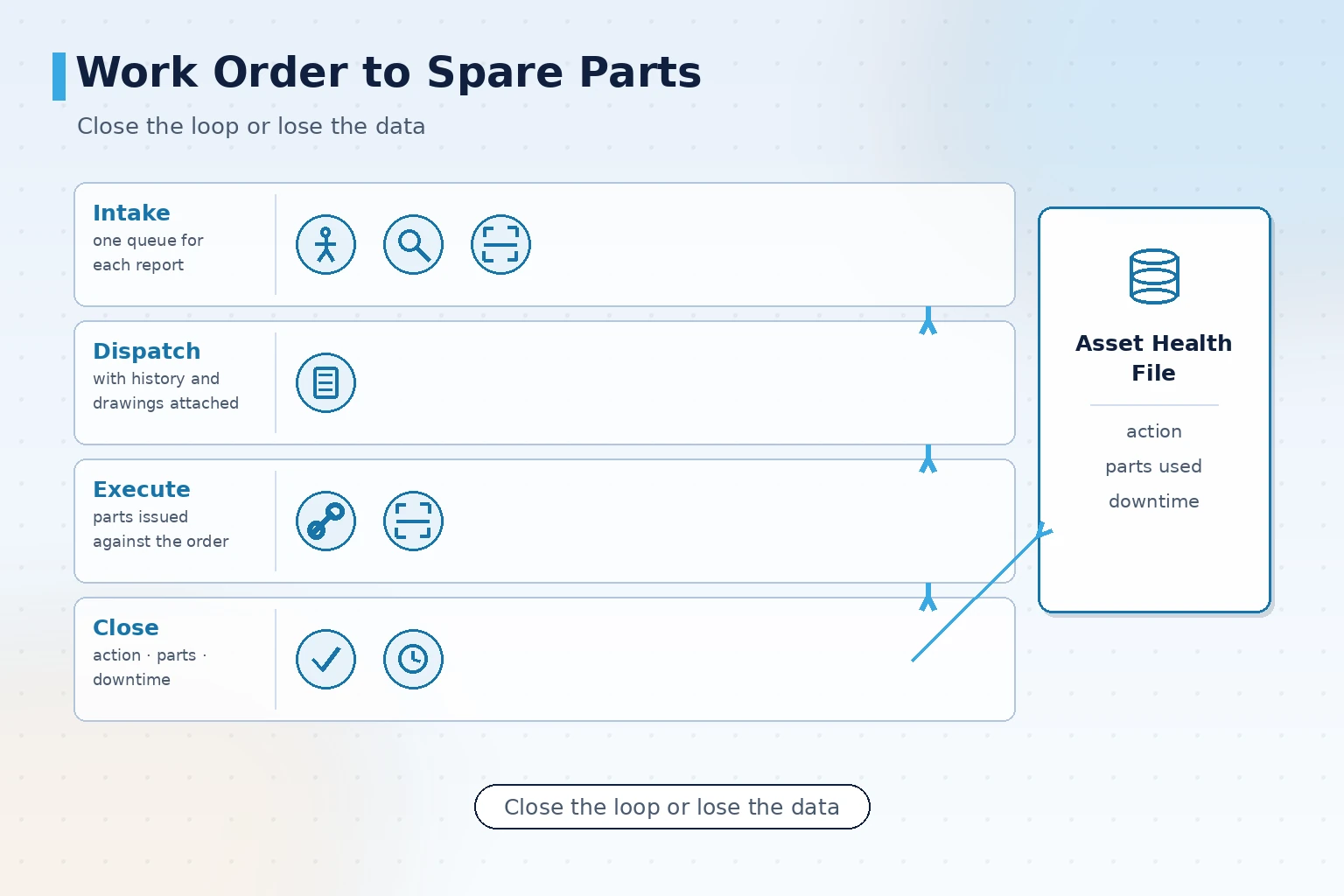
- One intake point: faults raised by operators, inspectors and patrol rounds all land in the same queue, removing the omissions and duplicates that verbal reporting creates.
- Dispatch with context: when a work order is assigned, it carries the asset history, previous fault records and the relevant drawings, cutting the search time on site.
- Tie parts to the work order: parts are selected and issued against an open work order, so consumption is attributed automatically to the asset and the fault type.
- Close the loop on completion: the action taken, parts replaced, downtime and follow-up recommendations are recorded together as part of the asset health file; anything not repairable on the spot moves into planned overhaul tracking.
After a few months of work-order data, patterns surface on their own: which fault types recur, which assets cause the most downtime, which parts move unusually. No separate analytics tool is needed, provided the work orders have been recorded against the same fields from the start.
Where the boundaries with OEE, MES and ERP sit
An equipment management system rarely runs alone, and boundaries left vague produce two versions of the truth after go-live.
| System | Its own responsibility | What crosses the interface |
|---|---|---|
| OEE / performance analysis | Calculates availability, performance, quality and loss structure | Equipment downtime events and reason codes as the OEE input |
| MES | Owns work orders, output reporting, line takt and quality data | Equipment status, downtime, repair order results |
| ERP | Owns purchasing, stock ledger and cost accounts | Parts receipts and issues, maintenance cost allocation |
Three things belong in the interface design before build: how often data moves, which fields move, and which side triggers it. Equipment codes, part numbers and units of measure must also match across systems, or the data will never reconcile.
Moving spare parts from recall to evidence
Spare parts management tends toward two extremes: too little stock, so a stopped machine waits for a part, or too much, leaving shelves of items that have not moved for years. The middle ground rests on evidence from two sources: historical consumption records, which show the real issue frequency and seasonality of a part, and the asset register together with the maintenance plan, which forecasts replacement demand over the coming period.
With both, safety stock stops being a guessed number and becomes something set by tier, according to asset criticality, procurement lead time and consumption rate. Parts with long lead times or single-point-of-failure impact justify a higher level; common, easily sourced and substitutable parts can be held low or bought on demand. These settings can be revised continuously as operating data accumulates, provided every issue goes through a work order and every receipt is recorded.
Rollout order from the register, and the usual mistakes
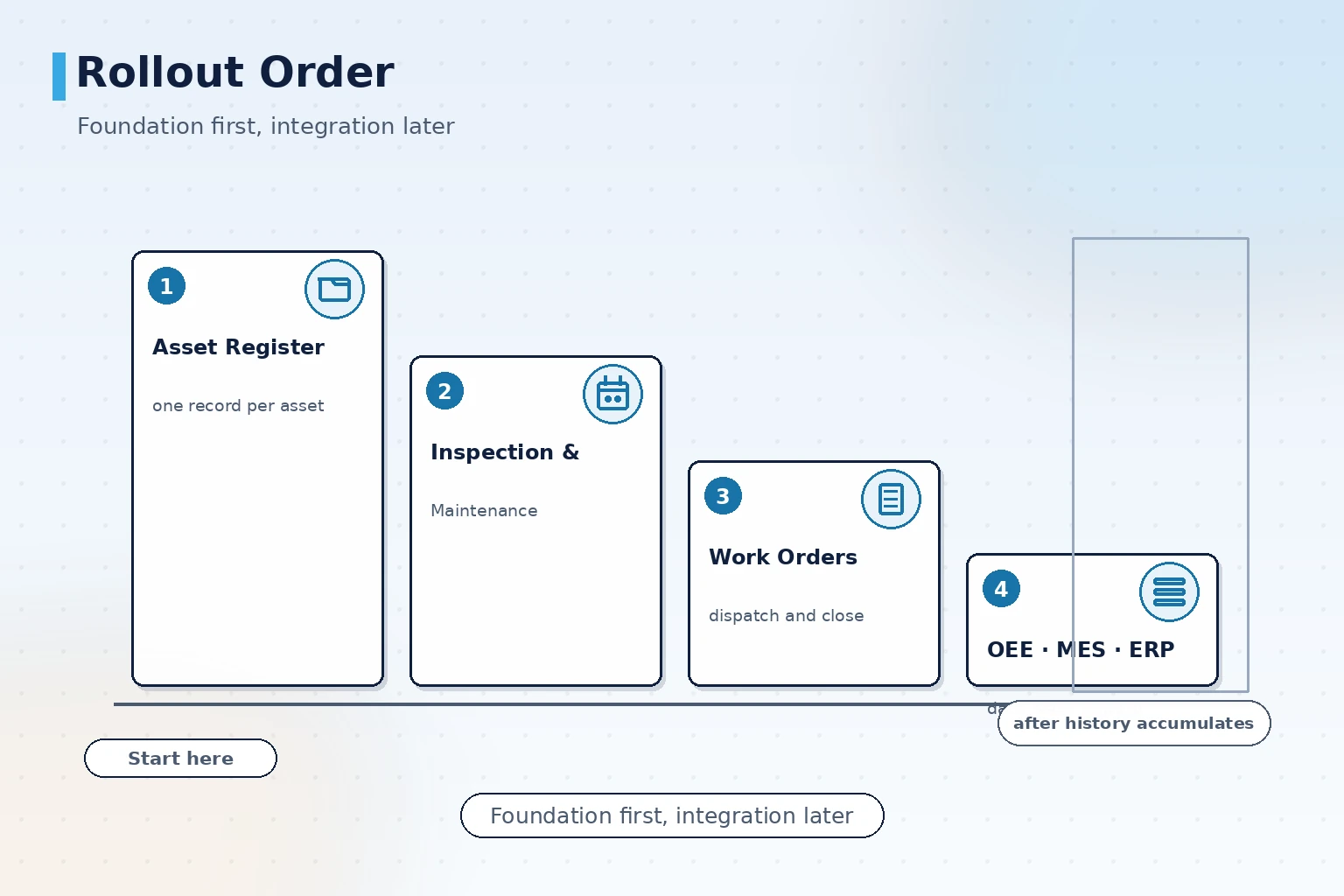
The recommended order starts from the register and the inspection standards rather than from a large screen.
- First, survey the asset register and complete specifications, location and warranty data for critical equipment, forming the per-asset record.
- Second, fix the inspection items and acceptance criteria for critical equipment, starting with the assets that fail often or matter most.
- Third, go live with repair work orders so that reporting, dispatch, completion and parts issue all pass through the system and build history data.
- Fourth, once history has accumulated, connect OEE and the MES and ERP interfaces, bringing equipment data into production and cost management.
Three mistakes are common. The first is treating the system as electronic paper forms, capturing data but never using alerts or interlocks, so it is abandoned within months. The second is copying inspection standards from elsewhere, detached from the actual failure modes on site. The third is reporting without closing the loop, where KPIs go up the line and nobody owns the follow-up.
Access control deserves the same attention as the data itself: who may change inspection standards, who may close work orders, and who may adjust parts stock should all have defined roles and an audit trail. The access-control requirements that the IEC 62443 series sets out for industrial automation and control systems work well as a reference for that design.
Conclusion
The value of a TPM equipment maintenance management system lies not in feature count but in whether four things keep running: an accurate asset register, inspections and maintenance executed to plan, repair work orders closed with a record, and spare parts decisions backed by data. Once those four hold, OEE integration, cost analysis and renewal decisions rest on reliable sources, and equipment management moves from firefighting to planned maintenance.
ORPAON has worked on manufacturing digitalisation since 2009, with years of implementation experience in equipment and production management across automotive components, electronics, food and beverage, and equipment manufacturing. If your plant is about to review its equipment management practice, start from the asset list and the last six months of fault records, stabilise the register and inspection standards first, and then decide the system scope and pace.
Request an on-site diagnosis
Not sure which part of equipment management to start with? Bring your asset list, current maintenance policy and recent breakdown records; an English-speaking engineer will run an on-site diagnosis and propose priorities for the register, inspection and work-order stages.
Contact Us