Test Bench Data Acquisition: Collect, Standardize, Trace
Test bench data acquisition software has to do three things: collect signals from PLCs, buses and instruments into one place, turn duty-cycle execution and limit checking into repeatable standard actions, and land every test's data, recipes and results in an archive that can be traced and reproduced. Miss any one, and test data is just numbers on a screen rather than evidence that supports R&D and release decisions.
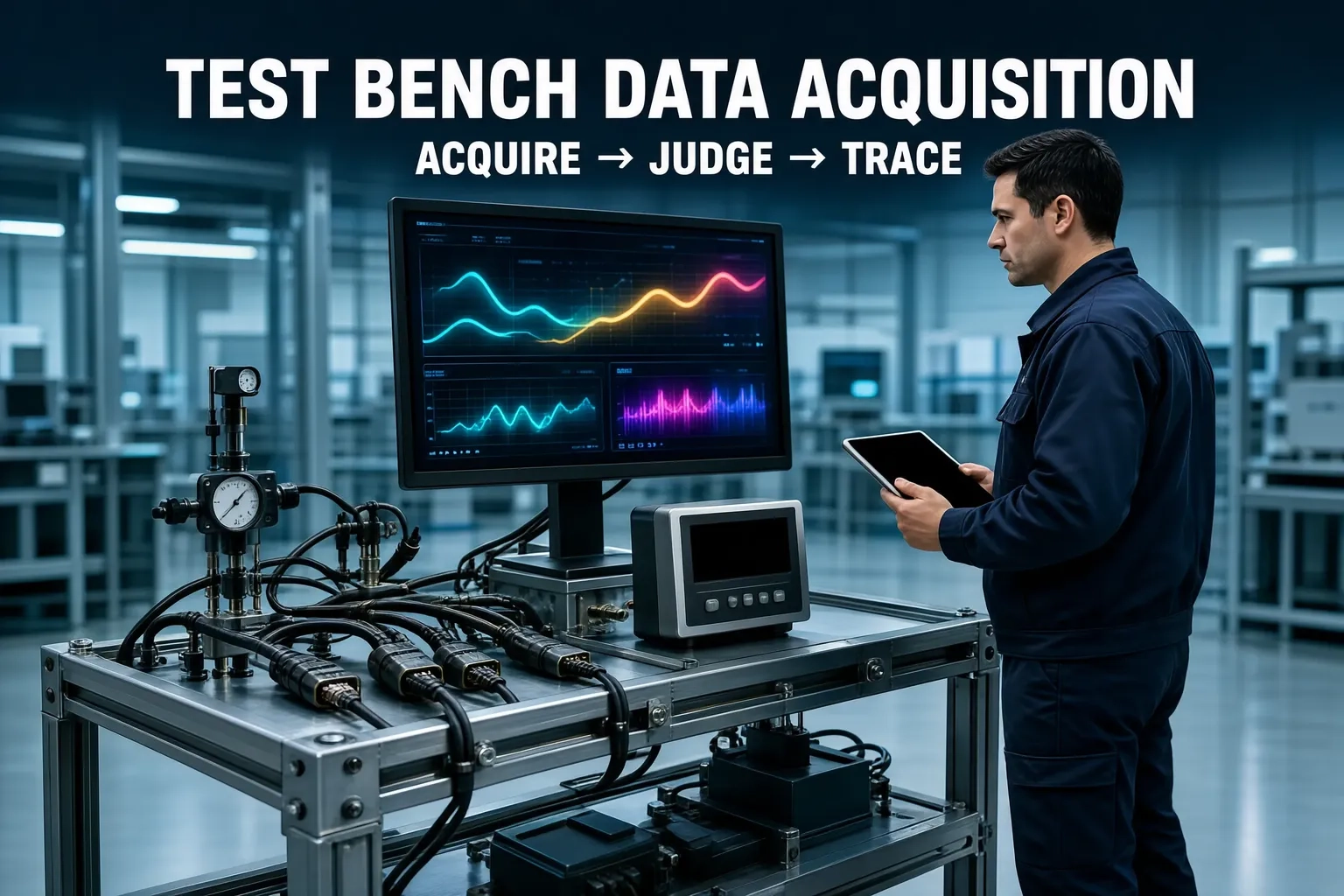
Why manual recording fails in the lab
Plenty of labs still run durability and performance tests by watching instruments and copying readings by hand. The problem is not careless operators but that the practice cannot last: a durability test runs thousands of hours, so nobody can be present the whole time; judgment points rely on someone reading a curve and deciding whether a limit was crossed, and different people decide differently; when a problem must be reproduced, the duty cycle, software version and sensor state from that run were never archived.
Manual recording loses not the numbers but traceability. When a customer audit or an internal R&D review needs the full course of one test, a handwritten notebook cannot produce an evidence chain. Unstandardized testing turns data into scrap paper, in both the R&D and release-testing stages.
Where the data comes from: multi-protocol boundaries
- PLCs and controllers: duty steps, interlock states and alarms, read over Modbus TCP/RTU, Profinet or Siemens S7
- Bus devices: CAN and LIN buses common on automotive and new-energy rigs, parsed into physical quantities
- Serial instruments: temperature controllers, power meters and sensors on RS485, polled one by one
- DAQ and analog: NI DAQ and high-speed cards sampling pressure, flow, vibration and speed directly
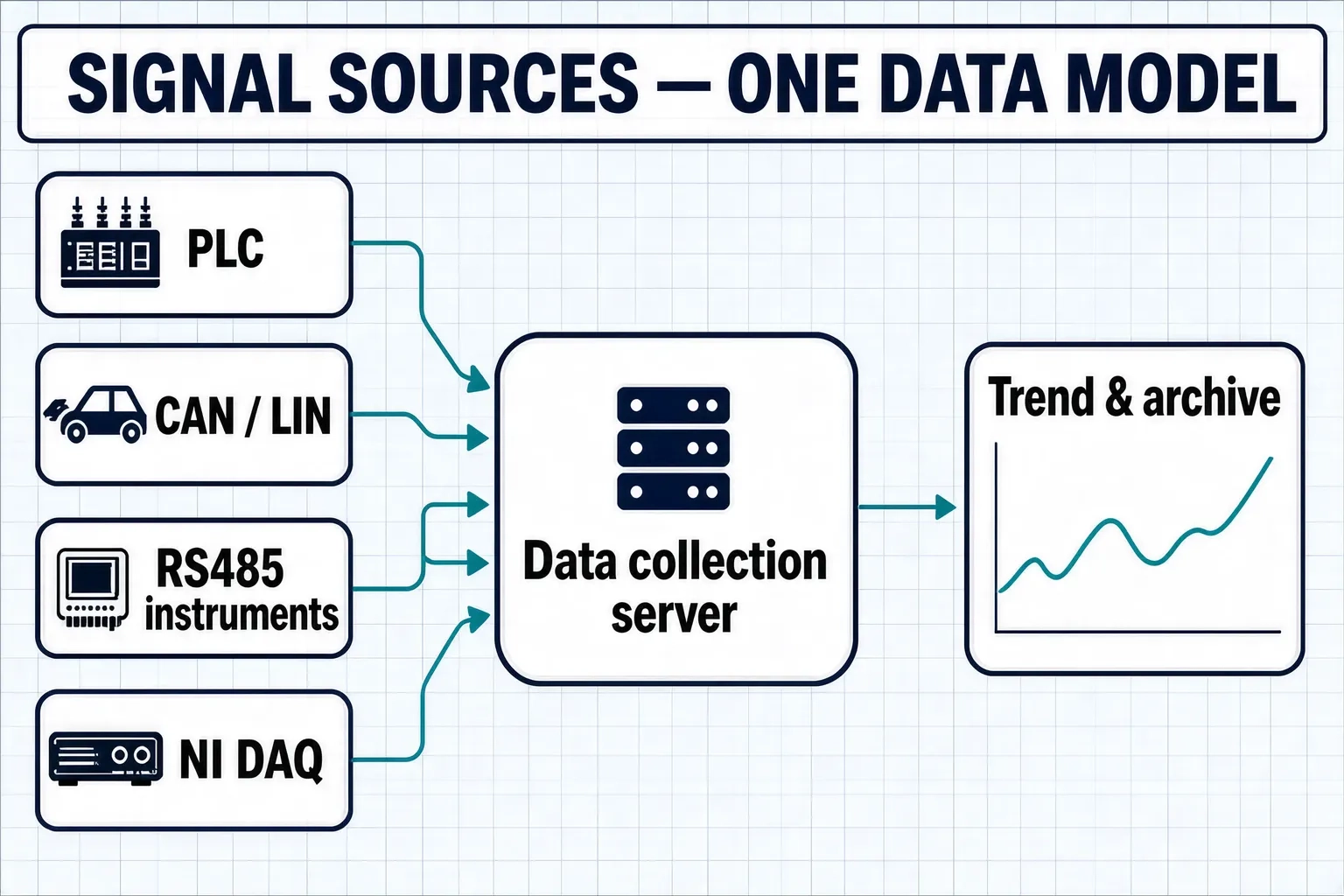
A test bench carries more varied signal sources than a production line, typically spanning several interfaces:
The first job of acquisition software is unifying these protocols into one data model with one timestamp, one unit system and one sampling cadence. If the acquisition boundary is unclear, every later judgment and trace rests on incomplete data.
Duty-cycle execution and limit checking: standardizing the judgment
A test bench monitoring system turns "what to run and how to judge" into repeatable configuration instead of improvisation run by run:
- Duty recipe library: store duty steps, targets and hold times per model, so switching models changes the recipe, not the code
- Automatic duty execution: load targets, record data and advance steps automatically, reducing manual intervention
- Automatic limit checking: set upper and lower limits on temperature, pressure and speed, with automatic recording, alarming or shutdown on breach
- Sensor calibration management: track calibration state so every measured value remains trustworthy
Once judgment is standardized, running the same duty twice produces comparable results, and the boundary no longer depends on one operator's experience.
Where traceability lives: recipes, binding and reports
Traceability is not a slogan; it lands in a few concrete places:
| Where it lives | What it does |
|---|---|
| Duty recipe | Records the exact conditions of each run, version included |
| Barcode work-piece binding | Ties data to a specific part, leaving no gap in the trace |
| Process archive | Stores curves, alarms and operation logs so runs can be replayed |
| Automatic reports | Generates reports from raw data by template, cutting manual work and errors |
When data can be exported, compared and reproduced, R&D teams share a common baseline; an auditor opens a curve and sees which part, which recipe and which sensor state it belongs to.
What Orpaon delivers for test bench acquisition
Shanghai Orpaon has worked in manufacturing digitalization since 2009 with more than 600 project and solution engagements; test bench host software, data acquisition and configuration engineering are part of its delivered scope. The system is built in C#/.NET (WinForms and WPF), runs on industrial PCs, and supports multi-protocol acquisition over Modbus, CAN/LIN, RS485, temperature controllers and NI DAQ, covering durability benches, performance test benches, burn-in rooms and release test benches, with interfaces available in Chinese, English, Japanese and more.
- Multi-protocol acquisition: PLCs, buses, serial instruments and high-speed DAQ brought together
- Duty and judgment: recipe-driven automatic execution, automatic limit checking and shutdown protection
- Traceable delivery: barcode binding, process archiving and automatic reporting, with replayable data
Conclusion
The value of test bench data acquisition software is not collecting more but collecting consistently, judging by a standard and finding anything back. Bring multi-protocol signals together, turn duty execution and limit checking into repeatable standard actions, and land recipes, binding and reports in a traceable archive; do all three and test data becomes evidence for R&D and release decisions instead of numbers on a screen.
If you are planning a bench upgrade or still recording tests by hand, walk three questions item by item: clarify where data comes from, turn judgment into configuration, and archive every run so it can be reproduced.
Request a consultation
Tell us your bench type, signal count and judgment requirements. We will propose an acquisition and traceability plan based on your rig conditions, with engineers speaking English.
Contact Us