How to set acceptance criteria for a test bench system
Acceptance criteria for a test bench system should be fixed across four layers before the contract is signed: the measurement layer for sensor range and accuracy, the acquisition layer for continuity and timestamps, the verdict layer for duty profiles and pass rules, and the record layer for evidence and traceability. With criteria written down, commissioning day produces a single verdict instead of an argument on the shop floor.
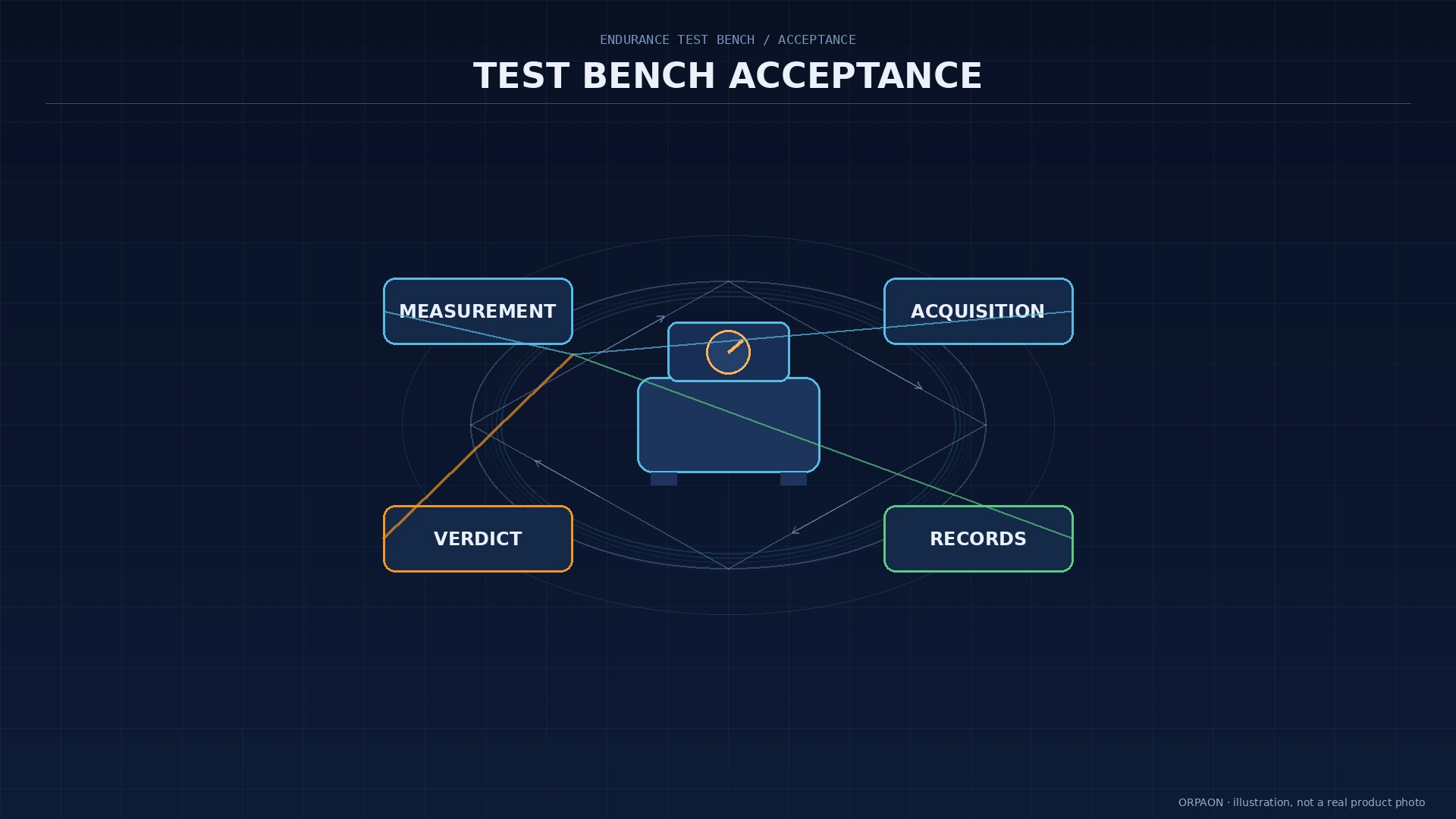
Measurement and acquisition: range, accuracy and timestamps come first
The measurement and acquisition layers set the credible lower bound of your test data. For every parameter used in a pass/fail decision, list the sensor model, range, accuracy class and calibration requirement, and confirm the calibration certificate is within its validity period; a common practice is to select the accuracy class at 1/3 to 1/5 of the tolerance of the unit under test, with the range covering the top of the duty profile plus margin. Below that bound, commissioning day turns into a dispute about whether the data can be trusted.
- Decision parameters: register sensor model, range, accuracy class and certificate validity item by item
- Acquisition continuity: no lost samples during a full-load run, unified timestamps with a declared time zone
- Control outputs: control cycle and actuator response written into the agreement, not judged by feel on the day
- Abnormal behavior: reconnects, over-limit alarms and protective stops demonstrated one by one
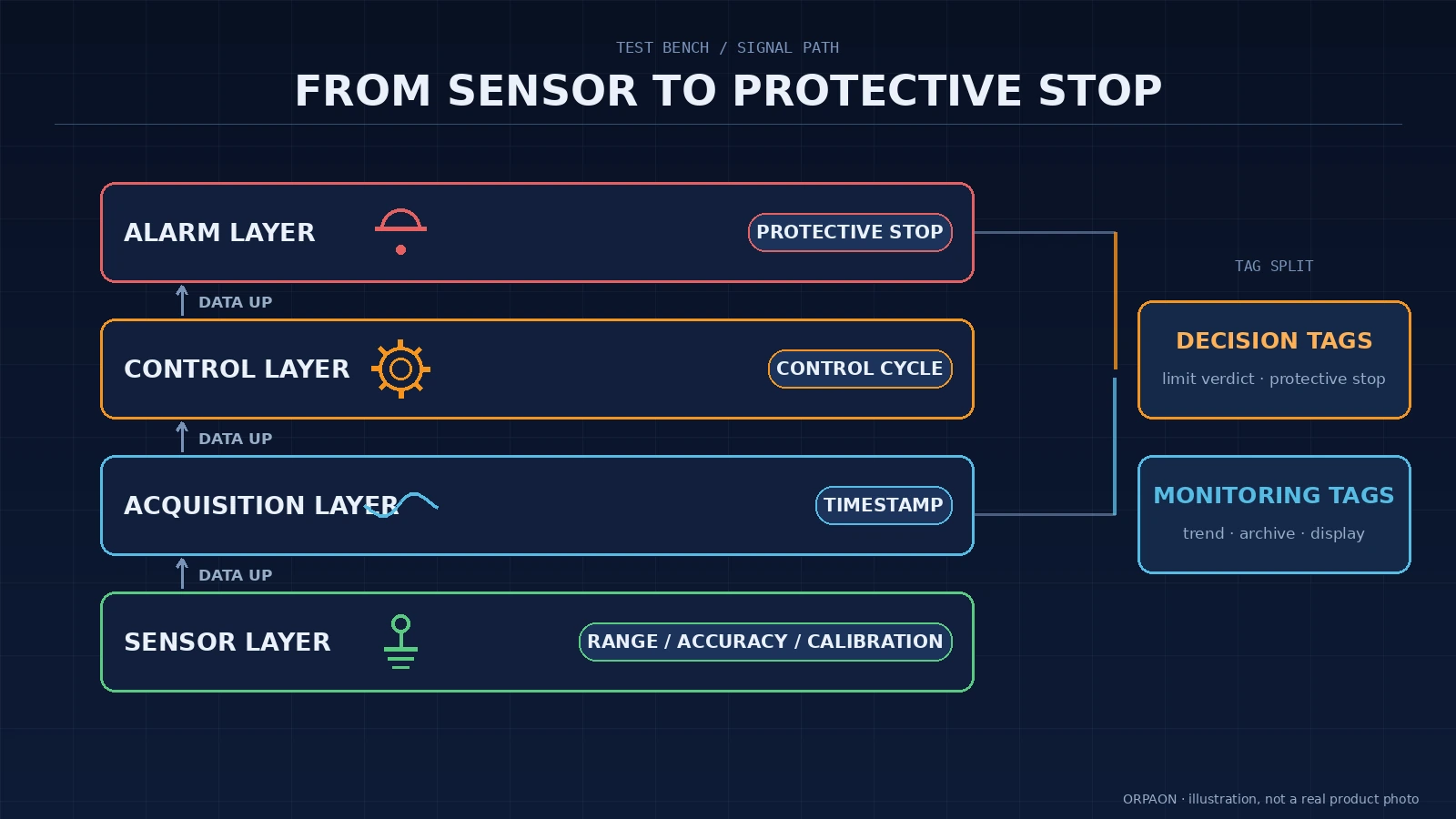
The most effective check at this layer is to split the tag list into decision tags and monitoring tags: decision tags go through every item above, while monitoring tags only need a valid range and working communication. Once the lists are split, acceptance effort concentrates on the few points that actually drive the verdict, and both sides spend noticeably less time on the walkthrough.
Verdict layer: duty profiles and pass rules that can be reproduced
The verdict layer answers two questions: what profile the machine runs, and what rule decides a pass afterwards. The test outline should freeze the duty profile, hold times, cycle counts and sampling rates as an executable recipe inside the system, so acceptance runs are driven by the recipe rather than by verbal adjustments. For compressor-type testing, ISO 1217:2009 provides the tolerance framework for acceptance tests of displacement compressors and can be cited directly as the basis of the pass criteria.
| Acceptance item | Method | Pass criterion |
|---|---|---|
| Recipe consistency | Run the same recipe three times in a row | Profile, hold times and cycle count match the outline |
| Temperature verdicts | Compare against an independent reference gauge | Deviation within the agreed tolerance and reproduced across three runs |
| Flow and power verdicts | Calculated under the ISO 1217:2009 tolerances | Results fall inside the tolerance band |
| Protective stops | Inject simulated signals | Protection triggers at the setpoint and leaves a record |
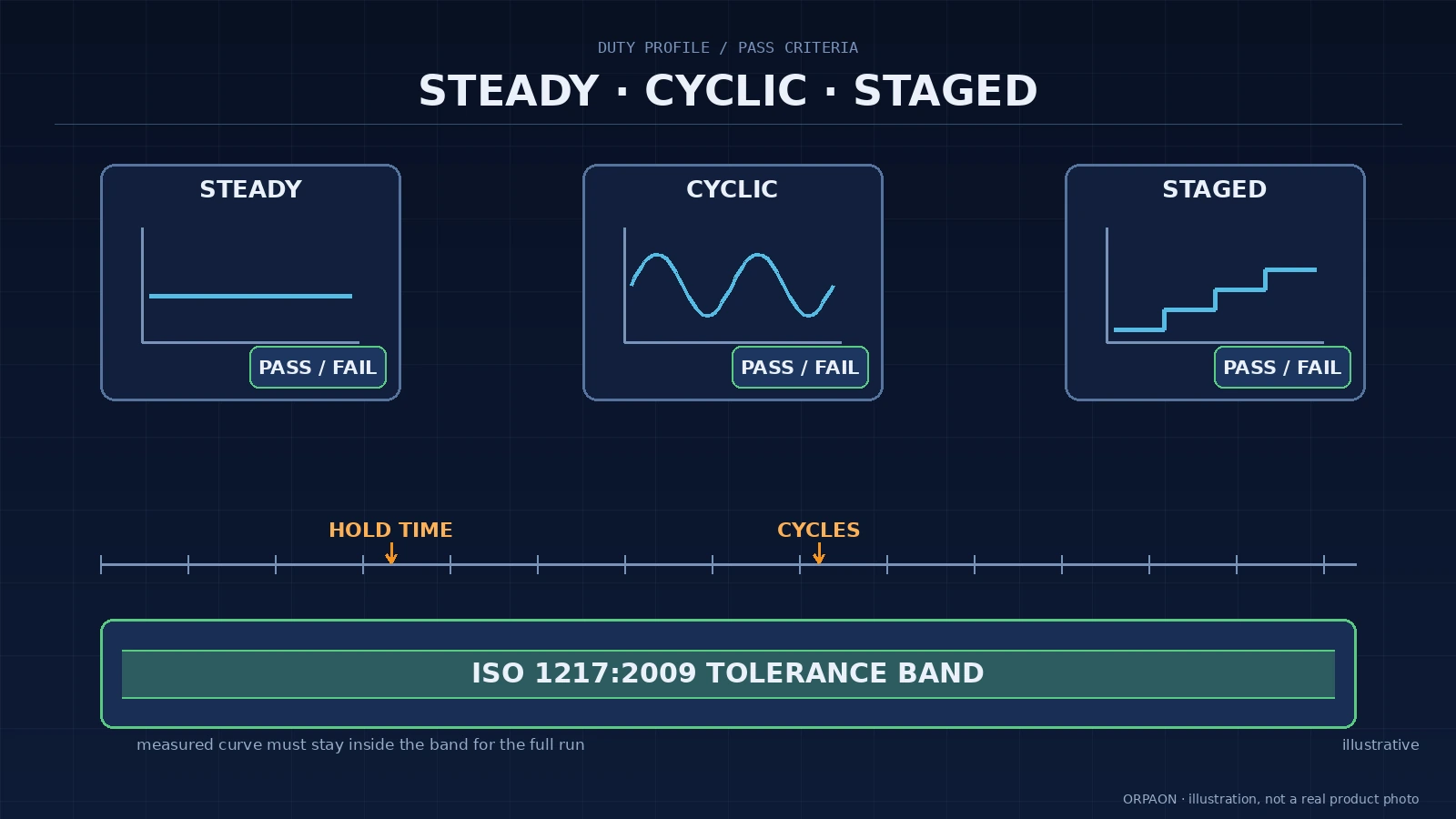
For endurance runs the pass rule must also define how invalid intervals are handled: whether a power outage or an operator error restarts the whole segment or only the remaining part has to be re-run must be fixed in the agreement. Most disputes come from the question of which hours count, not from instrument accuracy itself.
Record layer: raw data that can be traced
The record layer decides whether the test result survives a quality audit. Raw data should be stored in a database and organized by test batch, and reports generated automatically from the raw data with no manual retyping; ISO/IEC 17025:2017 defines requirements for records and data integrity in calibration and testing laboratories and works well as the reference frame for this layer.
| Record checkpoint | Method | Pass criterion |
|---|---|---|
| Raw data on disk | Re-read any test batch | Curves replay with the configured sampling period |
| Automatic reports | Trigger a report for a chosen batch | Report values match the raw data with no manual retyping |
| Calibration linkage | Open the record of a decision tag | The matching calibration certificate is one click away |
| Tamper resistance | Try to edit a closed batch | Closed records reject edits and keep an audit log |
| Storage and retrieval | Search batches three months back by model and date | Results are complete and exportable |
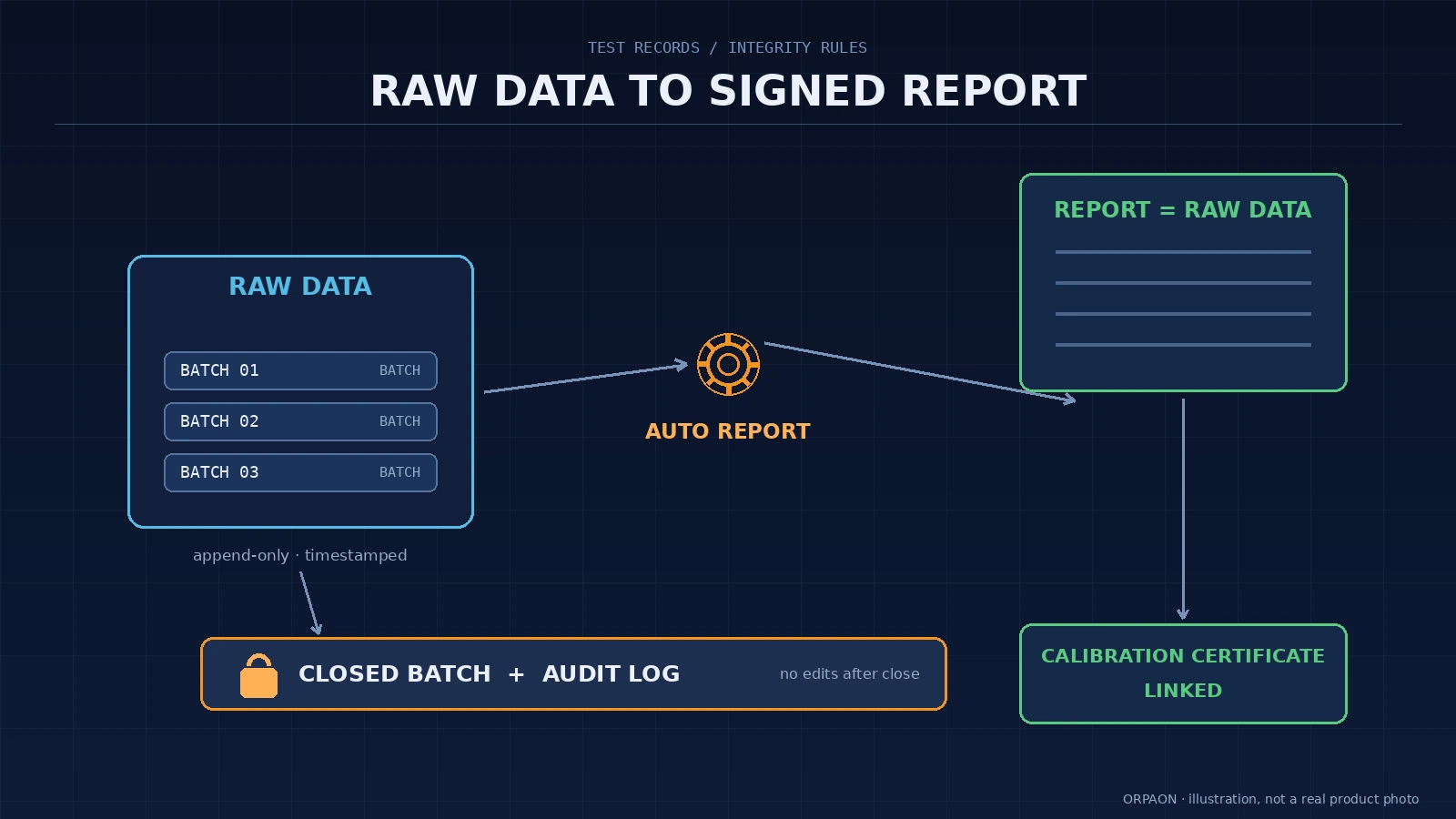
Once all five record criteria pass, acceptance stops being a snapshot of one day and becomes a replayable history. Shanghai OrangeX Intelligent has developed test bench control software since 2009; in 2026 we delivered the supervisory software for an electric compressor endurance test bench overseas, with multi-model recipe switching and dual-channel data recording - historical delivery facts as stated. Benches specified without these criteria usually expose their gaps in a quality audit a year later, at a cost far above fixing the clauses before signature.
Summary
The core of acceptance is one verifiable set of criteria per layer: range and accuracy for measurement, continuity and timestamps for acquisition, duty profiles and pass rules for verdicts, and evidence plus traceability for records. A bench specified this way reaches a single conclusion on commissioning day. If you need acceptance clauses tailored to your unit under test, request an on-site diagnosis - our engineers communicate in English, and we can compare in-house versus outsourced delivery boundaries with you.
Request an on-site diagnosis
Send us the unit under test, the duty profile type and your record requirements, and we will check the four layers item by item and draft the acceptance clauses.
Contact Us