SCADA Acceptance Test Checklist: What FAT and SAT Cover
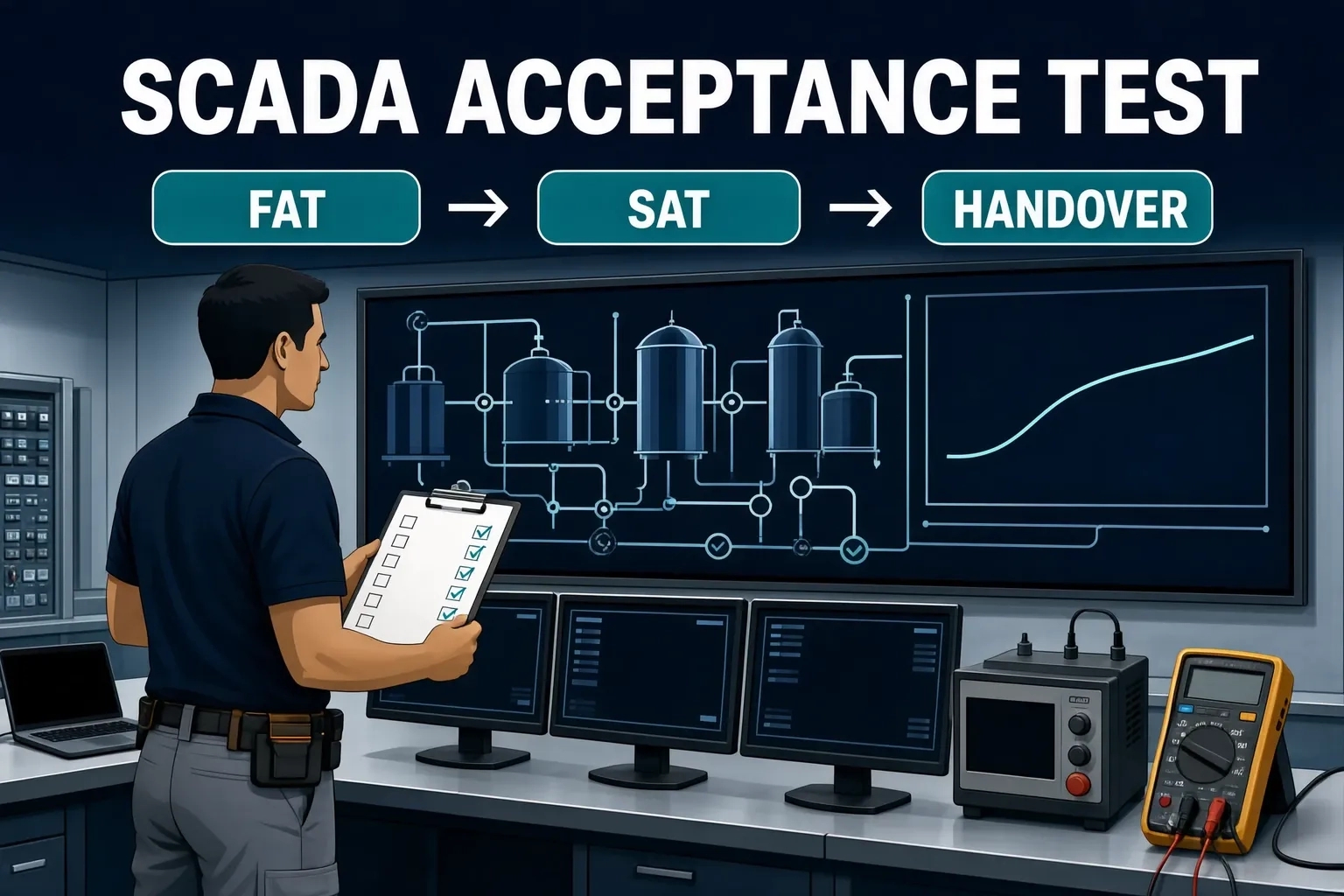
A SCADA acceptance test covers three stages: the factory acceptance test (FAT) confirms that functions and screens match the agreement, the site acceptance test (SAT) confirms that signals, interlocks and operating conditions pass on the real line, and documentation handover confirms the plant can maintain the system afterwards. Turning each stage into a checklist is where every SCADA project should start.
Why SCADA projects stall at acceptance
The usual scene: the screens are built, the demo runs, and then the disagreement starts at acceptance. Some signals were never in the list. Some interlocks nobody dares to trigger on the live line. Operators drown in alarms. Someone asks for a trend from last year and the data was not stored as agreed. The vendor says the functions are delivered; production says the system is not usable; the acceptance sheet stays unsigned.
Most of these disputes are not development problems. Three things were never settled before the project started: whose list defines the acceptance criteria, how much site testing counts as a pass, and what the handover documents must contain. Acceptance is the execution of an agreed standard, not the invention of one on site.
Six items to agree before acceptance
| Item | What to agree |
|---|---|
| Acceptance criteria | List every function with its demonstration method and pass judgment, signed by both parties |
| Signal list | Check every point: tag, range, unit, communication path, consistent with site wiring |
| Alarm policy | Priorities, limits, suppression and archiving, sized to the shift team's real response capacity |
| History data | Retention period, sampling granularity, backup method and query response as acceptance items |
| Operating conditions | Power supply, grounding, network segregation, continuous-run test duration |
| Documentation language | Manuals, screen annotations and training material in the end user's language |
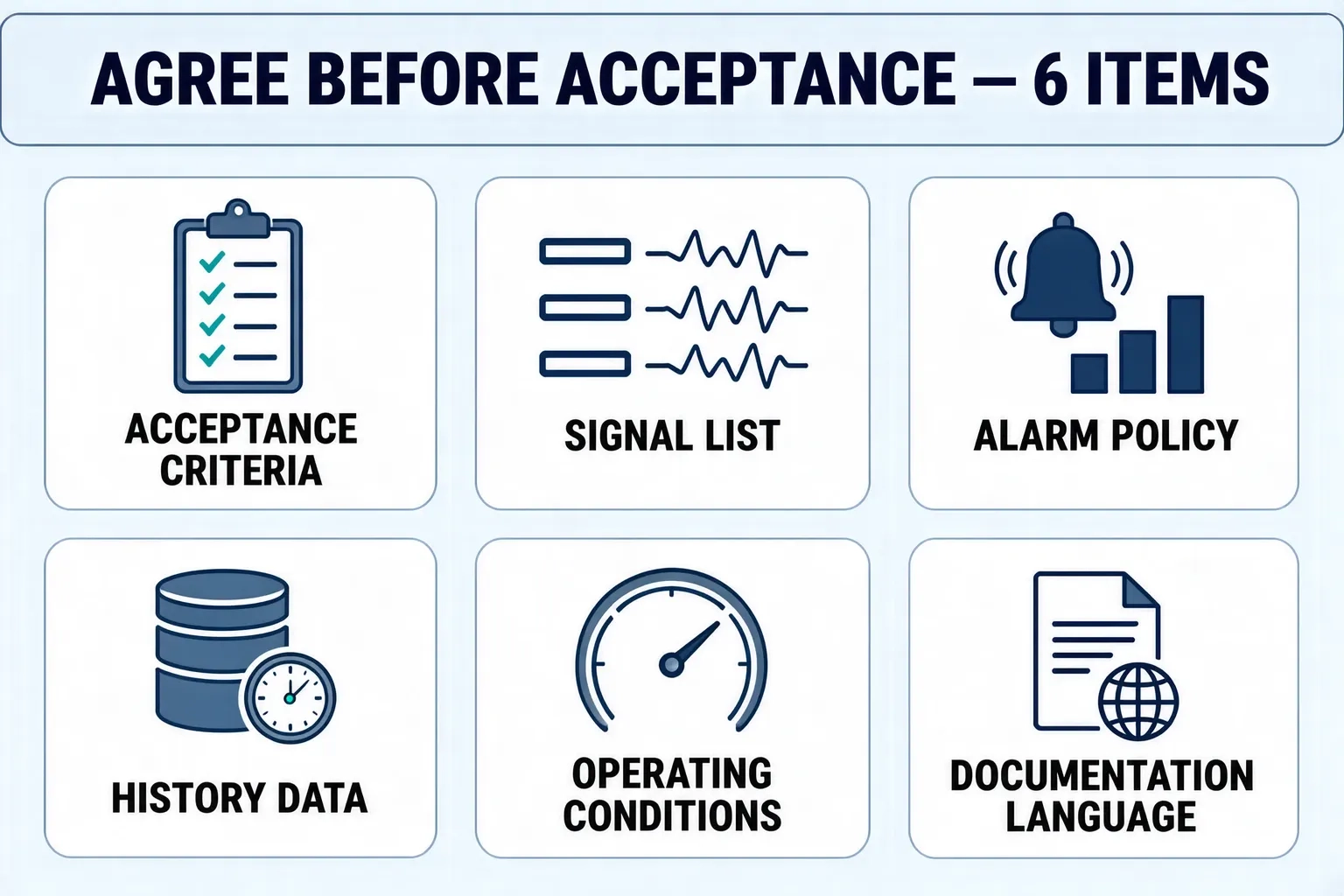
Put these six on paper and FAT and SAT share the same reference; leave any one out and acceptance becomes a negotiation.
FAT: what to rehearse at the vendor's site
The value of FAT is catching problems before shipment. Four items form the backbone of the rehearsal:
- Screen and function demonstration: monitor, control, trends and reports point by point against the signal list, with operators walking the full workflow
- Analog and interlock tests: signals injected at range limits, interlocks and linkage logic triggered one by one with results recorded
- Failure and recovery scenarios: power restart, communication loss and recovery, redundancy switchover, confirming alarm and data backfill behavior
- Performance and permissions: screen refresh and history query response measured at the agreed tag count, user roles checked against the role matrix
Problems found at FAT cost far less to fix than problems found on site; projects without agreed criteria usually need an extra round of negotiation right here.
SAT: what to test on the real line
SAT examines the system under real production conditions, where the environment is no longer controllable. Network and communication must be measured: whether the control network is segregated from the office network as designed, whether collection-server links to PLCs and instruments stay stable under full load, and whether data backfills completely after a disconnection.
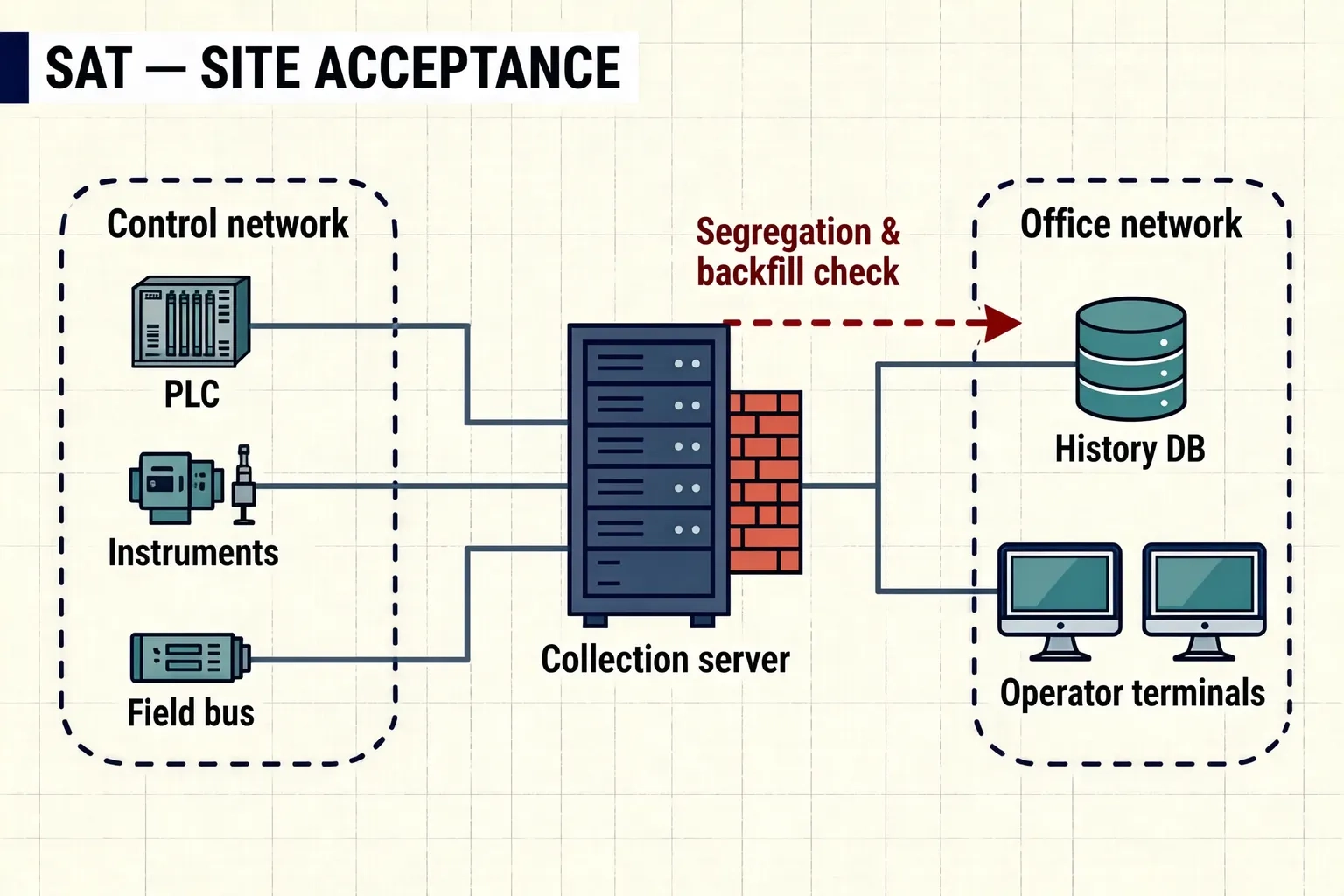
Interaction with real equipment is the other focus: interlocks and linkage logic confirmed one by one in production conditions, history data sampled and compared against the agreed periods, and the continuous-run test observed for alarm and trend behavior over the agreed duration. Only after SAT does the system truly pass to its users.
Documentation and knowledge transfer: acceptance is not complete without it
Plenty of projects are signed off yet cannot be maintained, and the cause is usually the handover. Four items belong in the acceptance documents:
- Final signal list: the as-built tag table with ranges, units and alarm limits, consistent with site wiring
- Operation and maintenance manuals: daily operation, backup and recovery, common fault handling, in the end user's language
- Configuration project and accounts: engineering files, administrator accounts and license transfer method in writing
- Training records: operator and maintenance training completed and signed off
With documents in place, acceptance closes properly and the system enters its maintenance phase supported by files rather than by individual memory.
What Orpaon delivers at the acceptance stage
Shanghai Orpaon has worked in manufacturing digitalization since 2009 with more than 600 project and solution engagements; SCADA configuration engineering, host software and multilingual interfaces are part of its delivered scope. For a European foundry equipment maker, Orpaon delivered a complete SCADA engineering package of 266 monitoring screens shipped with the equipment, with interface language and acceptance templates following the customer's standards. OEM companion delivery like this is exactly where documentation language and acceptance templates are most often overlooked.
- Checklist customization: turning acceptance criteria into signed documents that fit the industry and the line
- Two-stage execution: FAT rehearsal and SAT measurement run separately, exposing problems before shipment
- Multilingual delivery: interface and documents available in Chinese, English, Japanese and more for overseas lines
Conclusion
Acceptance is not the last formality of a SCADA project; it is an agreement that starts at contract stage. Settle the six items first, rehearse functions and failure scenarios at FAT, measure signals, interlocks and continuous operation at SAT, and close the handover with documents and training.
If your plant is planning a SCADA project or stuck at acceptance today, walk this checklist with your vendor item by item: signed criteria, recorded tests, and acceptance turns from a contest into a comparison.
Request a SCADA consultation
Tell us your line scale, signal count and acceptance requirements. We will propose an acceptance checklist and a staged delivery path based on your site conditions, with engineers speaking English.
Contact Us