PV-storage-charging EMS: solar, storage, EV on one platform
An integrated PV-storage-charging site puts rooftop solar, battery storage and EV chargers under one energy management system, so the EMS answers the cross-device questions directly: will daytime generation cover charging, where does night charging come from, and should the battery discharge at peak? In markets where time-of-use tariffs and green-power policies are advancing fast, moving from separate operation to coordinated dispatch is the practical choice for most industrial parks.
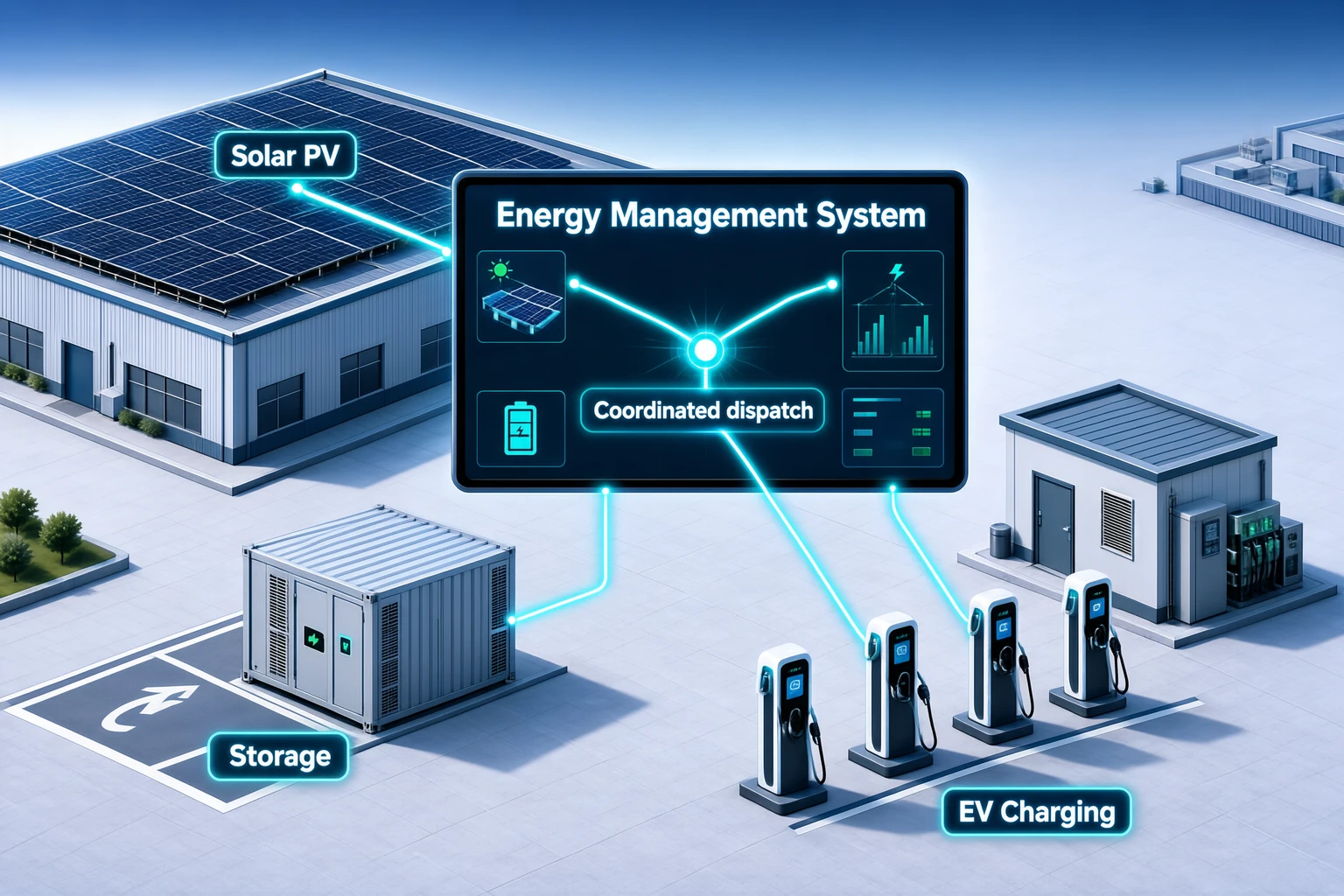
What integrated PV-storage-charging means: one account for generation, storage and consumption
An integrated PV-storage-charging site places rooftop solar, battery storage and EV chargers inside a single energy management framework. The question it answers is not "how does each device run," but the cross-device dispatch questions: will daytime generation cover charging, where does night charging come from, and should the battery discharge at peak?
In markets where time-of-use tariffs and green-power policies advance quickly, moving sites from separate operation to coordinated dispatch has become the practical choice for most industrial parks.
- Solar maximizes on-site generation: rooftop, carport and ground-mounted PV is consumed on site first, cutting grid purchases as output rises
- Storage shifts the timing: surplus solar is stored by day and released to chargers or loads at night, putting the tariff spread and the time gap to work
- Charging makes it visible: green-power charging becomes a selling point that can be explained to drivers and regulators, not a marketing line
Only the three together are "PV-storage-charging"; without the EMS layer that puts them on one account, they remain three separate devices.
What the EMS actually dispatches: the logic of four object types
- The precondition for dispatching all four is connected data: real-time data from PV, storage, chargers and meters must sit on one time-series foundation before cross-device decisions work
- Strategies must be reversible and traceable: why the battery held back by day and charged at night must be answerable from dispatch logs, for regulator audits and internal reviews alike
| Dispatch object | Coordination problem the EMS handles | Typical target strategy |
|---|---|---|
| Solar inverters | Generation forecast, whether surplus is exported, whether local load can absorb output | Self-consumption first, surplus export, anti-backfeed |
| Storage PCS/BMS | Charge and discharge timing, SOC protection, tariff-spread arbitrage | Charge off-peak, discharge at peak, load tracking |
| EV chargers | Whether charging power can be capped, whether time-of-use pricing is offered to drivers | Orderly charging, power allocation under load constraints |
| Plant and campus load | Whether total power exceeds capacity, how demand charges are contained | Demand management, load forecasting and pre-control |
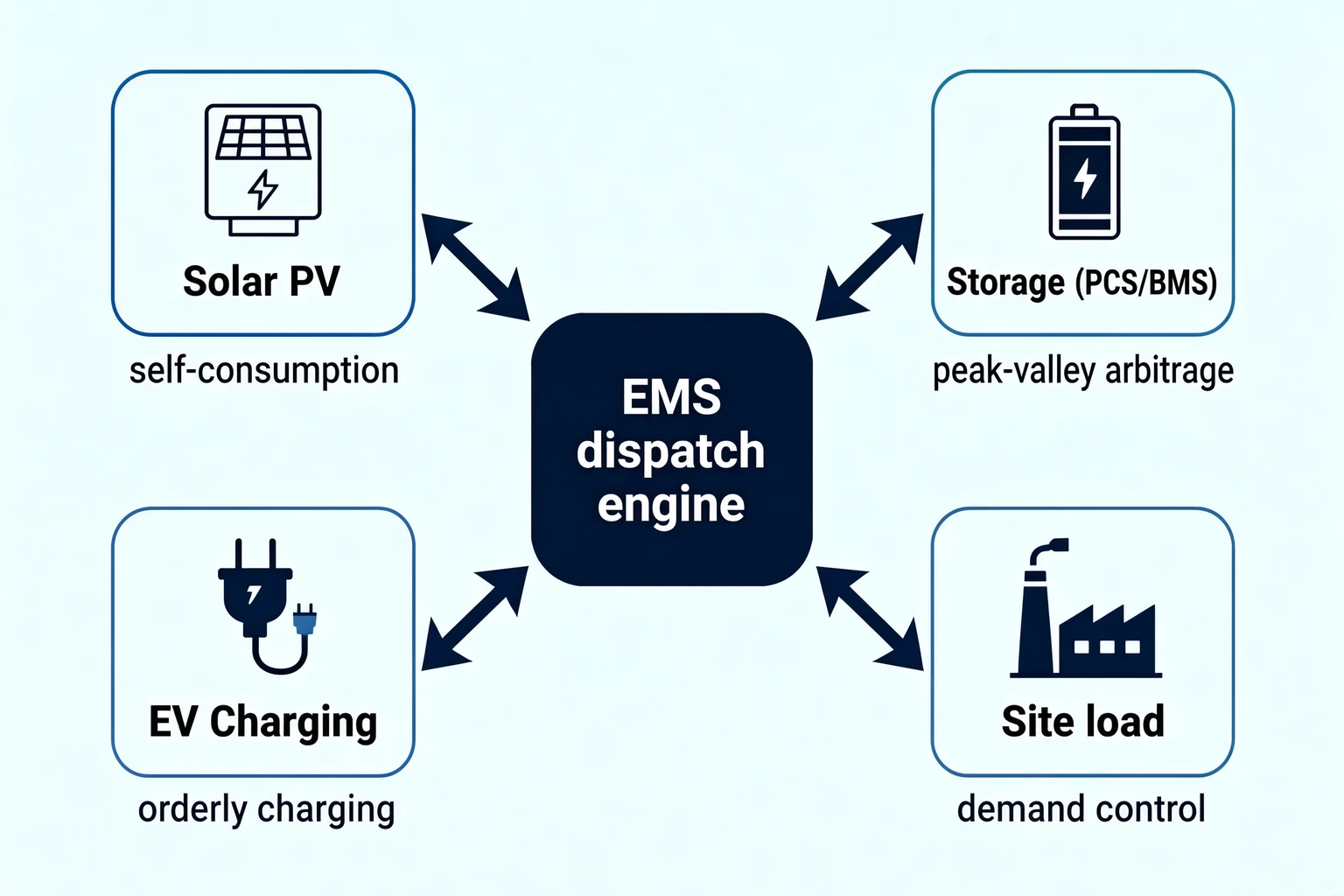
The dispatch objects of a PV-storage-charging EMS are, in essence, four device types driven by three variables: grid tariffs, PV output and the load curve.
The engineering content of a PV-storage-charging EMS lies not in how many devices are connected, but in writing the constraints of all four device types into one dispatch logic that is executable and traceable.
Why a unified platform: what goes wrong with three separate accounts
- Revenue cannot be totaled: self-consumption rate, tariff-spread arbitrage and charging income are booked separately, and no one can answer whether the site actually earns
- Power decisions are guesswork: when chargers surge at rush hour on top of HVAC and production load, transformer overload and higher demand charges surface only on the next electricity bill
- Safety has no interlock: storage alarms and fire response should trigger from one point, but across scattered systems they pass through verbal relays and slow down
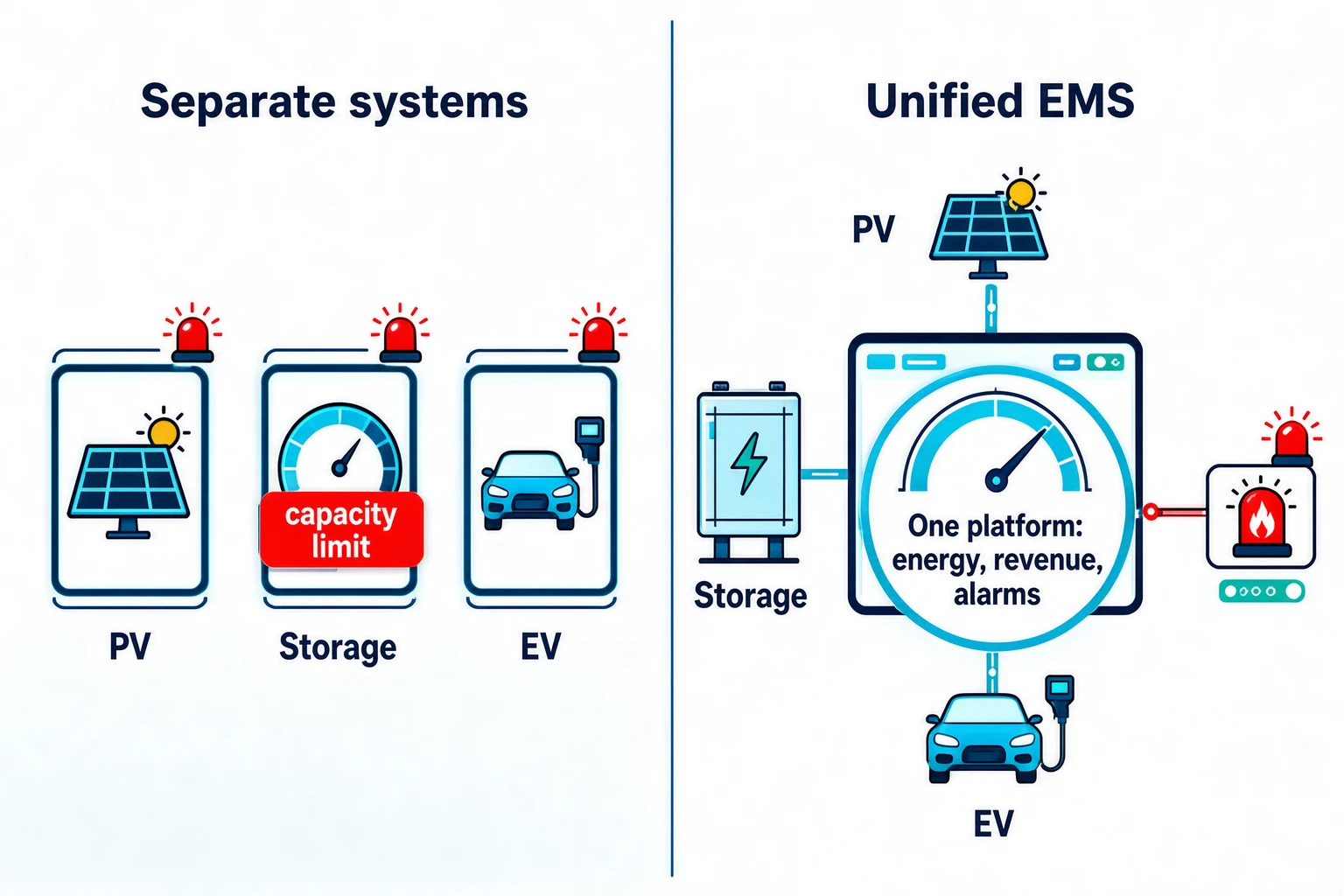
When solar, storage and chargers each run their own management software, the most direct result is that neither revenue nor safety is fully covered.
With the three accounts merged into one EMS, self-consumption, arbitrage and charging income are accounted on one definition, the power ceiling is enforced site-wide, storage alarms interlock with breakers and fire systems on preset logic, and operation shifts from watching single devices to supervising the whole site.
Rollout order: think it through first, then move in three steps
A PV-storage-charging site does not have to be built in one stroke. Phasing by site conditions lowers the initial investment and lets the operations team run the system before expanding it.
- Clarify boundaries and data first — confirm generation and load curves, capacity ceilings and demand-charge structure, and settle metering points and communication protocols upfront
- Connect by phases, revenue and safety in order — start with solar plus storage to establish self-consumption and arbitrage figures, then bring chargers in for orderly charging; the order follows the site's load profile
- Converge reporting and interlocks on one platform — revenue, power and alarms converge on one platform, strategy parameters adjust as tariffs and loads change, and the system evolves with operations
The core of this sequence is "accounts first, devices second, optimization last," which avoids endless cross-checking between three separate device systems.
What ORPAON delivers for PV-storage-charging and microgrid EMS
- Two form factors, on-site and platform: the on-site side carries charge and discharge strategy, SOC guardrails and dispatch logic, while the web side handles multi-site centralized control and revenue reporting
- A wide protocol range: Modbus TCP/RTU, CAN, OPC UA and MQTT are supported, and BMS data integration and power-meter collection have been verified across delivered projects
- Cross-platform client and AI dispatch suggestions: suggestions generated by a large model run in shadow-validation mode and are executed only after human confirmation; this capability is under reserve and pilot, with no delivery commitment
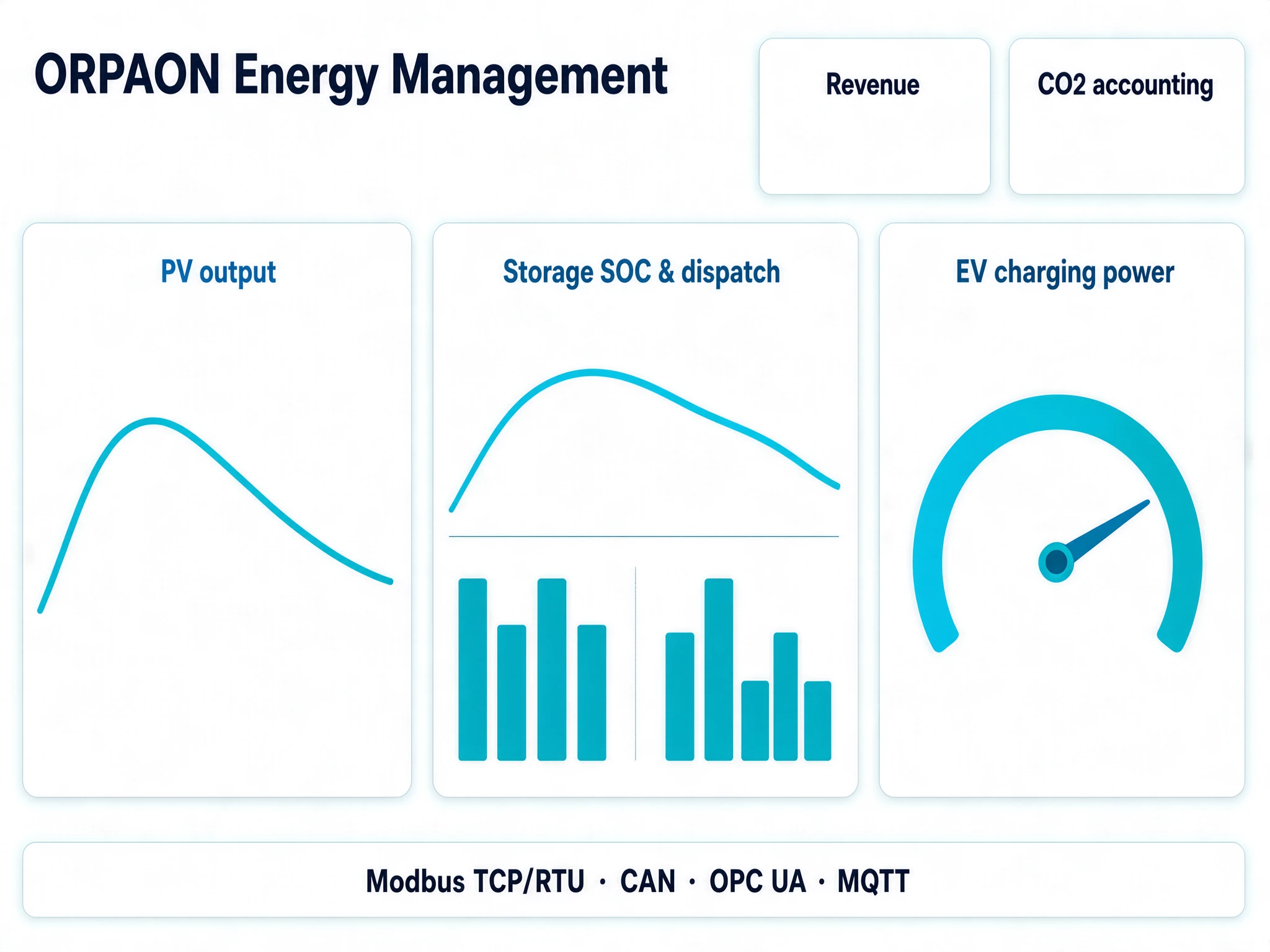
ORPAON (Shanghai Chengxuan Intelligence) has worked on manufacturing digitalization since 2009. Its energy management EMS is a delivered capability, covering sub-metering and benchmarking for plants and buildings as well as monitoring of chilled-water and compressed-air stations, and it provides an energy management platform for integrated solar-plus-storage sites, bringing generation, storage, alarms, revenue and CO2 accounting together on one screen.
Site-level integration for PV-storage-charging and microgrids can be delivered as custom development or solution design; site scope, mounting and equipment lists are fixed per project, and engineering assets can be opened to the customer's operations team on request.
Conclusion
The value of integrated PV-storage-charging lies not in installing solar, storage and chargers side by side, but in the EMS that puts generation, storage and consumption on one account: dispatch objects stated clearly, three accounts reconciled into one, and safety interlocks that do not wait. Only then does a site become one operable whole instead of three devices.
If your plant or campus is evaluating a PV-storage-charging site, or has one commissioned without a unified view of revenue and power, start from the tariff structure, load curve and equipment list: review the current state of accounts, power and safety, then define the EMS integration scope and pace.
Book a PV-storage-charging EMS scoping discussion
Tell us your tariff structure, PV and storage configuration, charger count and existing equipment list; an English-speaking engineer will propose the EMS integration scope and a phased plan.
Contact Us