Pump station telemetry: signal list and selection checks
A pump station telemetry system is the combined hardware and software that continuously acquires level, flow, pressure and equipment-status signals at a pump station, buffers them locally during outages and transfers them to a remote monitoring center for dispatch and maintenance use. For drainage and water utilities it determines whether unattended operation is dependable, anomalies are caught in time, and historical records can support audits. This article explains the typical architecture, the signal list and the selection checks in three parts.
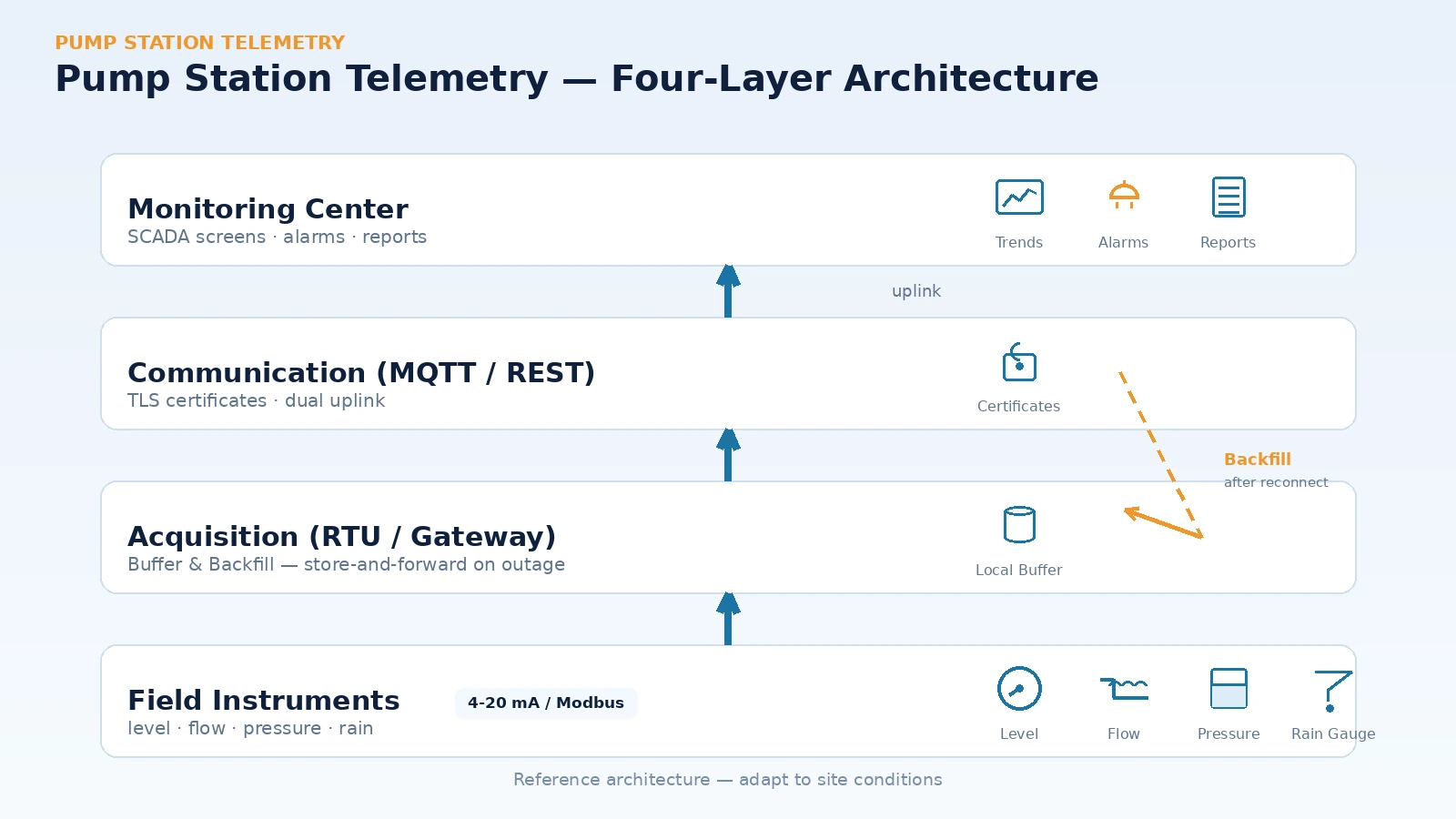
Telemetry system structure: from field instruments to the monitoring center
A pump station telemetry system capable of supporting unattended operation is usually organized in four layers: field instruments, acquisition and control, communication and transport, and monitoring applications. Field instruments provide raw level, flow and pressure measurements; the acquisition layer polls and scales them through an RTU or industrial gateway with local buffering; the transport layer returns data over carrier networks or dedicated lines; the application layer handles screens, alarms, reports and history storage.
- Field instruments: level sensors, flow meters, pressure transmitters, rain gauges — they set the source quality of all data
- Acquisition and control: an RTU or industrial gateway polls instruments on a cycle, buffers data during outages and backfills after recovery
- Communication and transport: 4G/5G APN private networks or wired broadband, MQTT/REST dual channels to the cloud with certificate authentication
- Monitoring applications: remote screens, alarm push, trend curves, report export and permission audit
Clear responsibilities per layer are what make the next station replicable from a template. Buffered backfill at the acquisition layer and certificate authentication at the transport layer are the two items most often missing from contracts — confirm each one during the requirements stage.
The signal list: work through one category at a time
The scale of a telemetry system is decided by its signal list. The method is to divide the station into process zones, list measurement, status and control points zone by zone, and fix the range, sampling period and alarm threshold for every point. The table below shows common signal categories in sewage and stormwater pump stations with typical pitfalls:
| Signal category | Typical points | Common gaps |
|---|---|---|
| Level and flow | wet-well level, main-pipe flow, overflow level | range and dead band undefined, output oscillates at low level |
| Equipment status | pump run/fault, gate position, screen status | only one fault signal wired, manual/auto state missing |
| Environment and safety | hydrogen sulfide concentration, toxic gas in wet wells, fire signals | no clause on gas detector calibration intervals |
| Power parameters | incoming current and voltage, pump consumption, switchgear temperature | only the main meter is read, submetering absent |
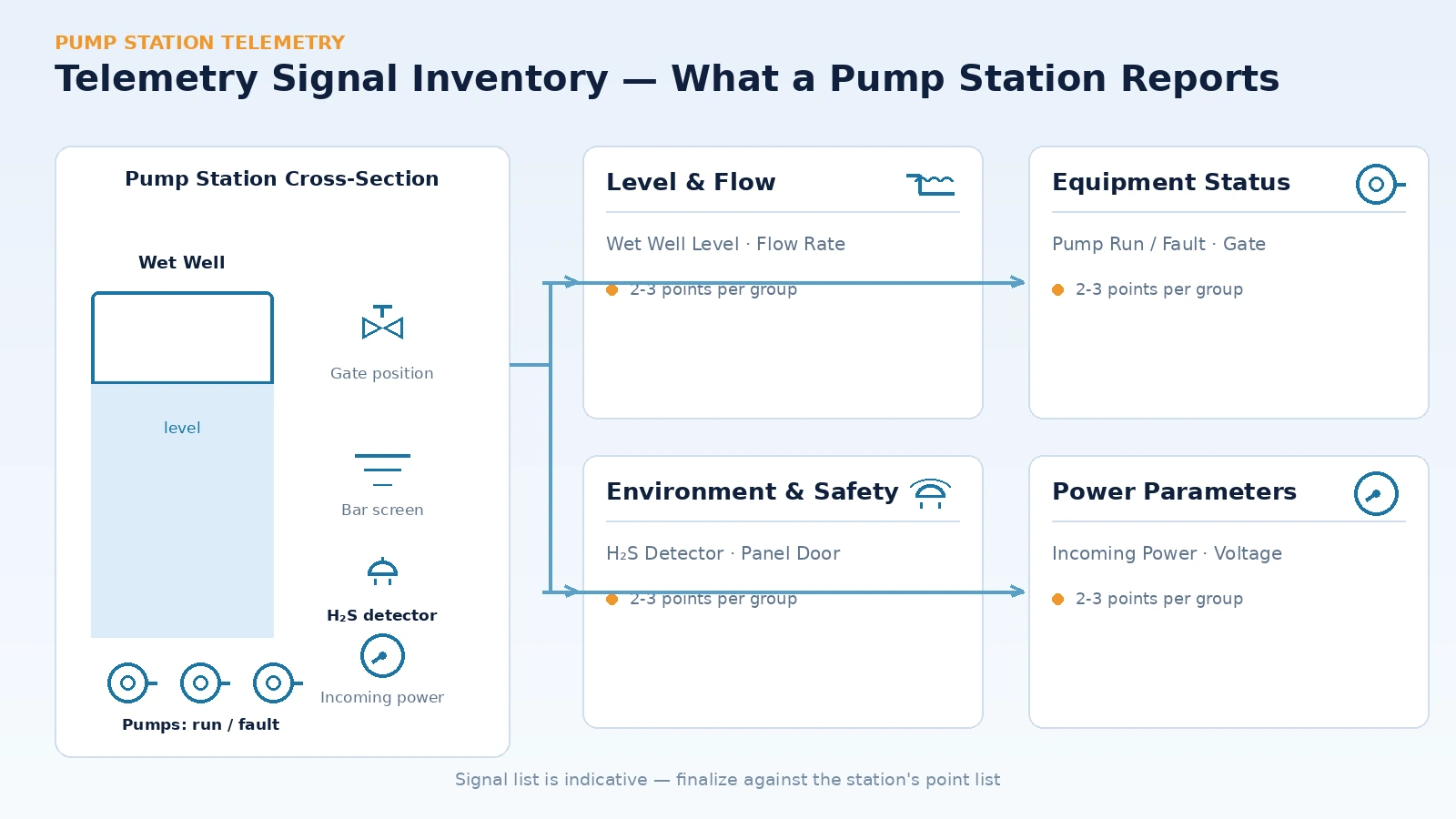
After the list is complete, run one verification pass: every instrument and status point on site must map to a unique number, range and threshold in the point table, with alarm levels and notification paths matched line by line. This table then serves as both the quotation basis and the acceptance basis — when both sides share one version, disputes naturally decrease.
Selection checks: confirm four items before deciding
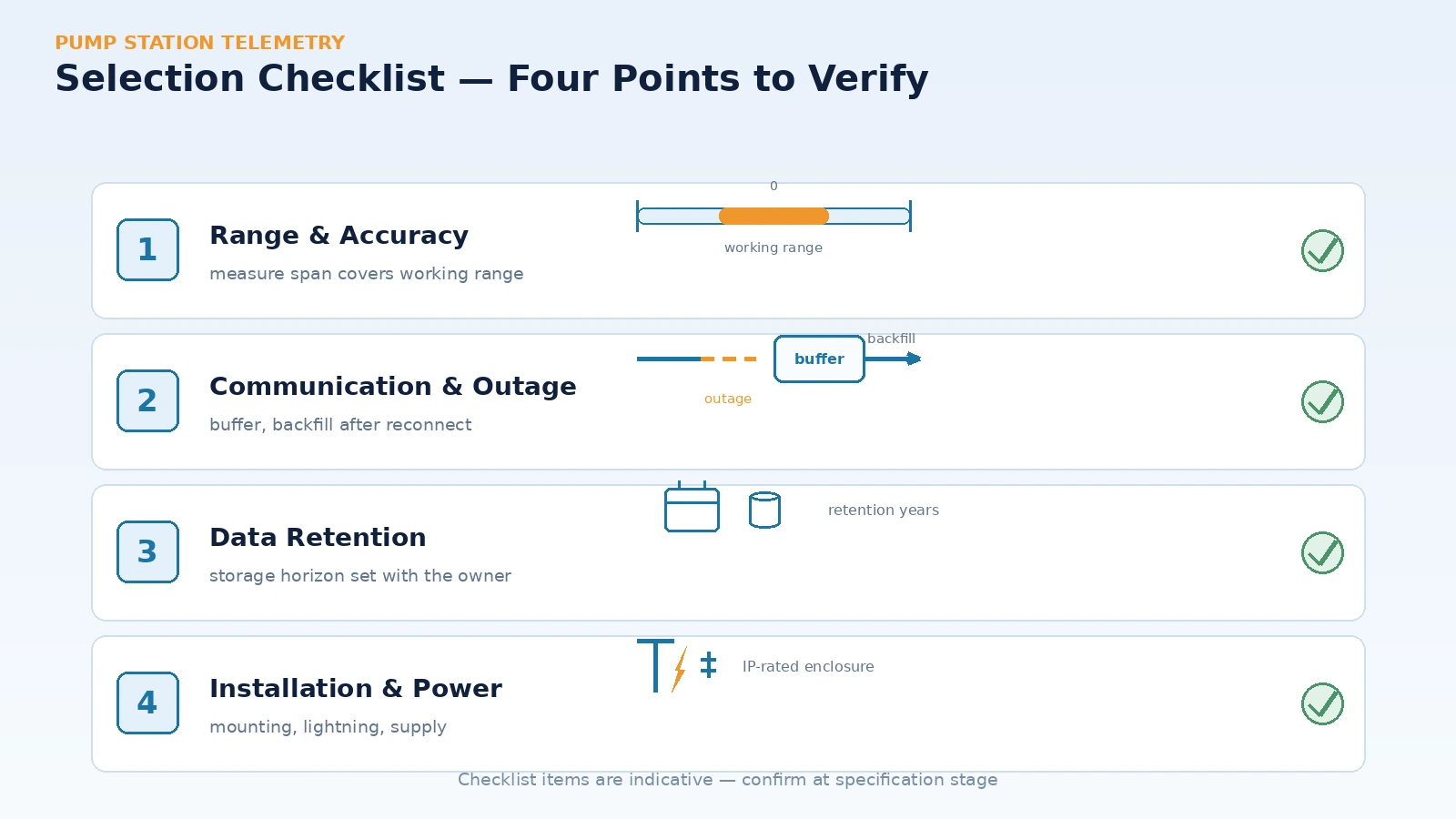
Working through four checks before procurement removes most late-stage disputes. Each one should be written into the technical agreement together with its acceptance method:
| Check item | What to confirm | Acceptance method |
|---|---|---|
| Range and accuracy | instrument ranges cover the operating window; dead band and accuracy class stated | compare readings against measured operating points |
| Communication and outage | channel type, cloud protocol, buffer duration and backfill behavior | cut and restore the link on site, then verify backfilled data completeness |
| Data storage | retention years, export formats and archiving method | export an arbitrary date and verify the trend curves |
| Installation and power | instrument locations, power supply and lightning protection, hazardous-area requirements | confirm point by point on site against the installation list |
Beyond the four checks, confirm the vendor's expansion path: whether a new station can be replicated from a template, whether address-map planning is documented, and whether platform interfaces are open. ORPAON (Shanghai Chengxuan Intelligence) has worked in industrial data acquisition and monitoring software since 2009. In 2026 it completed on-site delivery of pump-station IoT gateway access, Modbus TCP data acquisition, MQTT cloud transfer and address-map planning for a multi-city water utility, and maintains engineering assets such as a single-station unit-control template, a multi-station SCADA project template and certificate-based MQTT/REST dual-channel cloud transfer — a fit for the replicate-after-acceptance path for distributed pump stations.
A joint test with all vendors is also worth scheduling: instruments, gateway and platform engineers run one on-site integration test, proving the full path from instrument reading to platform screen before mass installation. Stations replicated after the path is proven tend to show acceptance issues in installation workmanship rather than in the data itself.
Summary
The value of a pump station telemetry system lies not in the number of devices but in the completeness of the signal list and the trustworthiness of the data path. Confirming range definitions, outage backfill, retention years and installation conditions in the agreement — each with an acceptance method — gives unattended operation, anomaly detection and audits a factual basis afterwards. For utilities with many distributed stations, accepting one station's template first and then replicating it remains the most controllable way forward.
Request an on-site diagnosis
Evaluating pump station telemetry and remote monitoring? Submit your station count, existing instruments and communication conditions, and our engineers — with an English-speaking contact — will propose a signal list and a build path matched to your site.
Contact Us