Remote Equipment Service for OEMs After Shipment
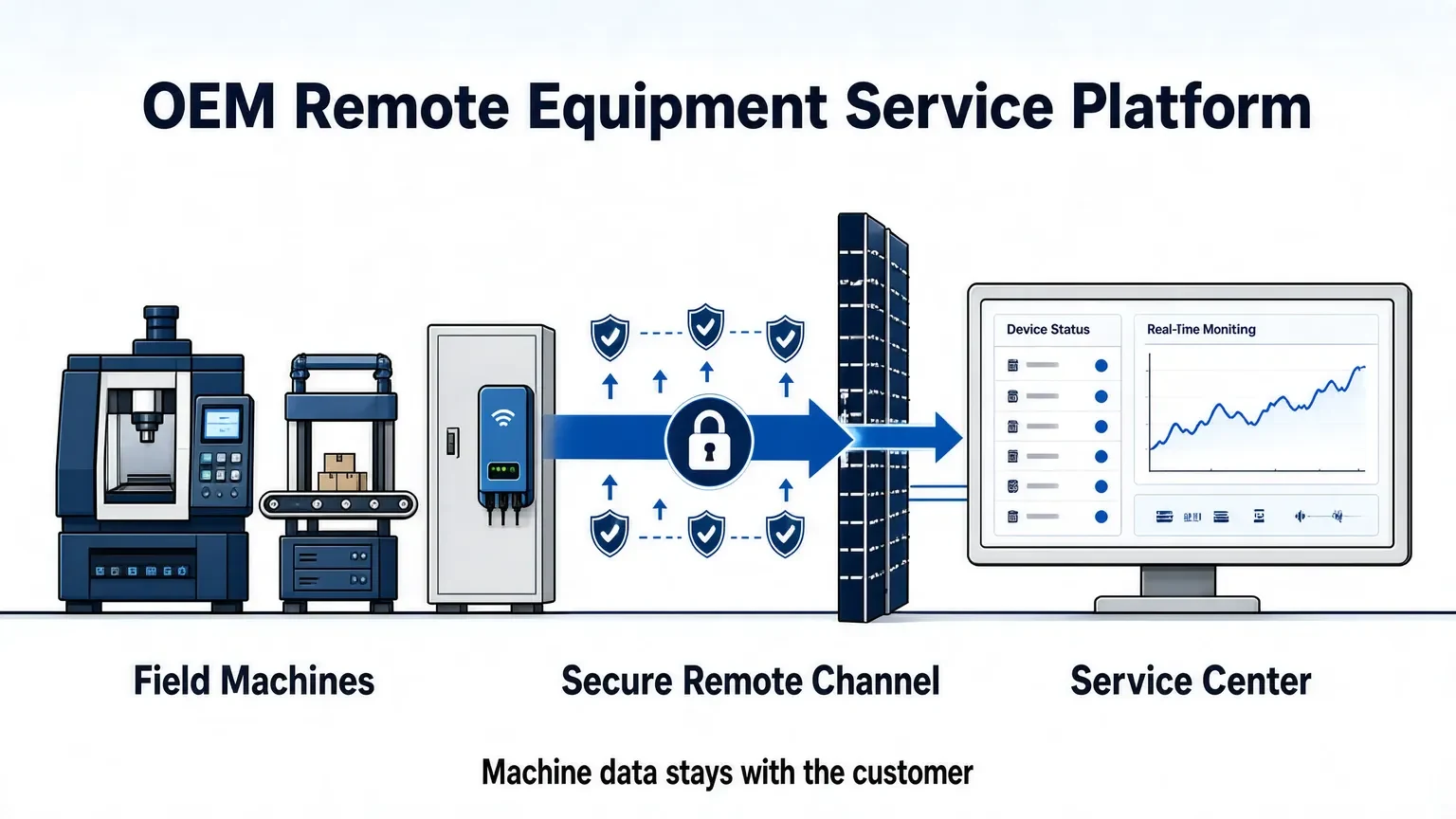
Remote equipment service for OEMs starts with four decisions: what to connect, how to keep the connection secure, who can see the data and when, and how far a site visit must go. Design the machine-side connectivity, the communication channel, the service platform and the data rules together, and an equipment builder can support machines after they ship.
Why service gets harder once machines leave the factory
Machines sit on the customer's site, and the builder's engineers cannot see their condition. When a fault occurs, the usual sequence is a phone call, a dispatched engineer, a discovery on site that a different program version or parameter is needed, and a second trip. The root cause is not the skill of the engineers: there is no continuously available information path between the builder and the installed machines.
Remote service is not the same as unattended operation. Its role is to make the machine's state and last change checkable at any time; the diagnosis still belongs to an engineer.
Three ways to establish the remote service channel
The channel depends on the site network and the customer's compliance rules. Three approaches are common, and they can be combined.
- Leased line or fixed public address: suitable where customer IT allows a fixed egress, but it requires changes on the customer network side
- Cellular 4G/5G channel: common when machines are dispersed or the customer network is closed; it works once the machine is installed
- Secure tunnel with reverse gateway dial-in: the on-site gateway initiates an encrypted connection, so no inbound port is opened and link drops do not affect the customer network
All three require one rule: the machine side opens only the necessary service ports, and every access by an engineer is logged.
What the platform side has to provide
The machine side answers "can it be reached", the platform answers "can it be managed and traced". A usable platform is usually organized in three layers.
| Layer | Functions it carries | Typical form |
|---|---|---|
| Communication | Protocol adaptation and data forwarding, store-and-forward, online status | Gateway or edge software |
| Application | Live and historical trends, alarm notification, service work orders | Server platform and clients |
| Service | Remote program upload, screen mirroring, parameter read and write | Platform modules and tools |
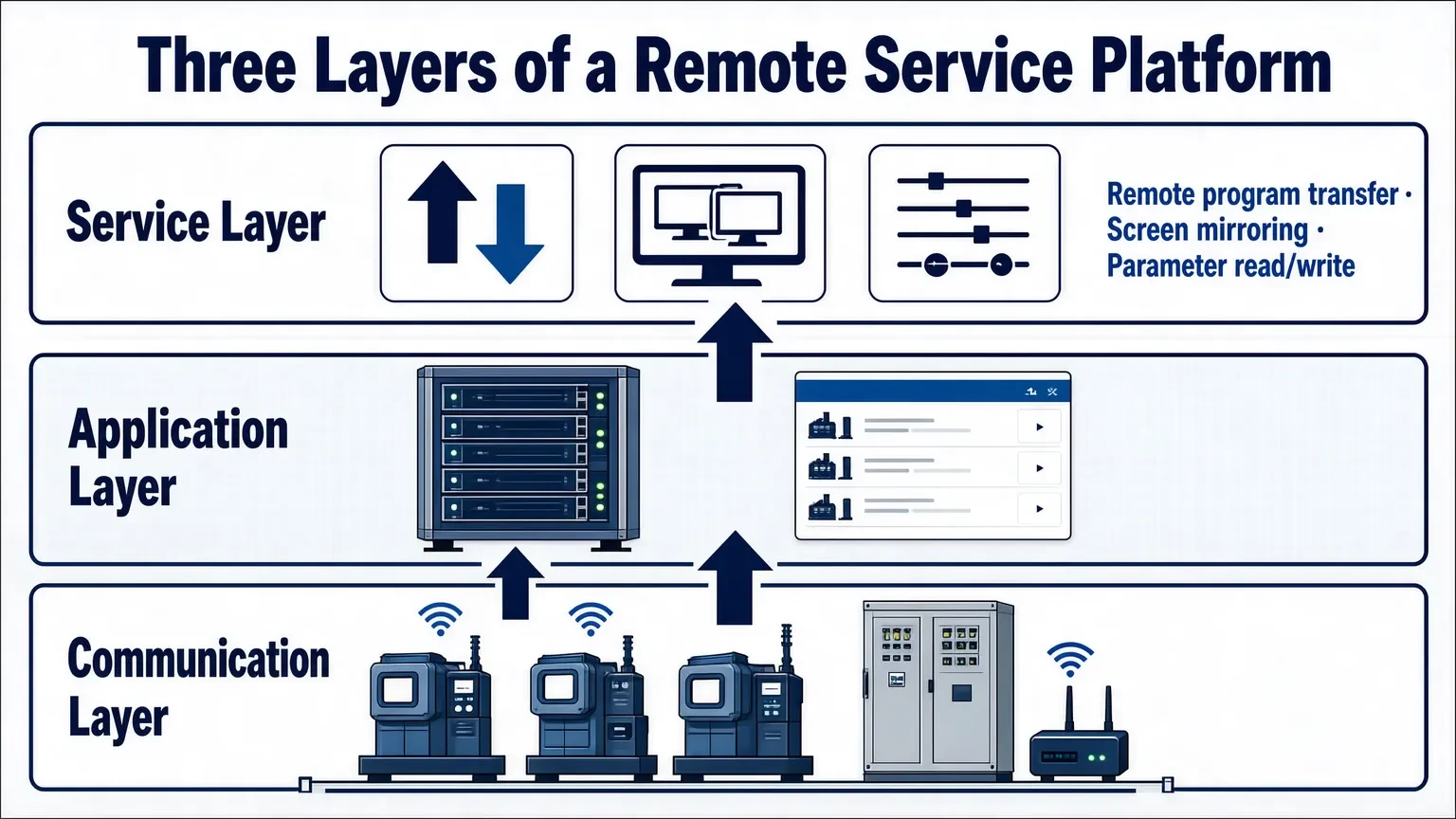
Only with all three layers does an alarm become a work order, and a work order a service record that can be reviewed later.
Who owns the data and who can see it
This is what customers care about most when they evaluate a remote service plan, and it belongs in the contract rather than in implementation.
- Data ownership: on-site process data follows the contract, commonly owned by the customer, with the builder granted use rights for service
- Tenant separation: when a builder serves several customers, the platform separates data and accounts per tenant
- Permission levels: connection and parameter changes are authorized by role, with read-only, download and edit rights set apart
- Operation logging: login, connection setup and every change are recorded with time, account and content
For the customer, being auditable matters more than having more features.
From alarm to resolution
Once the channel and the platform are in place, what decides service efficiency is whether the handling rules are clear.
- When an alarm fires, the platform notifies both sides together with the operating data at that moment
- The engineer reviews live and historical trends to judge whether this is a process fluctuation or a machine fault
- What can be solved remotely is handled and logged; what needs a visit starts with a clear diagnosis
- After the work, the action and reset time are recorded into the machine's service file
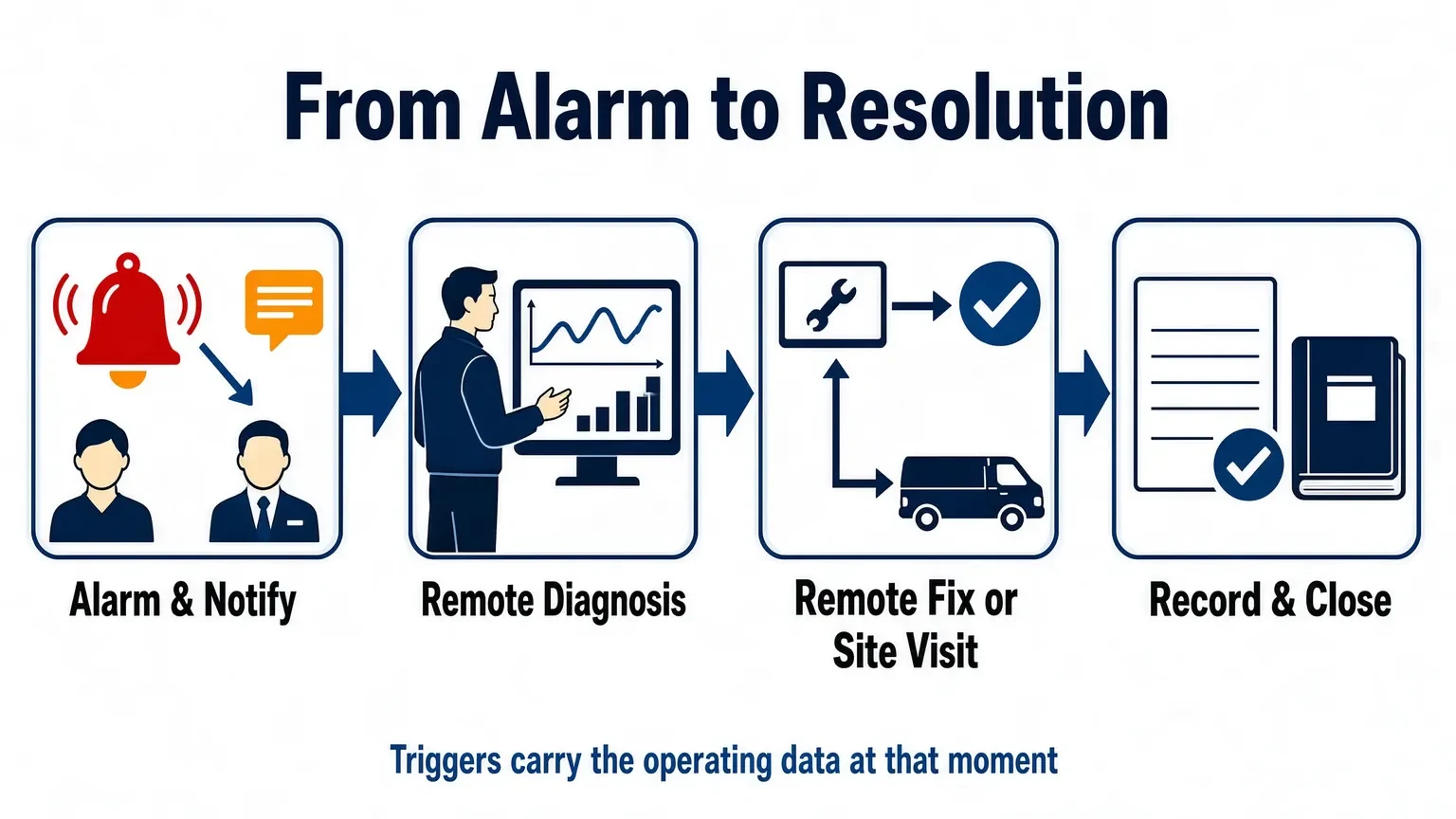
Done this way, "most issues do not need a site visit" is an outcome rather than a slogan.
Rollout order: start with a pilot model
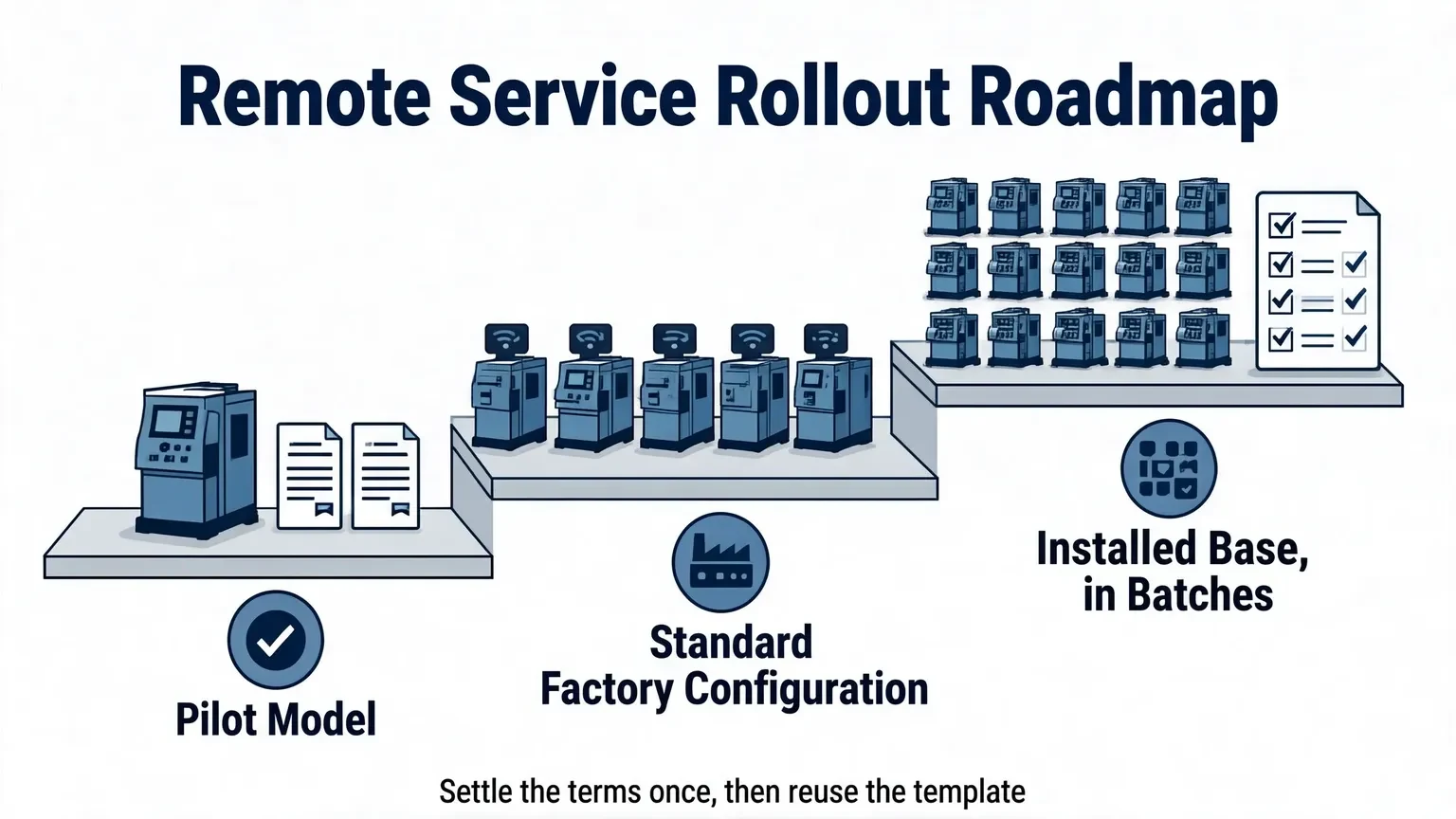
Connecting every model and customer at once usually stalls on permissions and retrofits. A steadier order is: pick one or two customers and one mature model as a pilot, settle the channel, the ownership clauses and the rules in one pass, make remote service standard on new machines, then review the installed base and connect it in batches.
Talking through the terms with each customer usually takes longer than the software work, so fixing the templates early saves repeated effort.
Information to confirm before implementation
Clear these before design starts: the controller and communication conditions of current models, the connectivity already present or possible, the customer's requirements on the channel and data retention, the list of actions to be performed remotely, and who handles installation and ongoing maintenance.
Shanghai Chengxuan Intelligent has worked in industrial software and equipment connectivity since 2009, and can confirm channel options and platform scope with the builder according to machine models and customer conditions.
Summary
The value of OEM remote equipment service is not how many machines can be reached remotely, but whether the service process can be traced and the customer is comfortable keeping the channel open. Set the channel options and security boundaries, complete the platform across three layers, fix the ownership and permission rules in the contract, and roll out model by model.
Request a solution discussion
If your machines are already shipped in volume and after-sales travel costs keep rising, share your model list and site network conditions, and we will suggest a channel and platform scope for the actual situation.
Contact Us