Line-side Material Call System: Call, Kitting and Timing
A line-side material call system turns a material need into a timed, traceable call: an operator calls from the station, the kitting team accepts it and delivers against a board, and line-side stock is reconciled on sign-off. It is not about making someone walk faster, but about letting demand reach the delivery team instead of being found on a patrol route.
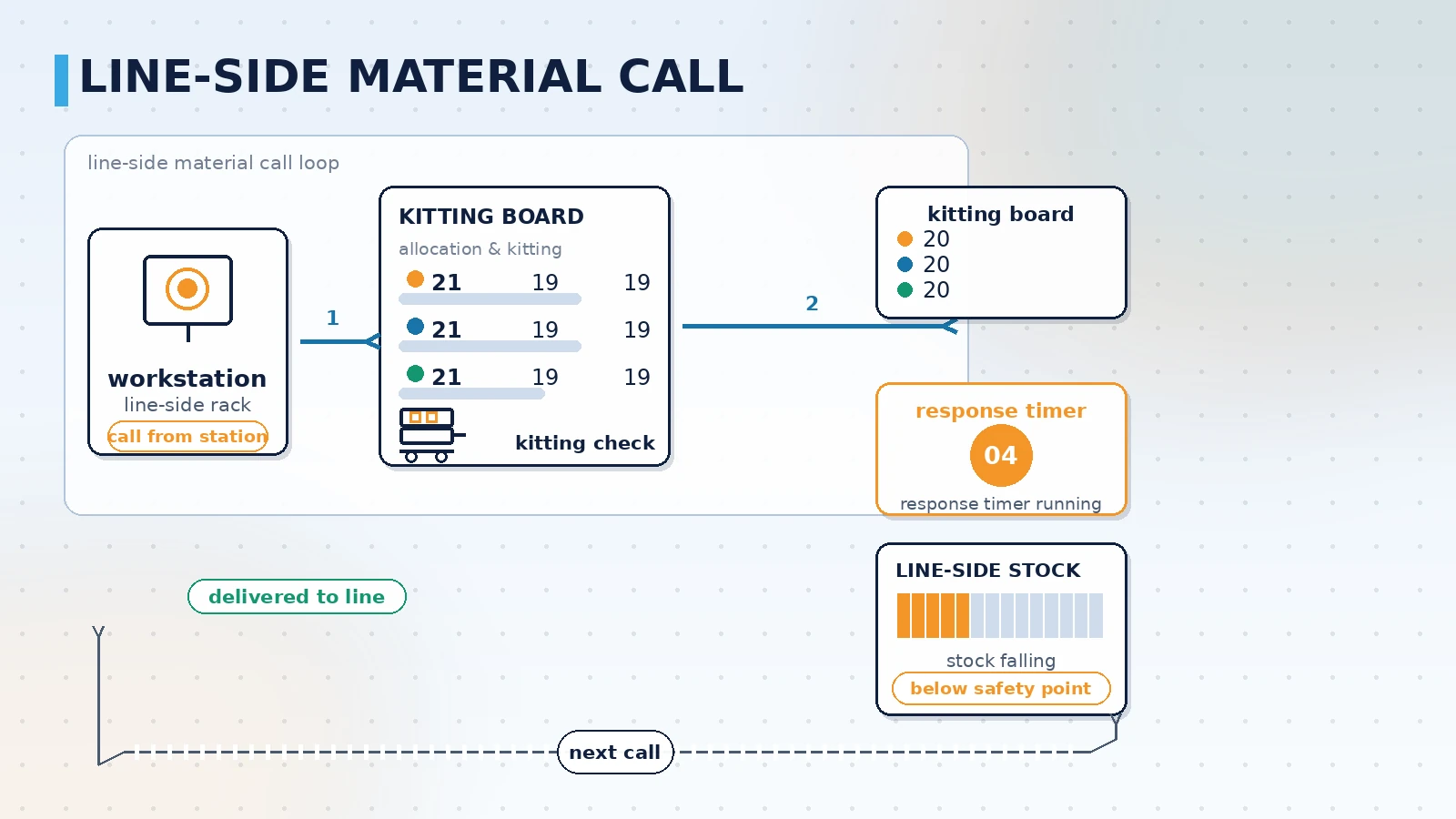
Why lines still run out: two ways of replenishing
A line usually runs out of material not because the warehouse is empty, but because nobody knows when the need appears. The common approach is route-based feeding: the kitting team walks a fixed round, or a line operator notices a bin running low and phones for a refill. Both depend on somebody noticing, and as takt speeds up and product changeovers multiply, the moment of noticing drifts later until it surfaces as a line stop.
Call-based replenishment reverses the direction. Instead of the delivery team searching for demand, the station raises a call when consumption reaches a set point, and that demand appears directly on the kitting board. The delivery team works the queue in order and every call and delivery carries a timestamp. The real difference is not the software — it is whether demand is patrolled downwards or raised upwards.
Table: route-based feeding versus call-based replenishment
| Item | Route-based feeding | Call-based replenishment |
|---|---|---|
| Demand detection | Delivery team patrols a route, or an operator phones | Station raises a call that lands on the kitting board |
| Queue order | Route order, so urgent items can be pushed back | Call time and priority decide the order |
| Process record | Mostly verbal handover, no delivery time | Call, acceptance, delivery and sign-off each carry a time |
| Line-side stock | Overstocked to avoid stopping the line, occupying floor space | Replenished to actual consumption, stock verifiable |
| Basis for improvement | Shortage causes recalled from memory | Calls and responses counted by station, shift and part |
The most telling row is the process record. Without one, line-side stock can only be protected by carrying more, and carrying more occupies line-side space while hiding the real consumption rhythm.
The five stages of one call
The value of a call system is not the button but whether the flow after the call is completed. Split that flow apart and one call normally has five stages, and each stage should have a named owner and a time point.
- Call raised: the station raises demand from a call button, tablet or handheld, carrying the part number and required quantity; a repeat call for the same part within a short window should be recognised as a duplicate so the board is not flooded.
- Acceptance: the kitting team accepts on the delivery board; acceptance marks the start of the response, and unaccepted calls sort by waiting time or trigger a reminder when a limit is exceeded.
- Picking and kitting: parts are picked against the kitting check, which can stop a shortage here — if a batch is incomplete, complete it before dispatch instead of discovering the missing piece at the station.
- Delivery: the driver confirms delivery on a handheld or line board and the time is recorded, so the station can see the material is on its way and does not call again.
- Sign-off and deduction: line-side staff sign off, line-side stock is deducted, and stock below the safety point raises the next call, closing a consumption-driven replenishment loop.
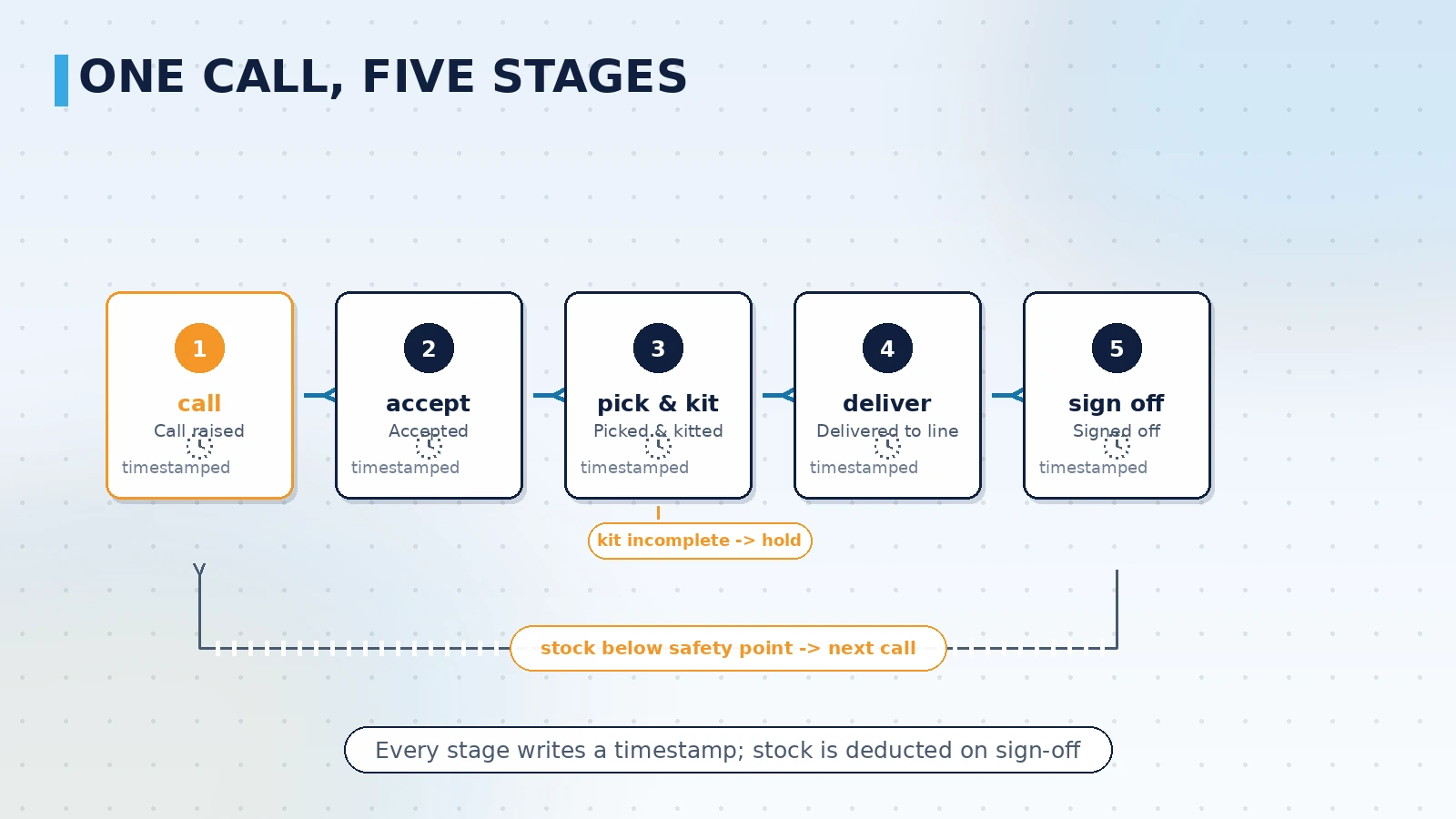
The stage most often skipped is sign-off and deduction. If sign-off never reaches the system, the line-side stock figure drifts away from reality and the kitting check loses its basis.
Four settings that decide whether the system lasts
Wiring a call button is easy; keeping the kitting team using it is not. If the following four settings are left vague, the site tends to fall back to phoning for material within a few months.
- Bind each call to a part and a station, not to one generic signal: a generic signal only says "someone called" — with part and station attached, the picking team no longer has to phone back to ask what is needed.
- Set the response limit per material type: heavy parts needing a forklift or AGV and small parts that a driver can carry should not share one response limit, or the two kinds of delivery crowd each other out.
- Attach acceptance and delivery to roles, not to people: naming the kitting team and the line-side leader as the responsible roles keeps the flow intact through shift rotation and leave.
- Link line-side stock and the kitting check to the call: deduction, kitting judgement and the next call trigger belong to one logic, which is what makes the stock figure meaningful and usable as a pull signal.
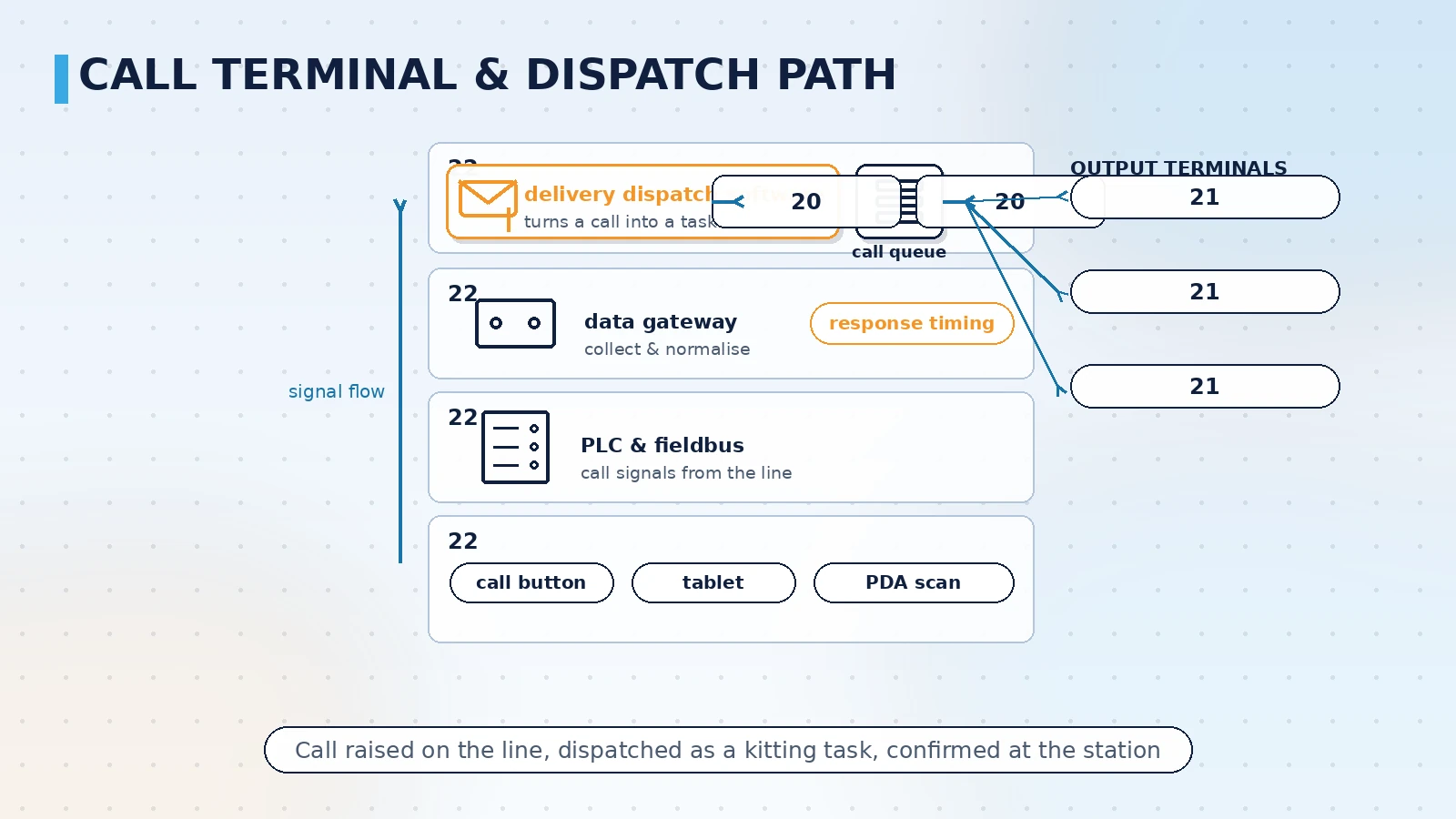
The fourth setting demands the most preparation. It requires line-side stock to be data connected to calls, delivery and kitting judgement rather than a separate ledger. A common arrangement is to bring call terminals in through the PLC or fieldbus to a data gateway, then let the delivery dispatch software own the call queue and push it to boards and handhelds; parts below their safety point enter the next call queue automatically. Replenishment is then driven by consumption, and the kitting team works a sorted queue instead of constant interruptions.
Acceptance: run the whole delivery path before handover
Before go-live, it is worth running the entire delivery path once under real or simulated conditions, so that the system and the actual crew split agree.
- Call and notification: after a station raises a call, do the kitting board and handhelds receive it within the set time, with the part and station details intact?
- Response timing: are acceptance and delivery times recorded automatically, and can response time be queried by station and part instead of relying on manual entry?
- Stock reconciliation: after sign-off and deduction, does the line-side stock figure match reality, and does stock below the safety point raise the next call?
- Kitting check: when a batch is incomplete, does the system stop it at picking and flag the missing part, instead of leaving it to be found at the station?
- Multi-terminal sync: do the delivery board, line board and handheld show the same status for one call, so two places do not disagree?
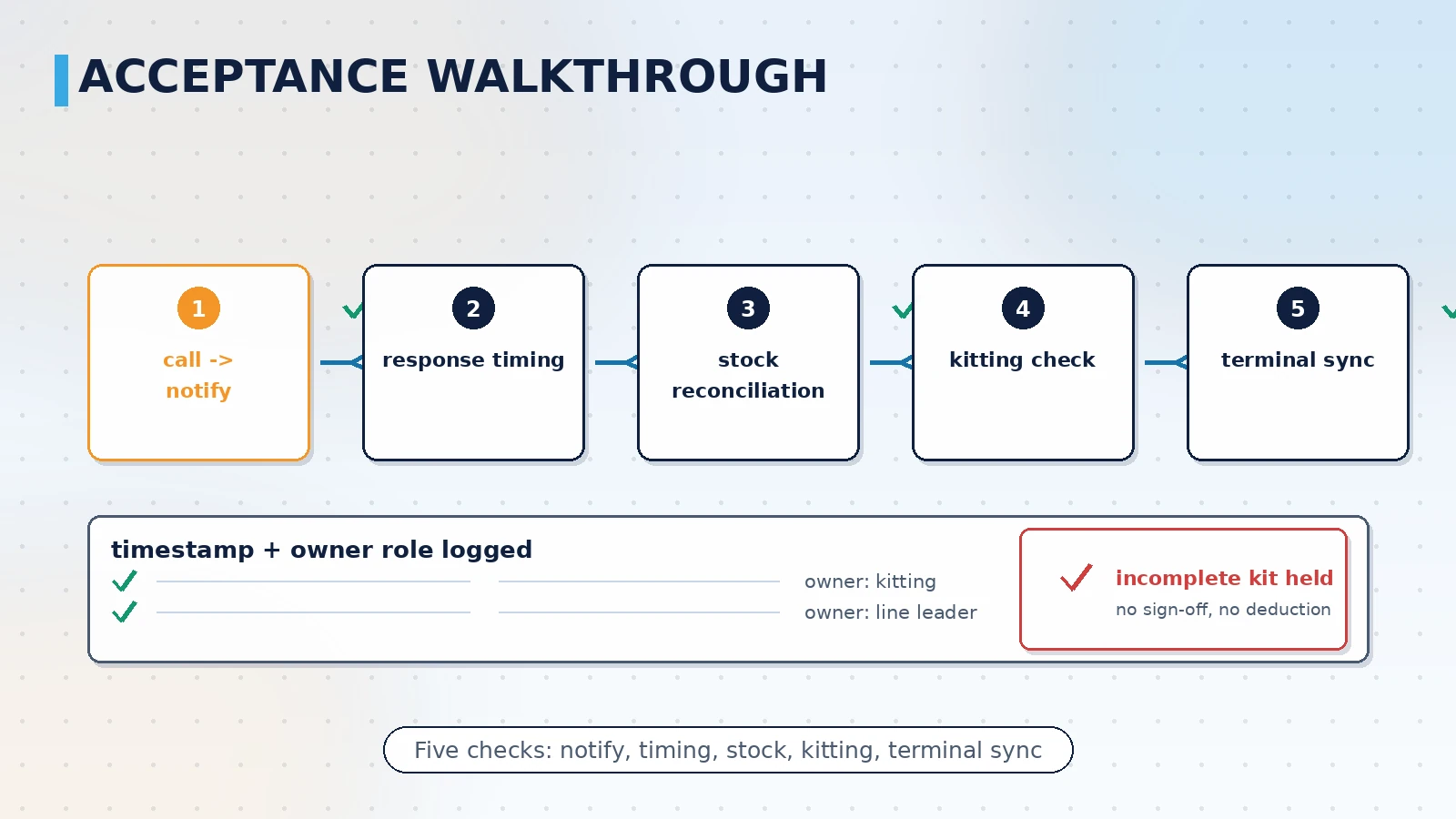
Once these checks pass, the material call system is genuinely delivered rather than just a button. Our line-side feeding projects usually proceed in this order: agree the part coding and line-side stock basis, set the call binding and response limits, complete call terminal integration and delivery board configuration, then run the full checklist once. We have delivered shop-floor systems combining LED andon and equipment networking on a discrete manufacturing line (public reference: a Japanese-affiliated home appliance group, Shanghai plant), joining station calls, shop-floor display and network communication on one path, and can build on that pattern according to line-side conditions.
Where line-side parts are numerous and fast-moving, the first acceptance step is a material classification and line-side stock list, deciding which parts belong at the line and which should be delivered from a central store on demand. Once those preconditions are clear, call rules are much faster to set and verify.
Conclusion
A line-side material call system is not a phone replaced by a button; it is a replenishment chain driven by consumption: the call carries part and station, the kitting team works to a response limit and records delivery, sign-off deducts line-side stock and raises the next call, and every stage leaves a time point. Whether it lasts depends on four things — calls bound to a specific part and station, response limits set per material type, responsibility attached to roles, and line-side stock and kitting checks linked to the call. Fix those four, and line-side feeding moves from being discovered on a patrol route to being triggered by actual consumption, so demand finds the delivery team before the line stops.
Book a product demo
If your assembly or packaging line is evaluating line-side material calls and kitting delivery, we can walk through a workable call and delivery response timing design based on your part classification and crew structure.
Contact Us