Lean manufacturing digitalization: where to start
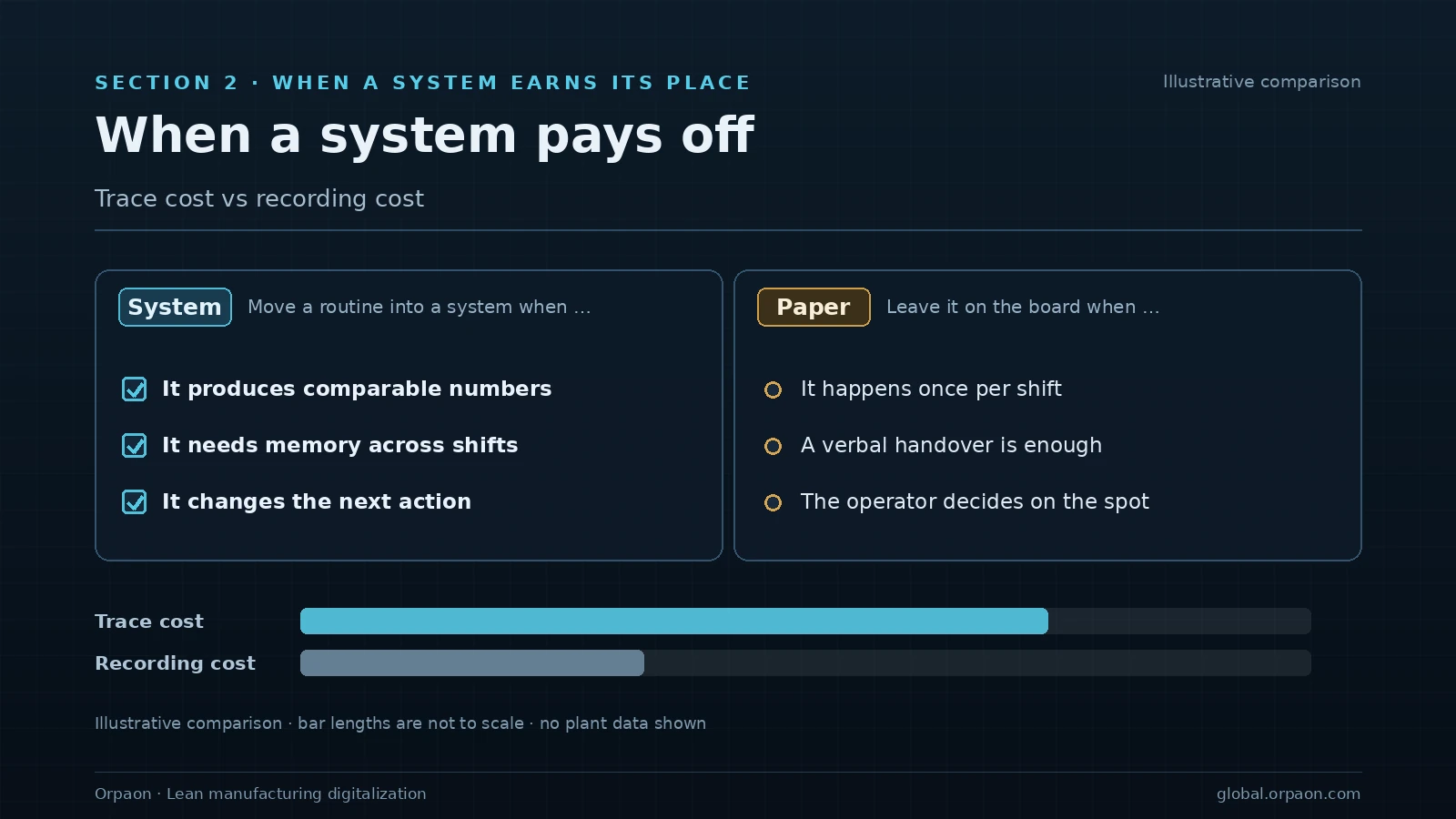
The first step in lean manufacturing digitalization is not choosing software. It is separating the routines that a system should carry from the ones that should stay with people, then moving them over one at a time in an order you can roll back. The usual test has three criteria: does the routine produce comparable numbers, must it be remembered across shifts, and does it drive the next action? A routine meeting two of the three is worth moving into a system. Getting takt, downtime reasons and work-in-process counts right first is accepted by teams far more easily than a dozen modules switched on at once.
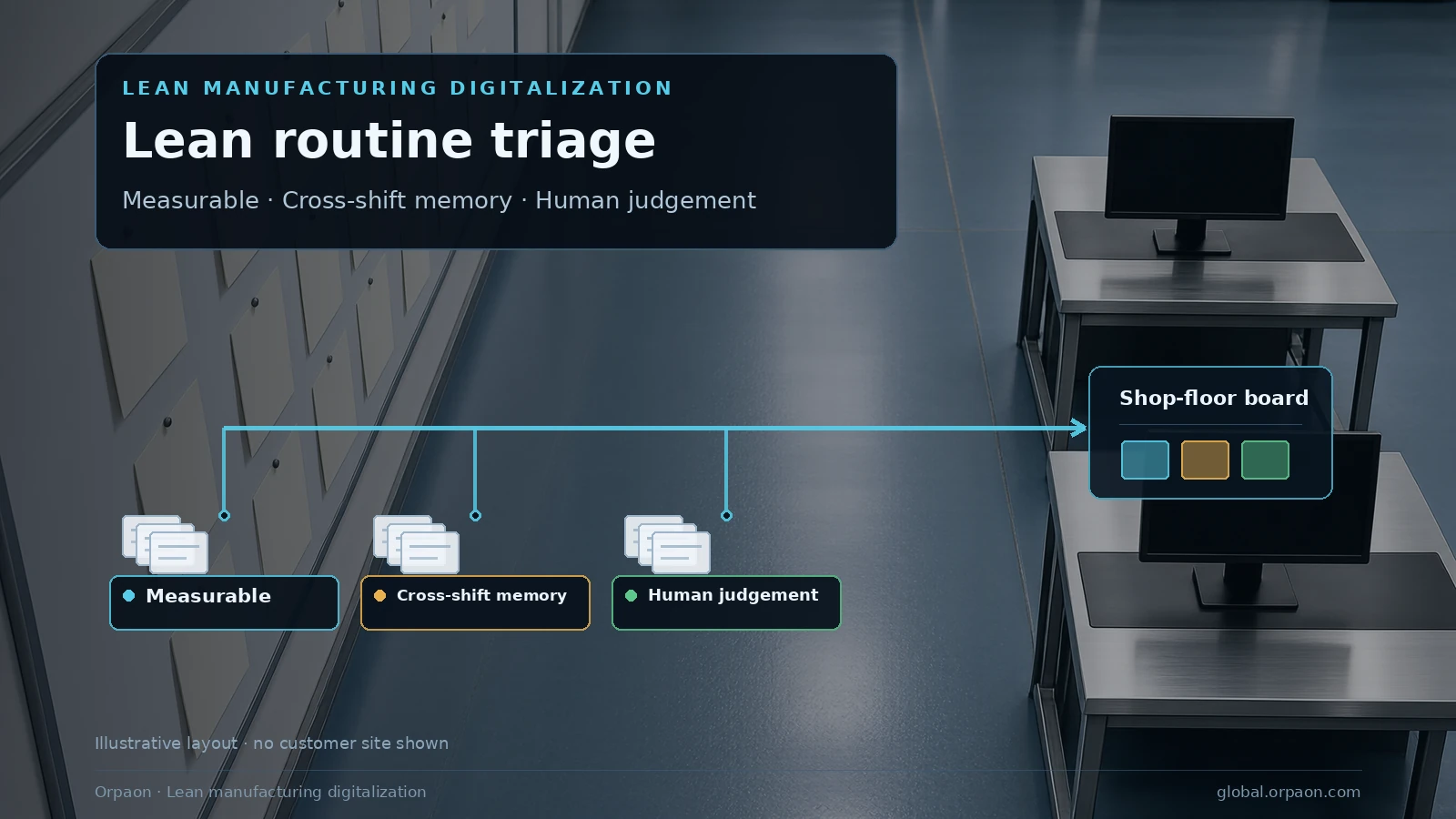
1. Sort shop-floor routines into three groups first
Waste in lean production usually sits between steps, and those handovers are still held together by verbal briefings and paper logs. Digitalization is not about moving every paper form onto a screen. It is about fixing the handovers that keep producing arguments. Without that split, the usual outcome is a system collecting data every day while the morning meeting still reconciles numbers from memory.
- Routines that produce comparable numbers: takt, downtime length, work-in-process count, first-pass yield. These belong in a system.
- Routines that must persist across shifts: downtime reason codes, changeover checklists, improvement proposal status. These belong in a system.
- Routines that depend on local judgement: first-piece approval, countermeasures for a specific fault. Keep them with people; the system only keeps the record.
- Routines used once per shift: briefing notes, handover signatures. A whiteboard and a paper card are enough.
- Routines already covered by a work standard: freeze the standard first, then go digital. Reversing the order means rewriting fields every month.
2. When a routine is worth putting into a system
The same lean method performs differently in two plants less because of tooling than because of recording load. Before commissioning anything, count how often a routine is questioned each week and how many records a single traceback requires. A system only lightens the load when traceback clearly costs more than recording.
| Shop-floor routine | Signal to put it in a system | Signal to leave it on paper |
|---|---|---|
| Takt and capacity reporting | Frequent changeovers across many variants, planning by experience | Single product, stable takt for years |
| Downtime and reason coding | The same fault recurs monthly with different explanations | Faults are rare and closed on the spot |
| Improvement proposals and standards | High proposal volume, versions no longer match stations | Proposals tracked verbally by the team leader |
| First-piece approval and changeover | Many changeovers, checklist items get skipped | Fewer than one changeover per week |
3. Definitions: takt, work-in-process and reason codes
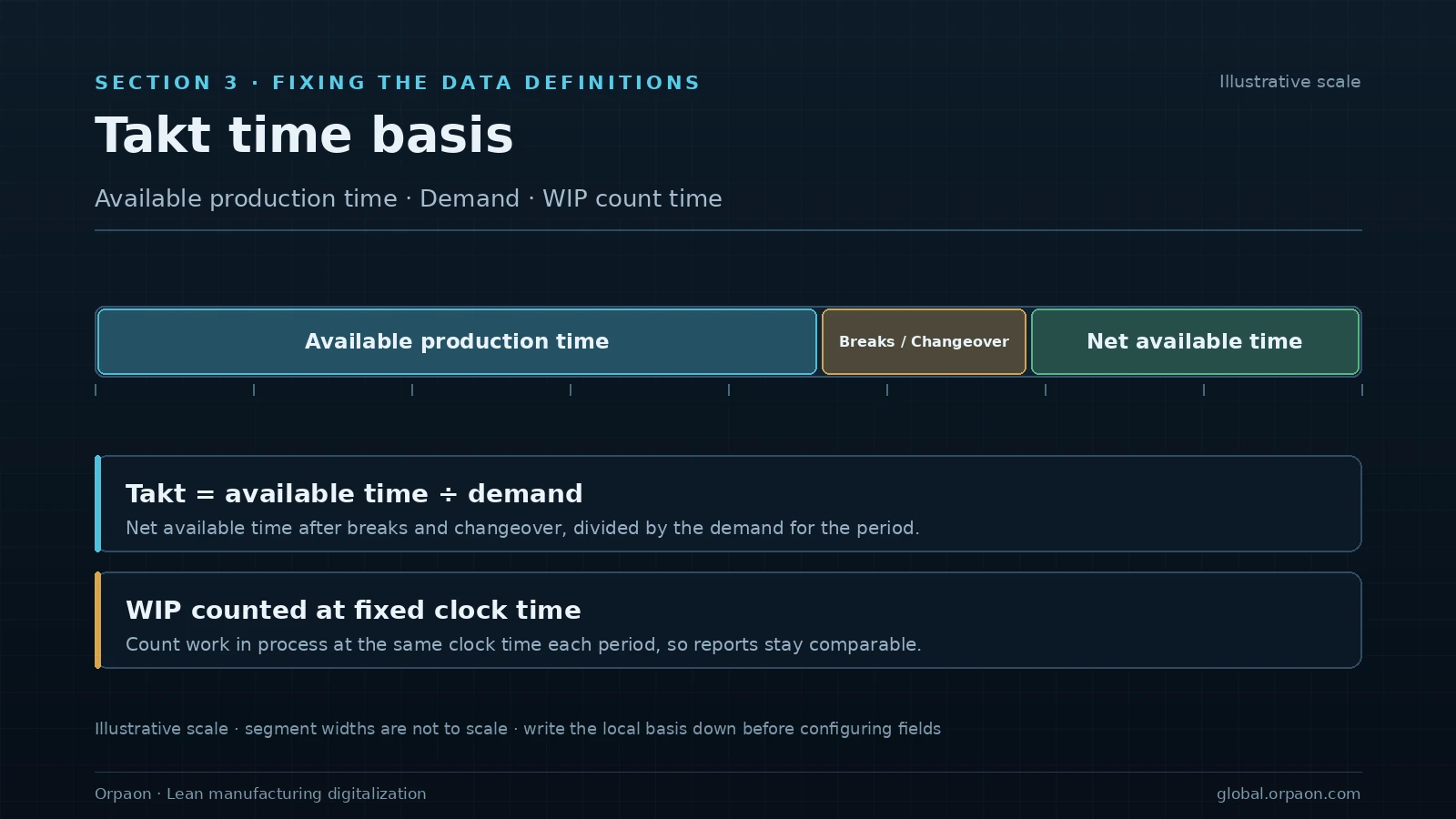
The three elements of standard work are takt time, work sequence and standard in-process stock, and they have defined lean practice since the Toyota Production System. Digital projects usually fail at the point where these words become fields without an agreed formula. Whether the denominator of takt is planned production time or calendar time decides whether two lines can be compared at all.
Work-in-process counting is the second recurring dispute. Counting by station exposes pile-ups; counting by batch supports cost allocation. The two methods cannot share one report. Reason codes need restraint as well: too many entries and people pick one at random, too few and the code cannot locate the problem. ISO 22400-2:2014 provides a definition framework for indicators such as throughput rate and allocation ratio, which helps when benchmarking plants, but each shop floor still has to write its own local version.
- State the denominator of takt: planned production time, with breaks and changeovers either deducted or explicitly kept.
- Fix the counting moment for work-in-process at the top of the hour so mid-shift swings do not distort the number.
- Keep reason codes under fifteen entries, merge the rest into an "other" bucket and review it monthly.
4. Rollout order and rollback
Lean digitalization works well on one model line, in four-week rounds, adding one group of routines per round. The reason is not caution. It gives the team time to settle definitions while the scope is still small, which is far cheaper than rewriting fields after a plant-wide launch.
- Weeks one to four: takt and downtime records only, with manual counting in parallel.
- Round two: add downtime reason coding, confirmed once per shift by the team leader.
- Round three: add improvement proposal status, linked to the work standard version number.
- Expansion: copy to a second line without changing field definitions, adjusting only thresholds and shift settings.
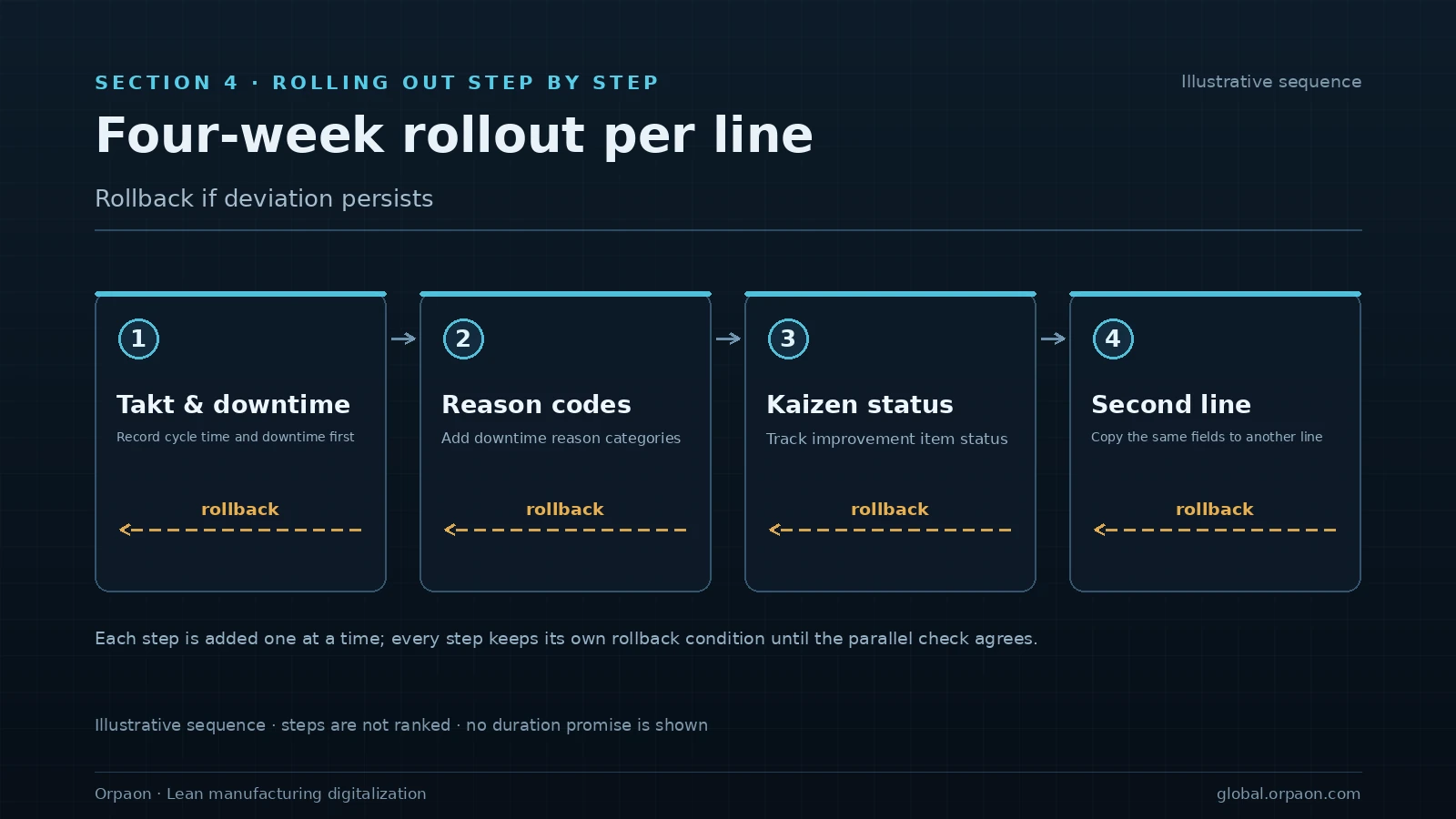
Every step keeps a rollback condition: if manual and system counts keep diverging beyond the agreed range during the parallel period, suspend that field and fix the definition instead of adding modules.
Summary
The value of lean manufacturing digitalization is not the number of modules but the conversion of memory-based handovers into records you can query: why this changeover overran, why this work-in-process pile appeared, why this proposal has been open for three months. Sort the routines, apply the criteria, write the definitions and keep a rollback condition, and teams will use the system on their own. Takt forecasting and automatic scheduling remain exploratory directions, available for joint validation rather than delivery commitments.
Book a solution review
Bring your current takt sheet, downtime log and changeover list, and we will propose an order for moving to a system and a draft definition set for your shop floor.
Contact Us