Epitaxy Furnace Monitoring: Signals and Traceability
An epitaxy furnace monitoring system is the supervisory software layer of an epitaxy reactor: it records thermal, gas flow and batch signals on one agreed sampling basis so that the conditions of every run can be reviewed and compared afterwards. Epitaxial growth is sensitive to the history of temperature, pressure and flow, and once those curves are not archived on a fixed cycle, a process dispute is settled from memory. This article covers which signals to connect, which definitions to fix before go-live, how recipes and wafer batches form a traceability chain, and what to check at each rollout stage.
1. What an epitaxy furnace monitoring system covers
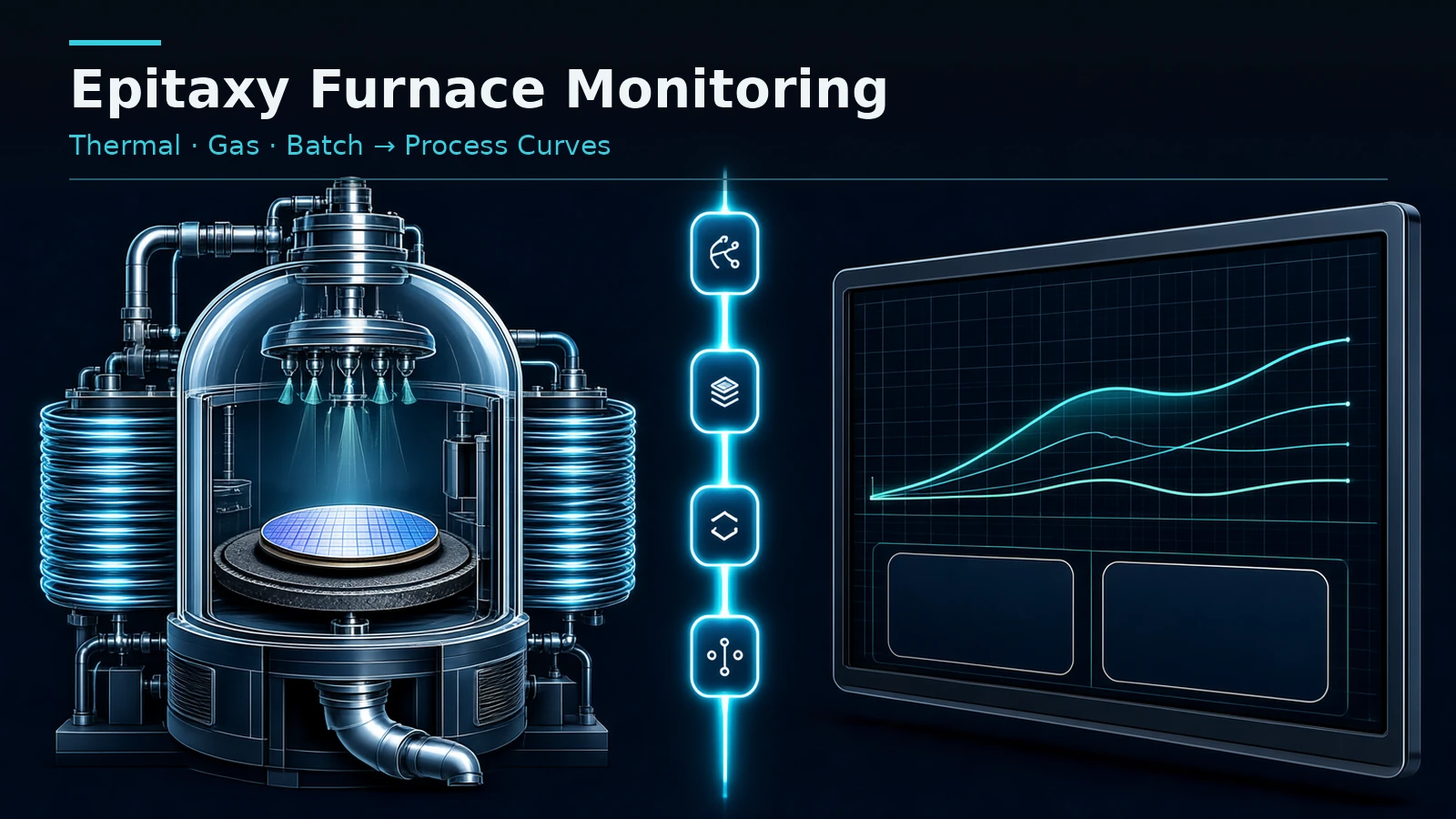
An epitaxy furnace monitoring system is the supervisory software layer above an epitaxy reactor. It takes three groups of signals continuously: thermal (temperature at each measurement point, ramp-up and ramp-down rates), gas and pressure (carrier and precursor flow, chamber pressure, pump-down state), and equipment and batch (valve actions, susceptor or boat position, recipe number, wafer batch number). Those signals are archived on a fixed cycle and become curves that can be reviewed later.
Compared with the local HMI supplied with the tool, the difference is retention and comparability. A local screen serves the current shift, and its records are usually triggered by operator events. A monitoring system samples on a fixed cycle and aligns every run to the same time axis and the same definitions, which is what makes comparison across tools, shifts and batches possible. Epitaxial results depend heavily on the thermal and gas history, so once the curves are missing, the dispute can only be settled by recollection.
There is usually more than one communication path between the tool and the supervisory layer. Semiconductor equipment commonly exposes SECS/GEM interfaces (SEMI E5, E30); older tools may offer only Modbus or a vendor-specific serial protocol, while general industrial equipment tends to use OPC UA (IEC 62541). The monitoring system has to support these paths under one tag database, and store raw values, engineering values and status bits separately, so that unit conversion or a range change does not corrupt the historical record.
2. Signals and sampling rules to fix before go-live
A single epitaxy furnace can carry several hundred tags, and archiving all of them at one-second resolution is neither economical nor maintainable. Before go-live, sort the tags by purpose into three groups: process-critical points (temperature, pressure, key gas flows), equipment status points (valves, pumps, door interlocks, alarms) and statistical points (run count, running hours, alarm count). For each group, fix the sampling period, the archiving period and the accuracy requirement, and write them into the scope document.
| Signal group | What to confirm | Common problem |
|---|---|---|
| Thermal and temperature | Sensor type, range, sampling period, whether zones are recorded separately | Only one representative temperature is kept, so zone-to-zone deviation cannot be judged |
| Chamber pressure and vacuum | Pressure unit and range, how pump-down and purge phases are recorded | Mixed units (Pa, Torr, mbar) make historical curves impossible to align |
| Gas flow | Full scale of the mass flow controller, gas species, conversion factor | Only percentages are stored, so recipes cannot be compared |
| Equipment status | Conditions and priority for running, idle, alarm and maintenance | Downtime reasons are typed by hand and cannot be attributed later |
| Recipe and program | Whether recipe number, version and parameter snapshot are saved with the run | Only the recipe name is stored, so a later revision cannot reproduce the original conditions |
| Batch and wafers | Mapping between batch number, wafer ID, loading position and run | Batch and curve are matched by timestamp, which fails during traceability |
Once the definitions are agreed, sampling and retention have to be decided together. Process-critical points are typically sampled per second and archived per minute; status points are recorded on change; statistical points are summarised per run and per shift. The retention policy has to answer two questions: can a complete curve still be retrieved for a run three months ago, and how much storage does one run consume. The first sets the retention period, the second sets the storage and backup budget.
3. How recipes, batches and the traceability chain connect
Reproducibility in epitaxy depends on three things being recorded together: the recipe version that ran, the state of the tool at the time, and which wafers were in the chamber. If any one is missing, the chain breaks in the middle.
- Recipe version: every change creates a new version with author and timestamp; historical runs are still interpreted against the version in force at the time, never re-interpreted with a newer one.
- Parameter snapshot: at run start, store the temperature setpoints, pressure setpoints, gas flow setpoints and alarm limits as a whole, instead of only the recipe ID.
- Batch binding: scan the batch and wafer IDs at loading, write the run number, chamber number and loading position into the record, and confirm once more at unloading.
- Status linkage: attach the shift alarms, valve actions and maintenance records to the same run timeline, so a process deviation can later be separated from an equipment fault.
- Export and archive: export a single-run report in a fixed format with curves, key parameters and status events, for customer complaints and customer audits.
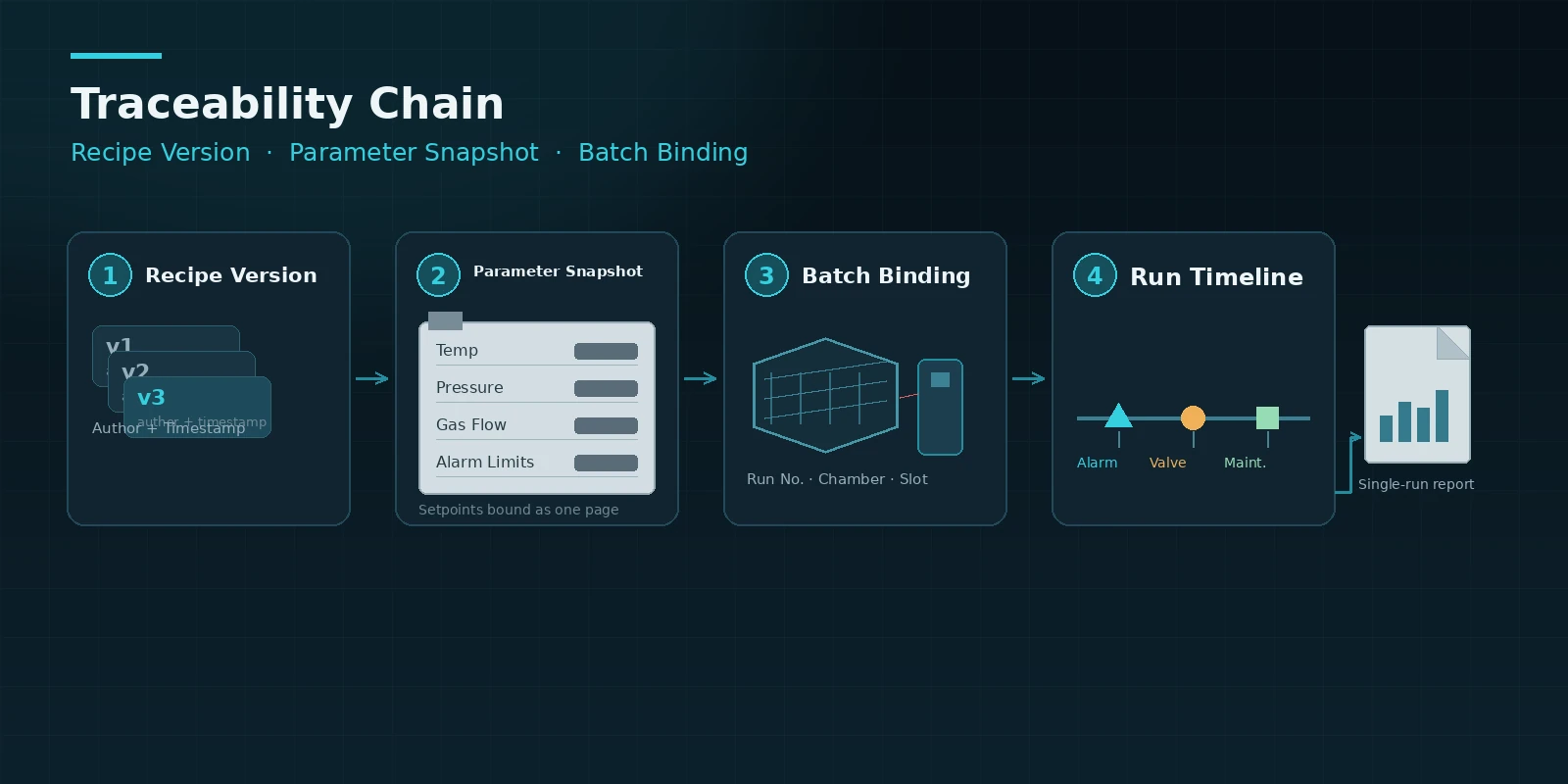
Of these five, the parameter snapshot is the one most often skipped. Many systems store only the recipe number, while the recipe file may have been revised several times within a few months; when a run has to be reproduced, all that remains is a number, not the setpoints that were actually used.
4. Rollout stages and acceptance points
An epitaxy furnace monitoring system should not connect every tool and every signal at once. A more reliable approach is to take one representative tool, get signals, recipes and batches working on it, and then replicate to the others.
- Stage 1, single tool: the goal is continuous, stable archiving of the key signals, with curve values matching the local HMI. At acceptance, sample several runs and check completeness and timestamp continuity for temperature, pressure and flow.
- Stage 2, recipe and batch management: recipe versioning, parameter snapshots and batch binding go live, and the single-run report can be exported in the agreed format. At acceptance, take one run and trace it end to end, confirming that the curve and the setpoints can be reached from the batch number.
- Stage 3, replication across tools: copy the validated tag list and report templates to other tools. Sensor arrangement, protocols and ranges may differ between tools; the definitions in the template should stay the same while the acquisition implementation may differ.
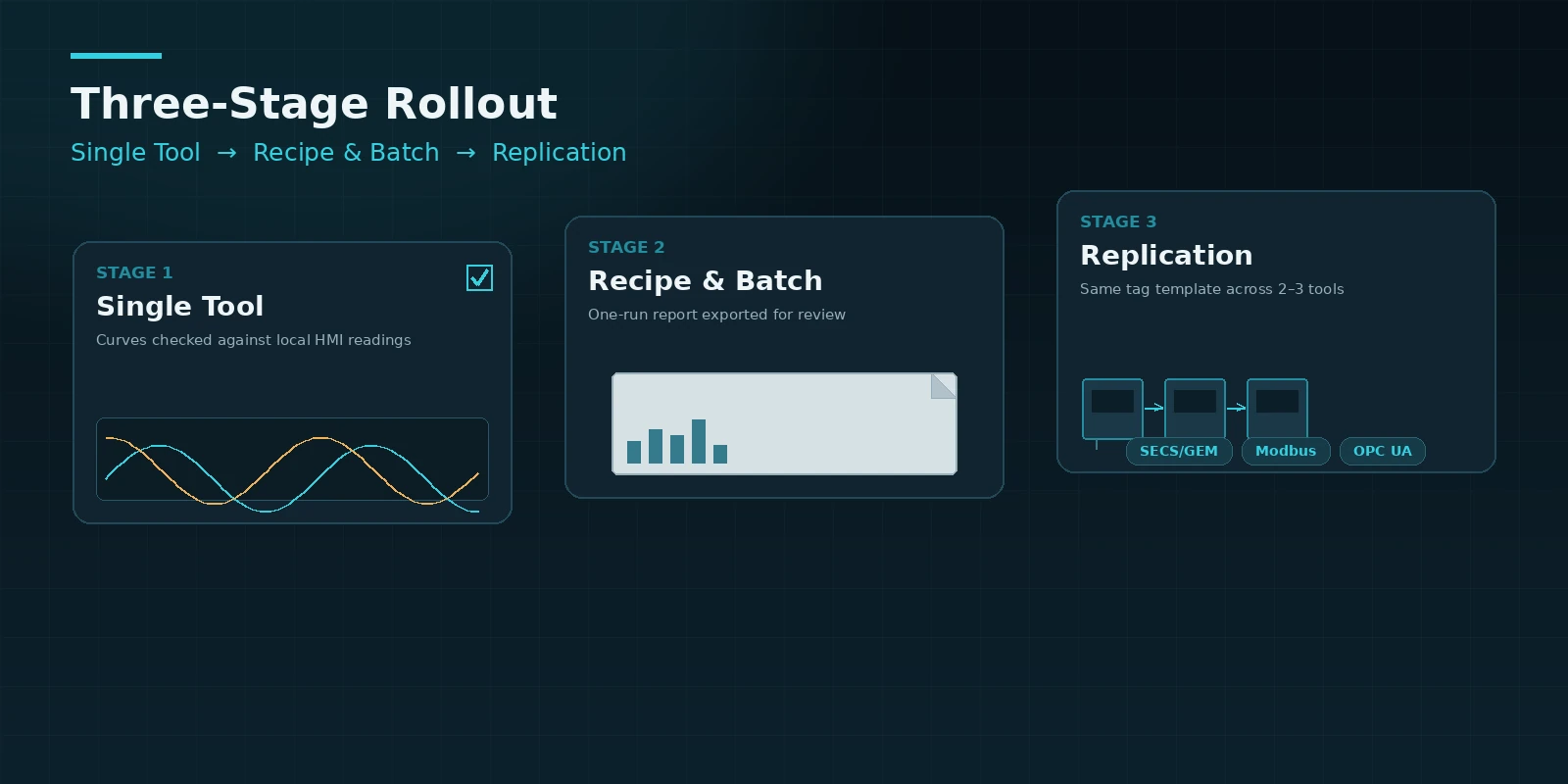
The test at each stage is whether engineers can use the data directly, not how many interfaces are connected. A connected interface is only the start; the layer has really landed when an engineer facing a process dispute opens the curves first instead of asking the shift operator.
Conclusion: settle the definitions before counting tags
The value of an epitaxy furnace monitoring system does not lie in how many tags are connected, but in whether the definition, sampling period and retention of those tags were settled in advance. Temperature, pressure and flow curves have to align; recipe versions and parameter snapshots have to be stored with the run; the mapping between batch and wafer has to be retrievable at the moment of traceability. Once those three are solid, process engineers will treat the system as a daily tool; without them, more screens only move the local HMI onto a different monitor. For a company running epitaxy tools, getting signals, recipes and batches working on one tool before replicating is usually more controllable than connecting the whole fab at once.
Book a solution discussion
If you are evaluating an epitaxy furnace monitoring system, or want to clarify the signal definitions and traceability requirements of your existing tools first, contact us to discuss site conditions and the order of rollout. We will give practical recommendations based on tool types, communication interfaces and process record requirements.
Contact Us