Compressor endurance test automation: how it works
Compressor endurance test automation means the bench runs multi-step test profiles—constant, cyclic, and gradient-load cycles—by itself while every measurement channel is recorded continuously, which is what a software platform delivered for an automotive research institute and a thermal-management test company set out to do.
What a compressor endurance bench must control
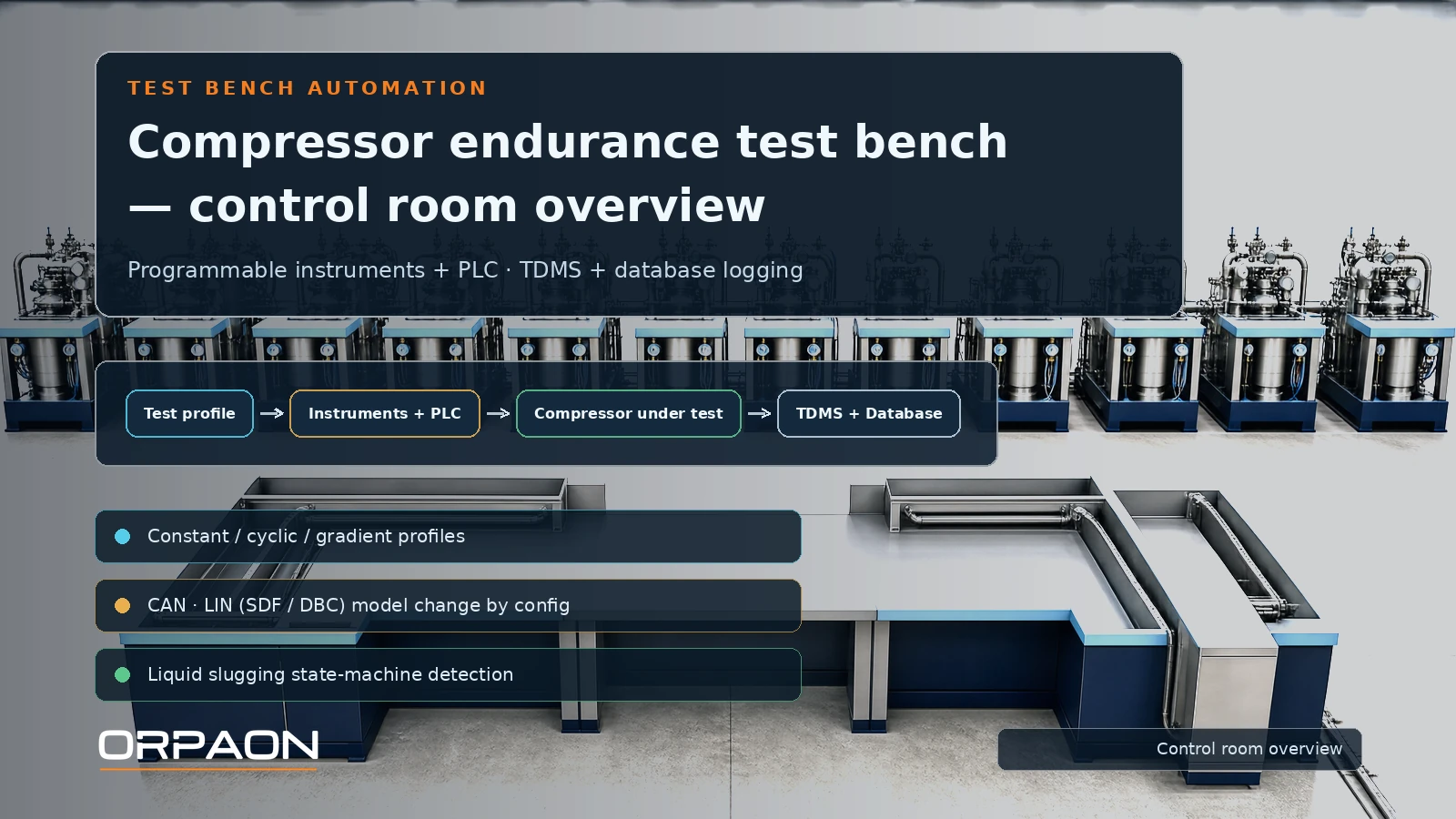
Endurance and run-in testing verify compressor reliability under long-duration load. A single bench faces the compressor under test, programmable instruments, a PLC, and a sensor network at the same time. Manual operation creates three bottlenecks: an operator babysits each profile step, data is copied by hand, and every new compressor model means rewritten code. Automation replaces these three with automatic profile execution, two-channel recording, and configuration-based model switching.
Running multi-step test profiles automatically
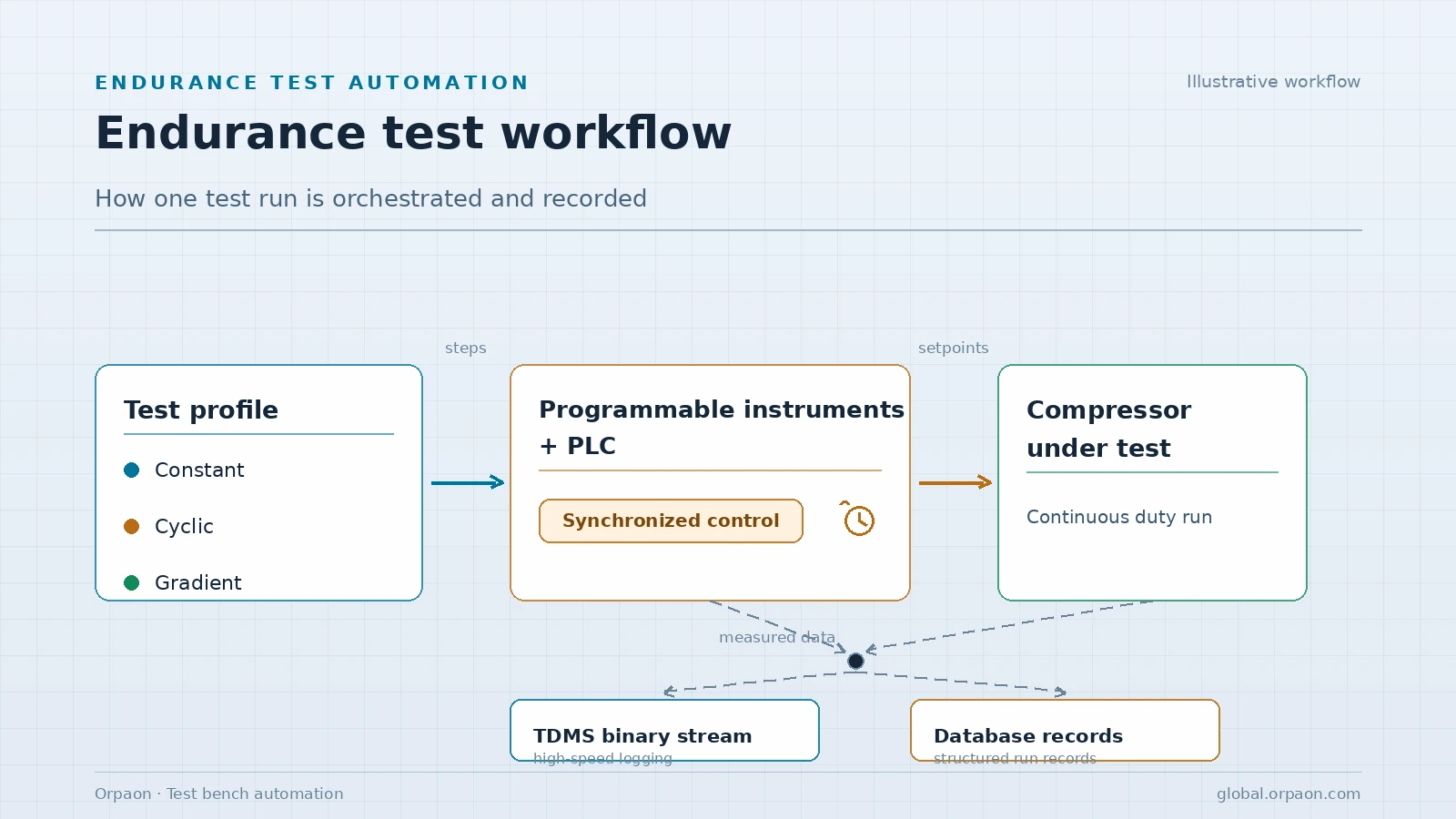
In the delivered platform, a test procedure is defined as a list of profile steps, and programmable instruments plus the PLC execute them in sync. Profiles fall into three types:
- Constant profiles hold fixed operating points for long durations to verify steady-state behavior.
- Cyclic profiles repeat load and unload sequences a set number of times to apply repeated stress including start-stop events.
- Gradient profiles ramp pressure, temperature, and flow along defined slopes to check transient response.
Condition monitoring during the run includes liquid-slug detection with a state machine, online refrigerant property calculation with NIST REFPROP, and airflow measurement by the nozzle differential-pressure method. This composition was confirmed in the delivery for an automotive design institute and an automotive thermal-management test company (based on archived documentation as of 2026).
Recording data on two channels
Data lands on two channels: high-frequency raw waveforms go to a TDMS binary stream, while test steps, verdicts, and alarms are stored as structured records in a database. The split of roles is as follows:
| Channel | Stored content | Main use |
|---|---|---|
| TDMS binary stream | High-sampling waveforms and profile states | Reproduction and deep analysis |
| Database | Profile steps, verdicts, alarm records | Reports and traceability |
The reason for two channels is to keep raw-data fidelity and structured searchability at the same time. Endurance runs last many hours, so paper logs and manual entry invite gaps and transcription errors; dual-channel recording narrows those gaps.
Switching compressor models by configuration
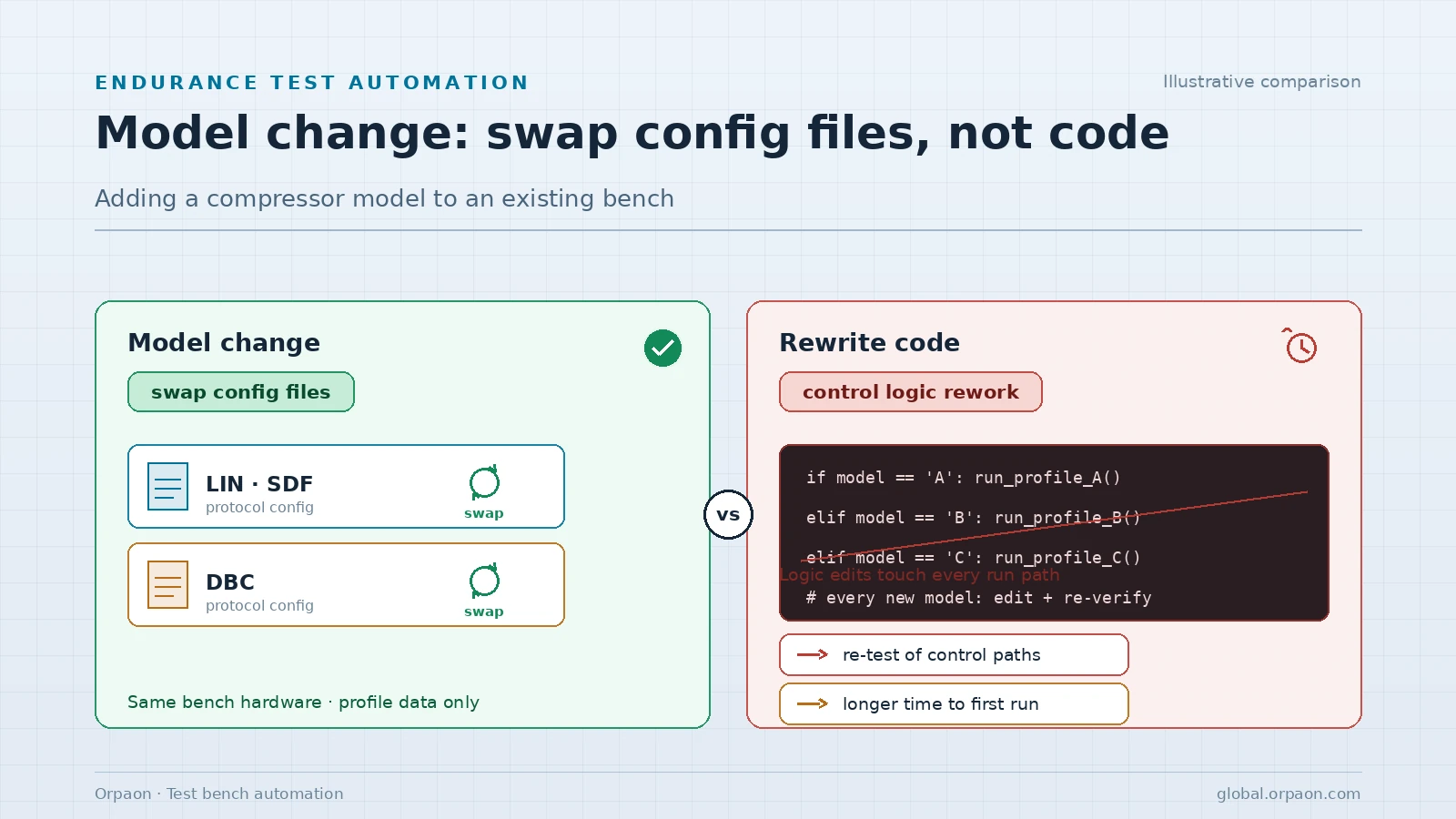
When one bench handles several compressor models, the differences surface in CAN and LIN signal definitions. The platform parses LIN SDF files and DBC message definitions, so a model change means swapping signal configuration files and profile parameters—not rewriting code. This approach was verified across batch deliveries for multiple customers and models. In international projects, the practical comparison between in-house work and outsourced development hinges on three documents: profile definitions, signal definitions, and recording specifications. A recommended approach is to have an English-speaking contact review these documents before kickoff, following ISO 50001 thinking on measured, verifiable records; in general manufacturing, this groundwork shortens pre-production verification.
Summary
Compressor endurance test automation stands on three elements: automatic profile execution, two-channel recording with TDMS and a database, and configuration-based model switching. Assess your lab against these three to set priorities, then start with an on-site diagnosis request.
Request an on-site diagnosis
Review your bench's profile definitions, recording specifications, and model-switching practice together with an English-speaking contact.
Contact Us