C&I energy storage EMS: strategy, safety, revenue
In markets with time-of-use tariffs, the economics of commercial and industrial storage are decided by long-term operation, and the EMS is the layer that runs it: charge and discharge strategy, battery safety, multi-site supervision and revenue accounting. As tariff spreads widen, storage has become a common component of site energy planning, and how to run it after commissioning is the question owners and investors share.
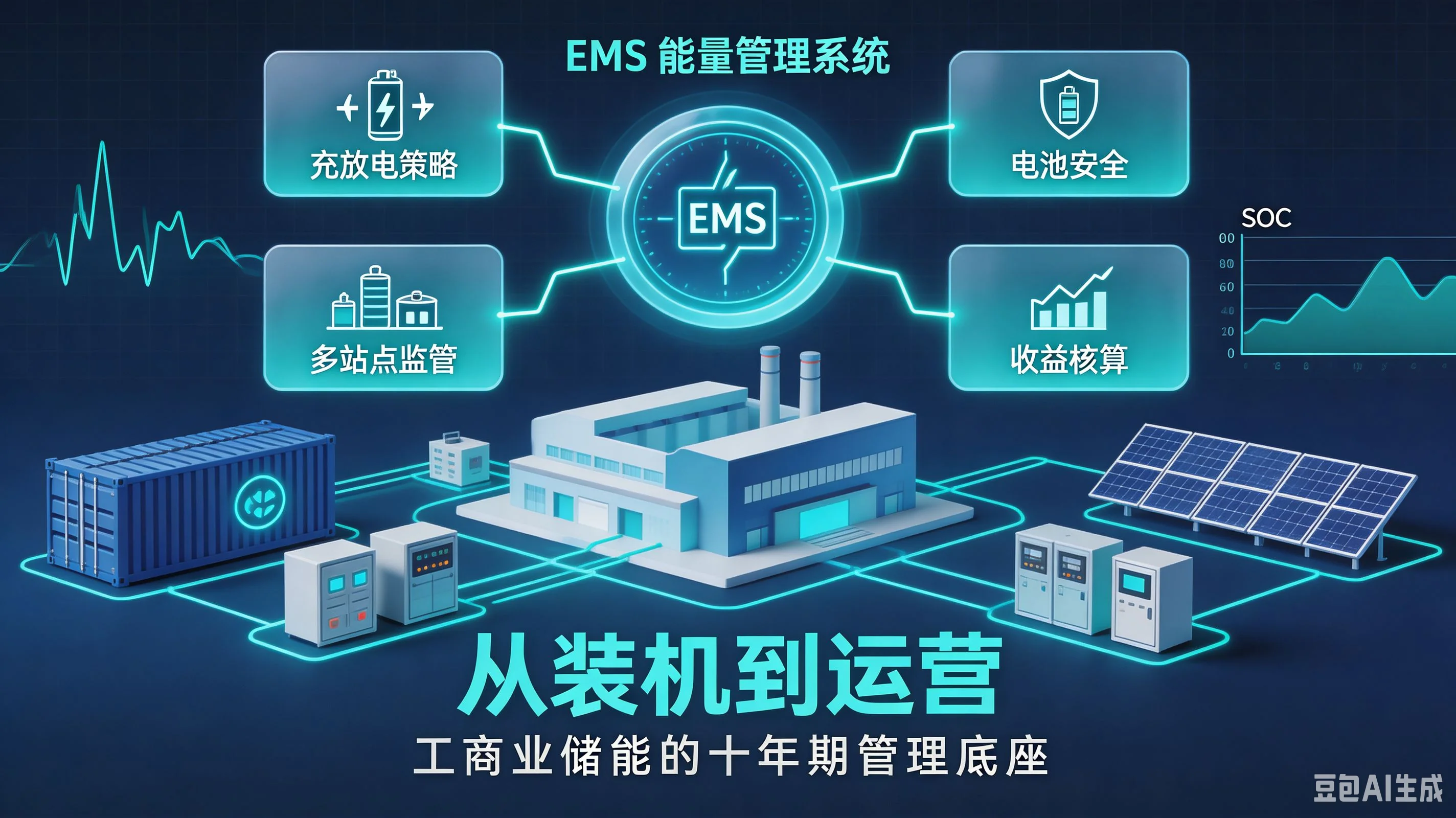
Why C&I storage moved from installation to operation
In earlier years, commercial storage projects were driven by subsidies, grid-connection quotas and policy, and installation itself produced the return. As subsidies phase out and connection conditions tighten, projects are judged by their own operating accounts. Installation is a one-time event; operation is a ten-year business.
Taking the August 2026 commercial time-of-use tariff of a Chinese province as an example, off-peak power costs about CNY 0.27/kWh and critical peak about CNY 1.32/kWh, a spread above CNY 1 per kWh. Where time-of-use tariffs exist, the precision of the charge strategy separates returns even under identical tariffs and hardware.
- Peak-valley arbitrage becomes an operating baseline: off-peak charging and peak discharging is only the starting point, and strategy must combine load following, tariff movement and battery condition
- Multi-site operation becomes the norm: solar-plus-storage stations, containerized storage and microgrids coexist within one group, and scattered sites with mixed-vendor equipment outgrow manual supervision
Whether a storage asset remains operable and replicable depends largely on how far the EMS manages every kilowatt-hour, every alarm and every unit of revenue.
The four things a storage EMS must manage
In discussions with plant owners, concerns cluster into four operating questions rather than technical parameters.
| Management object | What the EMS must deliver |
|---|---|
| Charge and discharge strategy | Combines peak-valley arbitrage, load following, anti-backfeed and SOC protection rules; configurable, traceable, with dispatch logs available |
| Battery and equipment safety | Staged alarms and very early warning, cell temperature-difference refreshed every second, interlocking with fire panel, breakers and PCS on preset logic |
| Multi-site central supervision | Station overview, device status, cluster data, SOC trends and revenue curves on one screen, with remote strategy deployment |
| Revenue accounting | Charge and discharge volume and revenue split by site, month and strategy effect, supporting investment review and strategy adjustment |
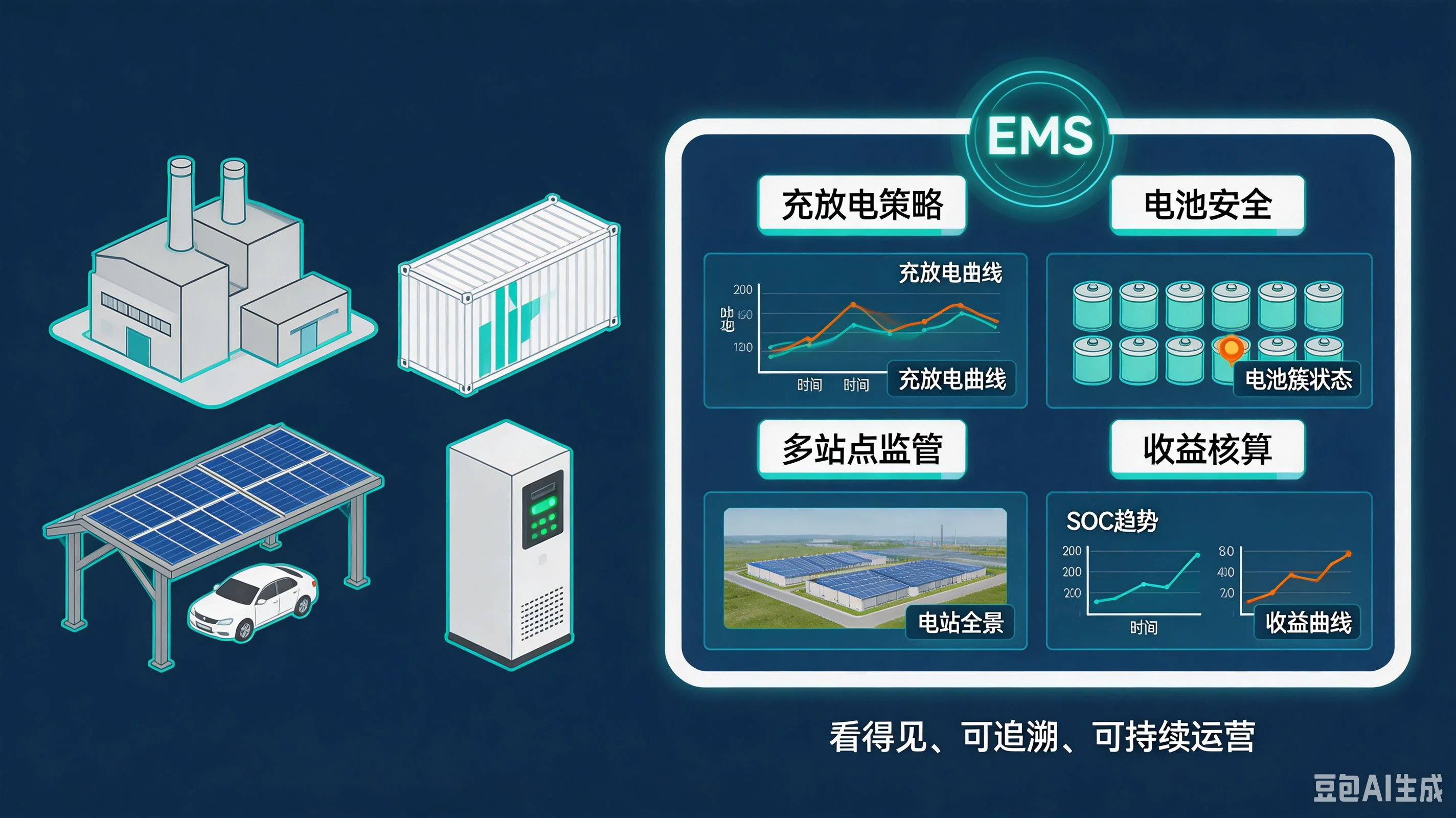
The common thread is visibility and traceability: why the strategy ran as it did, why an alarm fired, and why revenue was calculated as shown — the system must be able to answer all three.
Three scenarios, one foundation: the ORPAON storage EMS
ORPAON has worked on manufacturing digitalization since 2009. Its storage EMS is designed as one system for three scenarios — commercial storage cabinets, containerized storage stations and solar-plus-storage stations — with the form factors sharing one time-series data foundation, one alarm scheme and one revenue definition, so data flows through a single path from acquisition to display.
- On-site edition (OrpaonEMS): an industrial PC and HMI carrying charge strategy control, cluster monitoring, fire interlock and revenue statistics
- Web edition (LeanEMS): a browser-based platform for multi-site control, remote maintenance, report export and permission audit trails
- Large-screen edition: LED/LCD visualization for showrooms, dispatch centers and visitor reception
- Cross-platform client and AI dispatch advisor: model-based dispatch suggestions run in shadow-validation mode, for reference only, executed after human confirmation
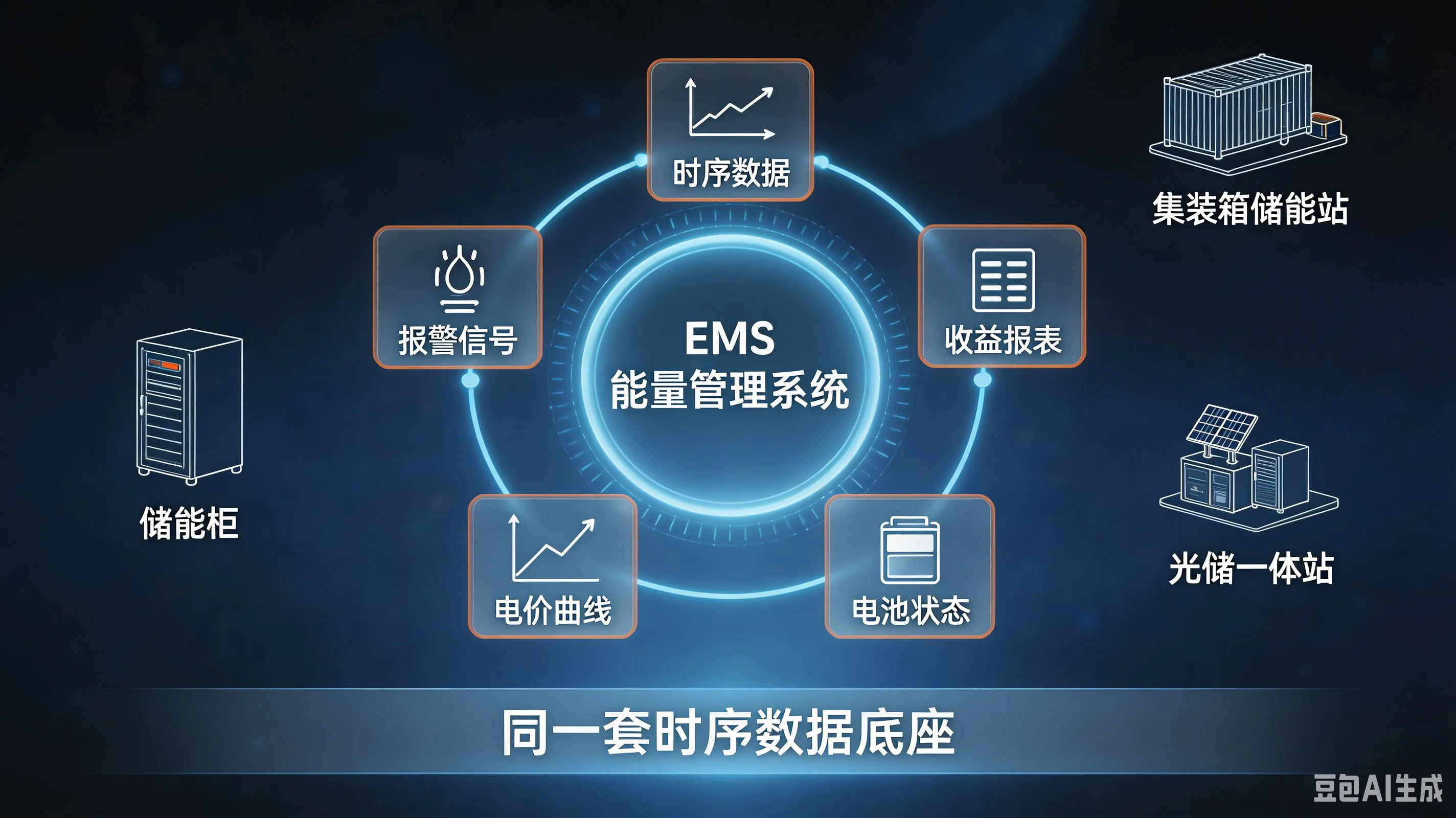
The on-site edition runs in delivered projects, the web edition is scoped per project, and the cross-platform client and AI advisor are in development and open to joint validation. On the protocol side, Siemens S7, Mitsubishi MC, Modbus TCP/RTU, CAN, OPC UA and MQTT are supported, and BMS integration, CAN acquisition, Modbus TCP communication and power-meter collection have been verified across multiple delivered projects.
What the EMS manages across a ten-year operating life
A storage asset typically operates for more than ten years, and commissioning is only the starting point: tariffs change, batteries age, sites expand and regulation moves.
- Whether strategy parameters should follow a tariff revision, and how to back-test before applying it
- How to judge balancing and replacement as cell health declines after years of service
- How to bring a new site or new cabinets into the existing platform
- How the system supports changing regulatory reporting, safety inspections and insurance terms
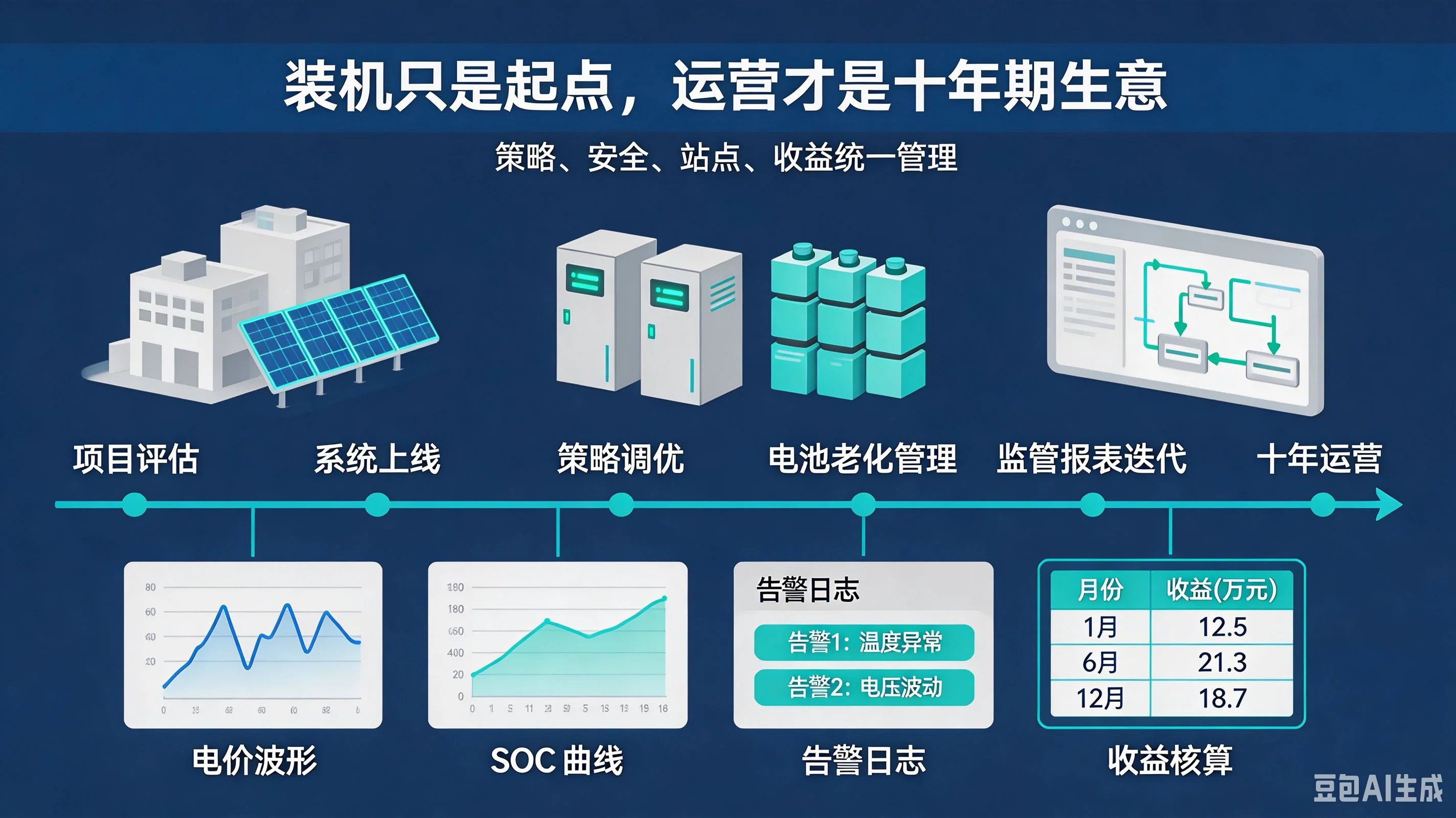
ORPAON opens strategies, protocols, reports and permissions to the customer's operations team, delivers source code and documentation, and provides remote tuning, annual maintenance and direct engineer support as needed, so the system keeps evolving with tariffs, batteries and regulation.
Conclusion
Storage is a long-term business, and the EMS is not an add-on but the layer that carries a storage asset from installation into operation: a strategy that runs steadily, alarms that stay governed, multi-site control that scales, and revenue figures that can be explained — these are what make the asset operable and replicable.
If your plant, campus or group is evaluating storage investment, or has storage commissioned with an unclear operating account, start from the tariff structure and the equipment list: review the current state of strategy, safety and accounting, then define the EMS integration scope and pace.
Book a storage EMS scoping discussion
Tell us your tariff structure, storage configuration (cabinets, containerized stations or solar-plus-storage) and existing equipment list; an English-speaking engineer will propose the EMS integration scope and a phased plan.
Contact Us