How a batching error proofing system works
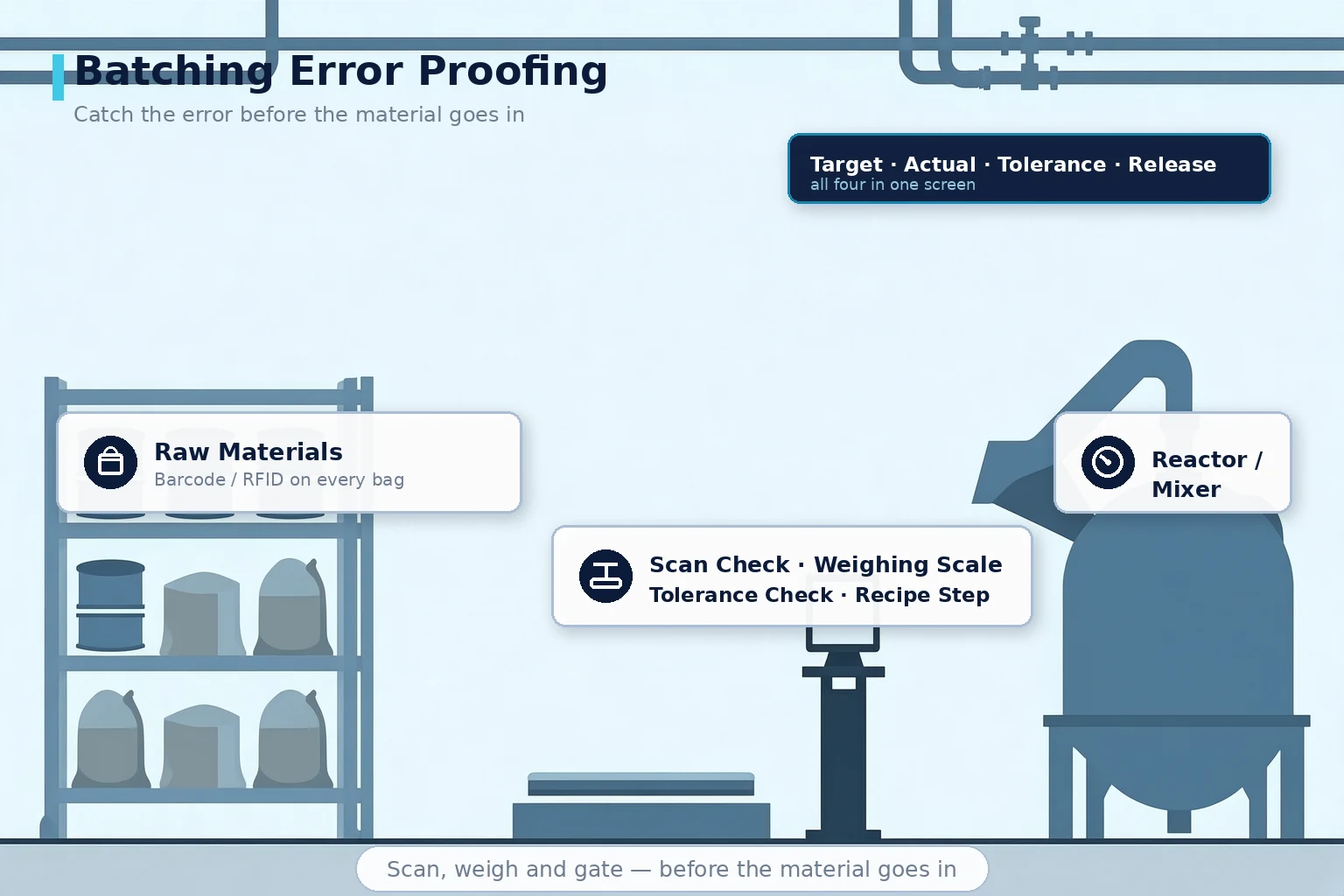
A batching error proofing system solves a concrete problem: at the two steps where mistakes are most likely — weighing and dosing — it stops the wrong material, the wrong weight and the wrong sequence before the action happens, using data rather than added manual double-checks. Instead of extra people, it embeds verification into the process: weight values come straight from the instruments, materials and recipes are checked by the system, and every step is logged for traceability. This article follows four lines — where errors start, how to set the control gates, what traceability must keep, and how to draw the system boundary — to give a practical design approach.
Where batching errors usually start
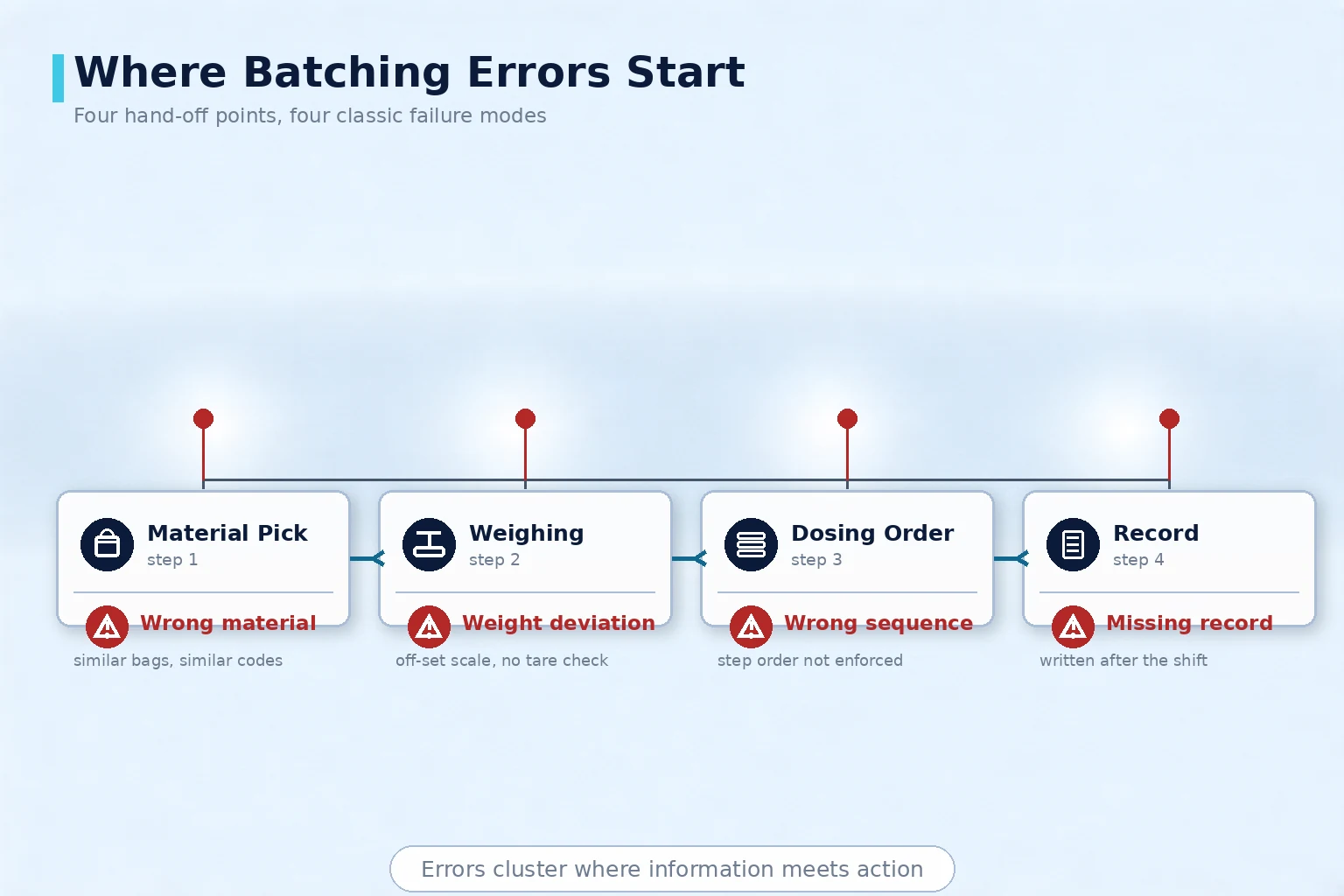
A batching error is rarely a single cause; it tends to appear where information, action and records meet. Four common starting points:
- Wrong material: raw materials that look alike, or powders and liquids in the same series but different grades, are told apart by eye and label — easy to mix up during shift changes or rush orders.
- Imprecise weighing: reading a scale by eye and copying the number, or a scale that has gone uncalibrated for a long time. The deviation is invisible in a single batch and only surfaces in the finished product.
- Wrong sequence: multi-step batching has before/after requirements; reversing the order changes the reaction or mix result, and a paper process sheet cannot verify it in real time.
- Missing records: how much was weighed, which vessel it went into, who operated — filled in afterwards, so a quality issue cannot be traced back to a specific batch.
The four control gates
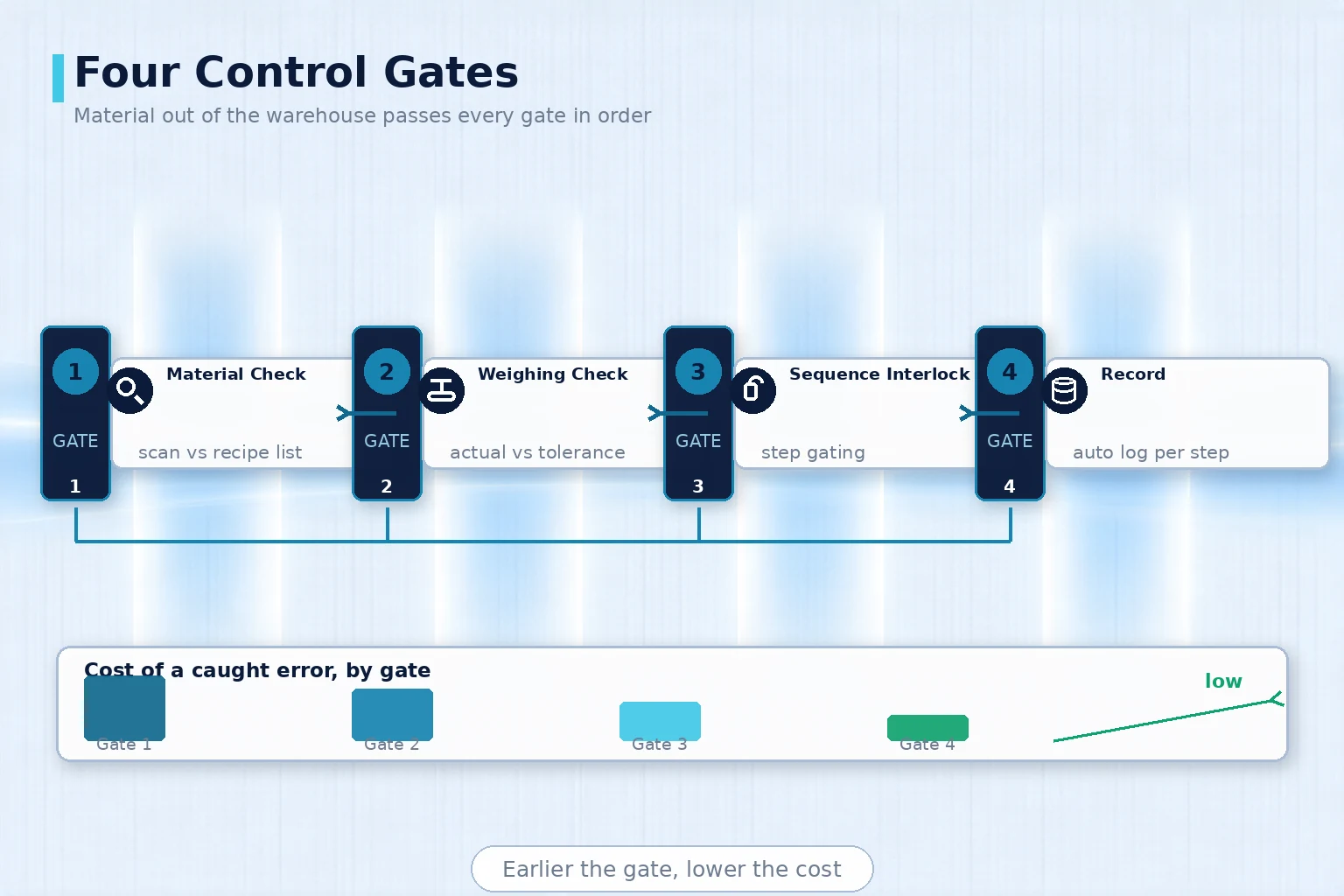
Error proofing does not try to cover everything at once; it sets gates in the order of "the earlier you stop it, the cheaper it is". The four gates divide the work as follows:
| Gate | What it stops | How it works |
|---|---|---|
| Material check | Wrong material, wrong batch | Barcode or RFID scan checked against the recipe list |
| Weighing check | Out-of-tolerance weight, misread value | Direct data from the weighing instrument compared with the target tolerance |
| Sequence interlock | Reversed order, missed dosing | Driven by recipe steps; the next step is not released until the prior one is done |
| Record keeping | No traceability afterwards | Automatic logging per step, binding operator, time and actual value |
Weighing: from manual re-check to direct instrument capture
Weighing is the section with the highest value density in error proofing. Moving the data source from "what the operator sees" to "what the instrument outputs" is the starting point here.
- Direct capture: the weighing instrument sends the live weight to the system over RS485, Modbus RTU/TCP or OPC, so manual reading is no longer needed.
- Tolerance check: each material has upper and lower tolerances; a value is confirmed only inside the range, and an out-of-range value is flagged immediately rather than discovered later.
- Tare and calibration on file: tare weight, calibration time and calibration records are stored with the batch, so scale drift can be detected.
- Parallel scales: with multiple scales batching at once, each scale's data is captured and judged independently, avoiding mix-ups and batch cross-contamination.
How recipe and material verification works
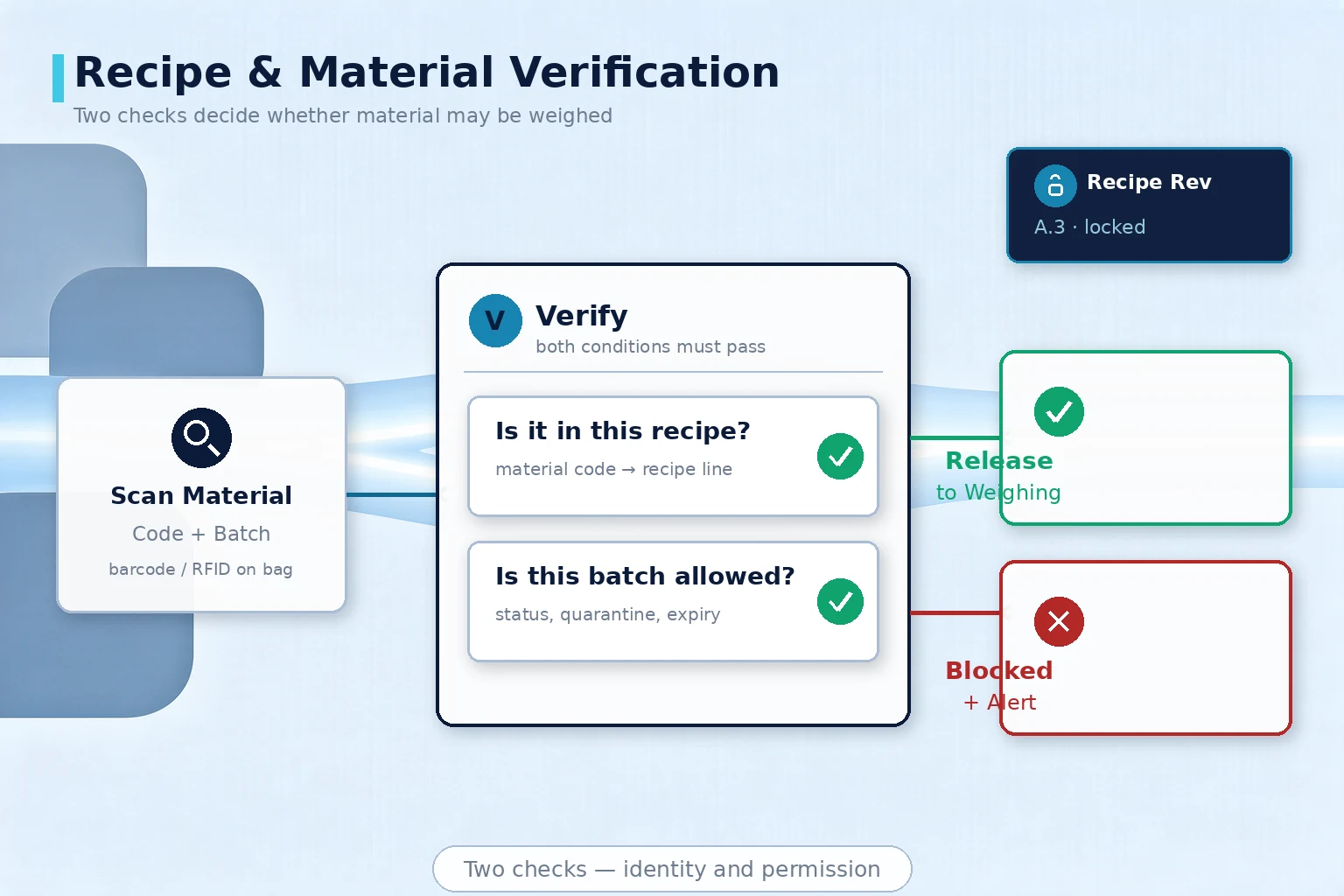
How recipes are managed sets the ceiling for error proofing. A recipe is not a piece of paper; it is a set of rules the system can read and compare.
- Recipe versioning: different versions of the same product are released separately; production locks to a version, and ad-hoc changes are not accepted.
- Double material verification: a scan yields the material code and batch; the system checks both "is it required by this recipe" and "is this batch allowed".
- Separated roles: recipe editing and production execution belong to different roles; changing a recipe needs authorization and leaves a record, avoiding arbitrary on-floor adjustments.
- Traceable changes: recipe change records are bound to their effective time, so which version a batch used can be verified directly.
What traceability and audit must keep
The depth of traceability decides how fast you can respond when something goes wrong. What to keep is the minimum dataset that can reconstruct the scene:
| Trace item | What is recorded | What it is for |
|---|---|---|
| Material origin | Material code, supplier batch, receipt time | Locating the impact scope of a problem material |
| Weighing actuals | Target value, actual value, tolerance, scale ID | Judging whether a deviation is within acceptance limits |
| Operator info | Operator, time, station, confirmation method | Reconstructing the process and the responsibility interface |
| Recipe version | Recipe ID, version, effective time | Confirming the process used for that batch |
Boundaries with MES and ERP
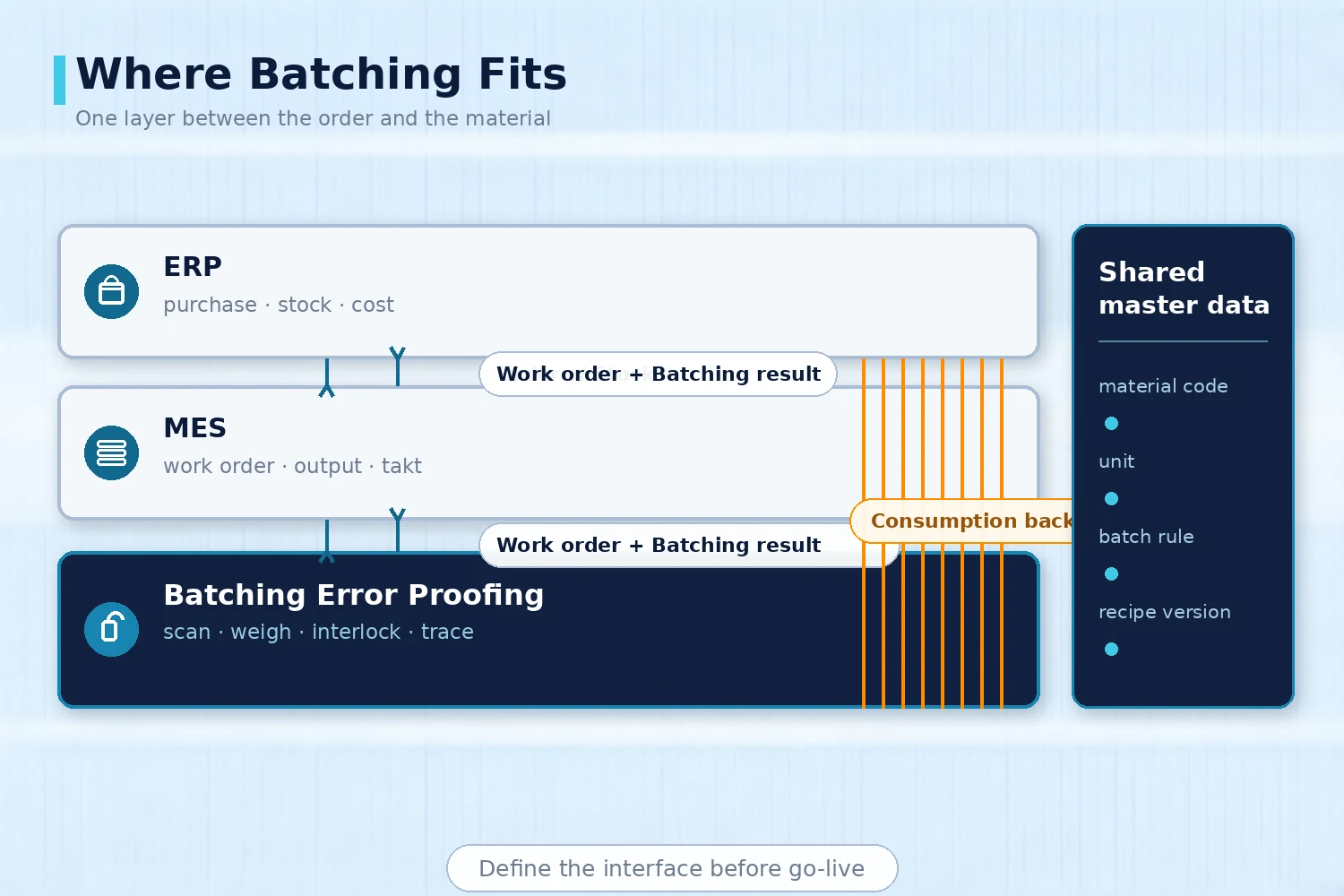
Batching error proofing is not a stand-alone system; it divides work with production management and the enterprise resource layer, and the boundaries should be agreed upfront.
- Against MES: error proofing covers weighing and dosing actions, while MES covers work orders, output reporting and line takt; the interface passes batching actuals and batch results.
- Against ERP: ERP covers purchasing, stock and cost accounts; error proofing reports consumption back as the evidence for material issuing and cost accounting.
- Define the interface clearly: at what frequency, which fields, and which side triggers it — written into an interface document to avoid disagreements after go-live.
- Unified master data: material codes, units and batch rules stay consistent across systems; that is the precondition for the interface to line up.
Rollout order and common pitfalls
For rollout, start where the pain is strongest: pilot batching error proofing in one workshop or one line, get material check and weighing check working, and turn it into a repeatable template; then complete the sequence interlock and traceability; finally connect the MES and ERP interfaces. Three common pitfalls: first, building a big platform before fixing scale data — if the source is inaccurate, no amount of polish upstairs helps; second, setting tolerances too wide, which amounts to no error proofing at all — tolerances should be set by the process, not filled in casually; third, treating error proofing as a software feature and ignoring scale calibration and floor discipline, so the system flags a deviation and no one acts on it. The international model for recipe and batch control can be referenced from the ISA-88 standard, and the process control and traceability requirements of quality management from ISO 9001:2015; both can serve directly as the framework for designing this mechanism.
Whether to build in-house or outsource depends on the on-site scale base and IT capacity: with instrumentation and electrical staff you can handle scan checks and instrument capture yourself, while recipe management, interlock logic and the traceability platform can go to a team experienced in production management delivery — just agree the boundary on "who defines the data rules, who does the integration, who runs operations".
Conclusion
The core of batching error proofing is not an extra approval step, but moving the verification points ahead of the action: material scan checks, direct weighing capture, locked recipe versions and automatic traceability logs — get these four solid first, and errors are stopped at the source. Then clarify the interfaces with MES and ERP, and batching actuals flow straight into production and cost management. Shanghai Orpaon Intelligent has years of implementation experience in weighing, batching and production management; bring your on-site batching process and scale data for a solution discussion with us.
Request an on-site diagnosis
Want to know which part of your batching process causes most of the errors? Bring your batching process flow, scale list and recent batch records, and we will arrange an engineer to run an on-site diagnosis, then suggest gate settings and a rollout priority.
Contact Us