Production scheduling: write the constraints first
A production scheduling system starts not with the algorithm but with turning the real constraints of the shop floor into rules a solver can read: what each machine can do, how long a changeover takes, when materials are actually ready and which orders cannot move. Clear constraints produce a schedule the team will run; unclear constraints produce a table nobody accepts, however good the engine. The usual path is finite-capacity scheduling first, compared week by week against actual shop-floor data, with optimisation targets added later.
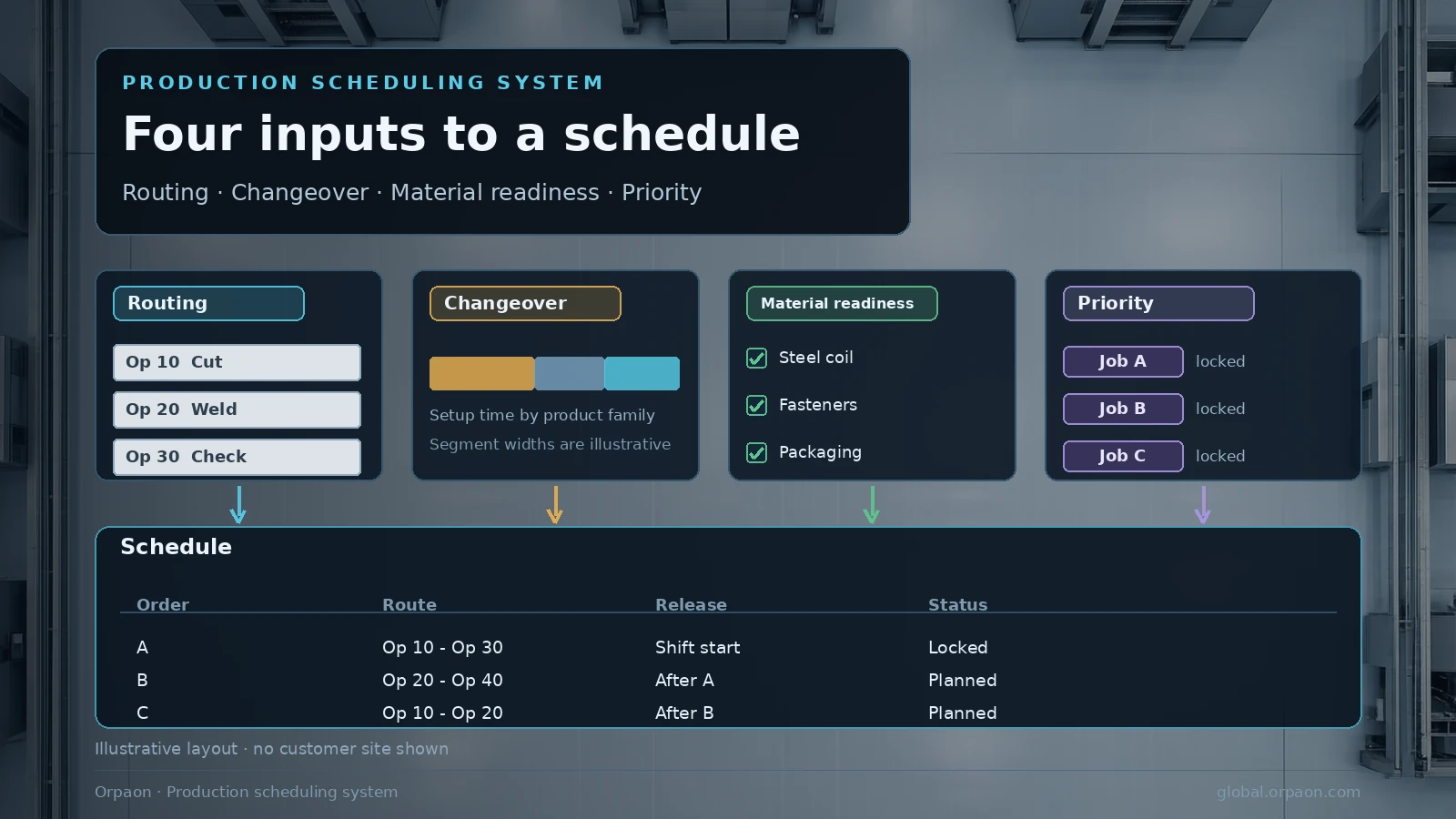
1. When the schedule does not stick, the algorithm is rarely the cause
The pattern repeats: the system produces a plan, the team leader glances at it, puts it aside and keeps scheduling from experience. Look closer and the problem is usually the input, not the solver. Missing operations in the routing, one average changeover time, no visibility of material readiness: with all three present, any schedule is a rehearsal.
- Incomplete routing: operations, work centres and standard hours are missing or no longer match the floor, so the schedule computes on assumptions.
- Changeover entered as a fixed number: switching products on the same machine varies widely, so the plan is re-sequenced again and again.
- Material readiness invisible: a job is scheduled for a date when a critical part has not arrived, and the plan collapses that morning.
- No agreed priority: delivery dates, customer tiers and bottleneck operations are ranked differently by different people, so the output is never accepted.
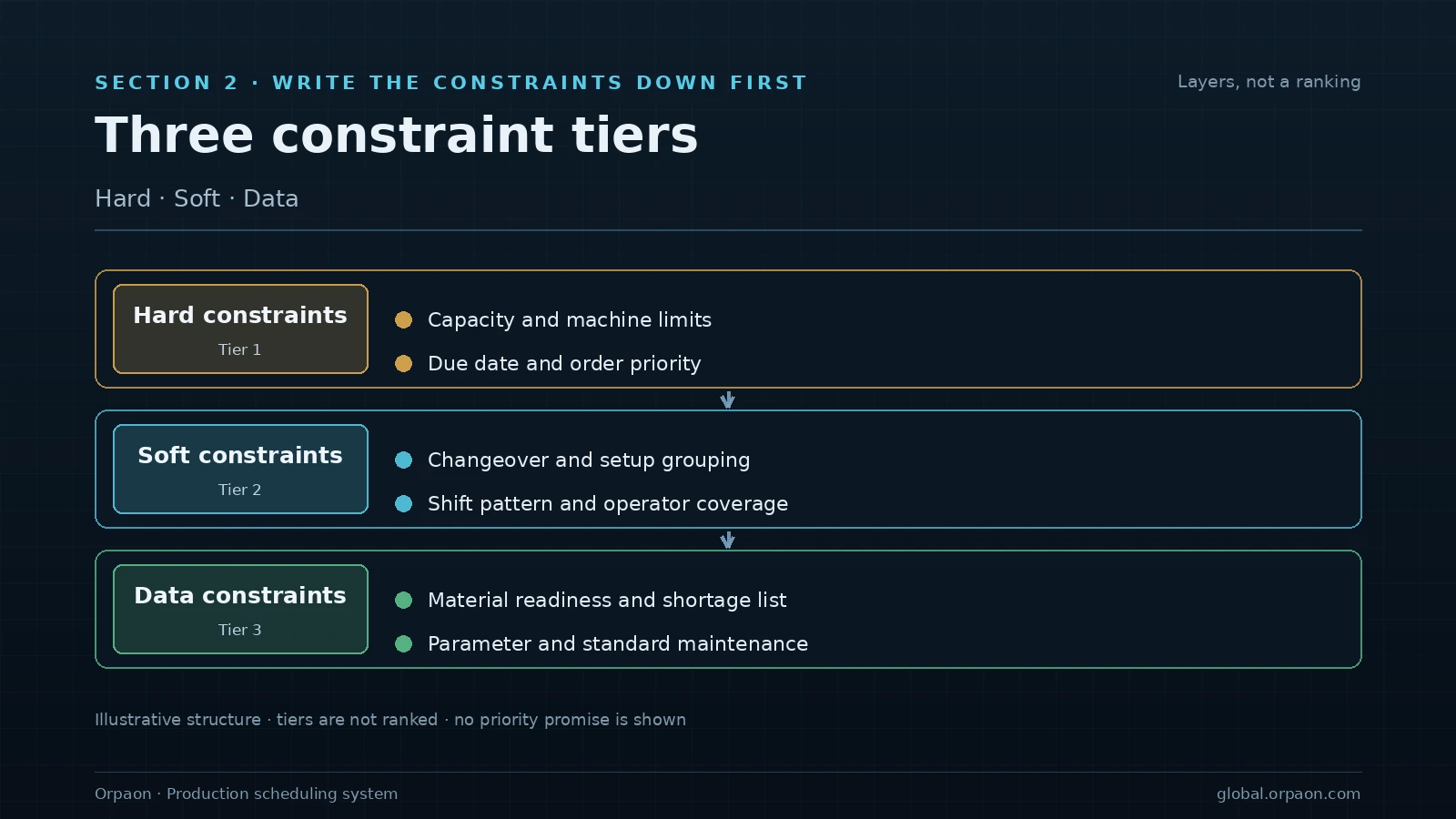
2. Write down the constraints in three tiers
Scheduling input falls into three tiers: hard constraints that cannot be broken, soft constraints that can be traded off, and data constraints that decide whether the plan can be trusted at all. Writing them separately means that when a plan is challenged, you can tell quickly whether the issue is a rule, a trade-off or a data problem.
| Constraint tier | What to write down | What is usually missing |
|---|---|---|
| Hard, cannot be broken | Machine capability and routing, tool and fixture count, shift and headcount limits | The link between machines and operations lives only in one supervisor's memory |
| Soft, can be traded off | Changeover time, delivery slack, customer priority | One average changeover time for every product combination |
| Data, decides credibility | Standard work hours, material ready dates, work-in-process counts | Work hours taken from the theoretical value, not corrected against actual pace |
3. Feed shop-floor data back into the schedule
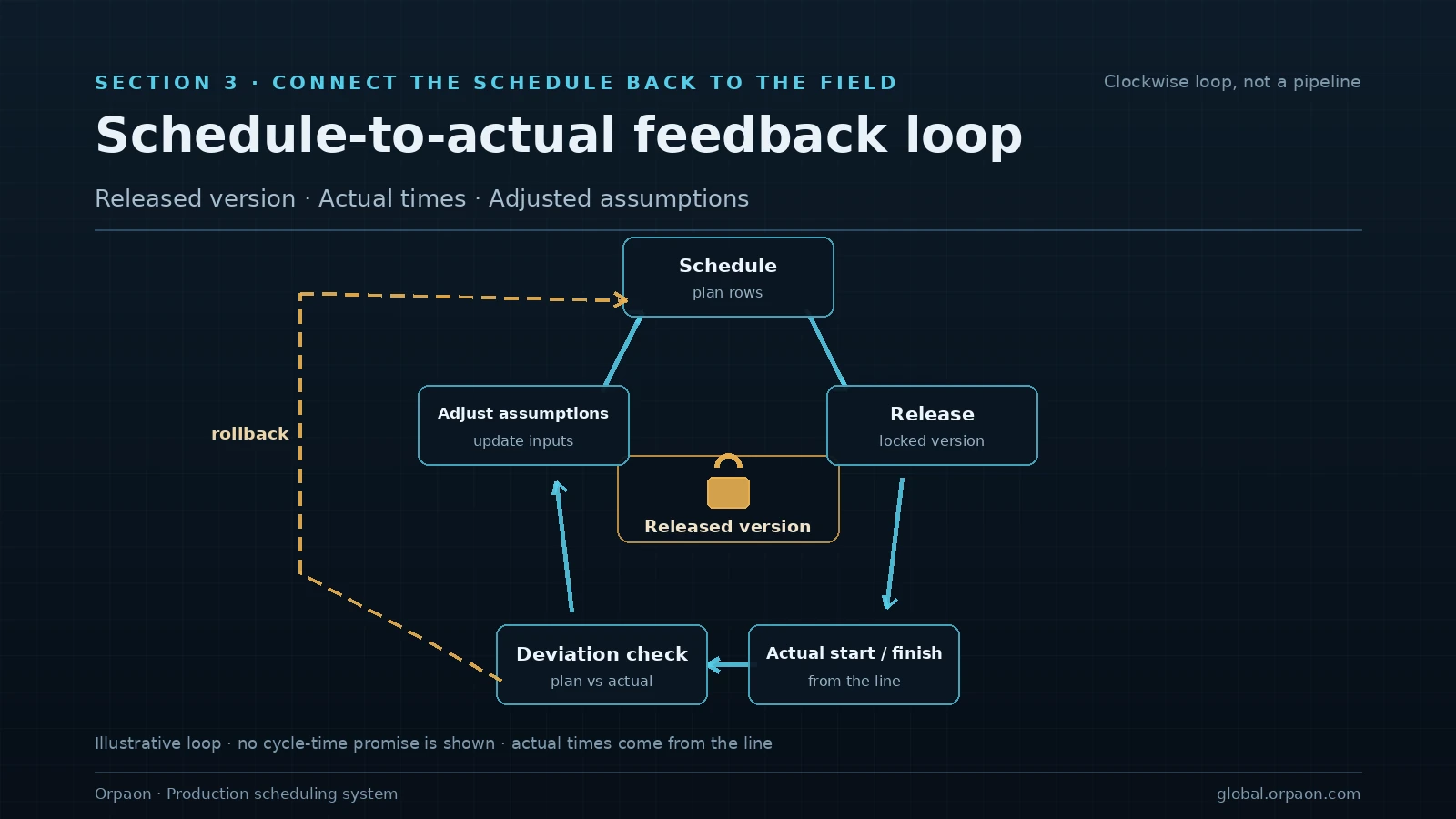
A schedule is not a one-off calculation. Actual start, finish and downtime must flow back after release, otherwise the next run keeps computing on the previous assumptions and the deviation grows round after round. This is why scheduling usually shares one data path with equipment connectivity and OEE: state collection is what makes a plan verifiable.
- Lock the version on release: every change leaves one revision record, so later deviations can be traced to a source.
- Write back actual start and finish: when the deviation passes an agreed threshold, the next run adjusts its hour assumptions.
- Watch bottleneck equipment separately: downtime and changeover on the bottleneck are collected first, because the schedule is most sensitive there.
4. Roll out in three steps: executable, comparable, optimizable
Scheduling projects lose time when the first version tries to optimise. A steadier order is to make the plan executable, then hold it against the floor, and only then add optimisation targets; without the first two steps there is no baseline for comparing scenarios.
- Step one: replace manual sequencing with finite-capacity scheduling; the goal is an executable plan, not an optimal one.
- Step two: compare plan against actuals week by week and correct work hours, changeover times and material lead times.
- Step three: add optimisation targets such as changeover count and on-time delivery, and compare scenarios once the constraints are stable.
Each step keeps a rollback condition: if plan adherence stays below the agreed level for several weeks, return to manual sequencing in parallel, fix the constraint definitions, and only then continue, rather than adding more algorithm.
Summary
The value of a production scheduling system lies less in algorithmic sophistication than in whether the team runs the plan and whether deviations can be explained: why this order was inserted, why this machine changed over four times, why this batch was still late. Clear constraint tiers, data flowing back from the floor, and a three-step rollout with rollback conditions are what make optimisation meaningful. Dynamic order insertion and multi-objective optimisation remain directions in progress, available for joint validation rather than delivery commitments.
Book a solution review
Bring your current routing, changeover records and delivery list, and we will propose a rollout order and a draft rule set for your constraints.
Contact Us